THE LAST BOOT A techno-thriller
THE STORY OF MITCHELL FOGLER
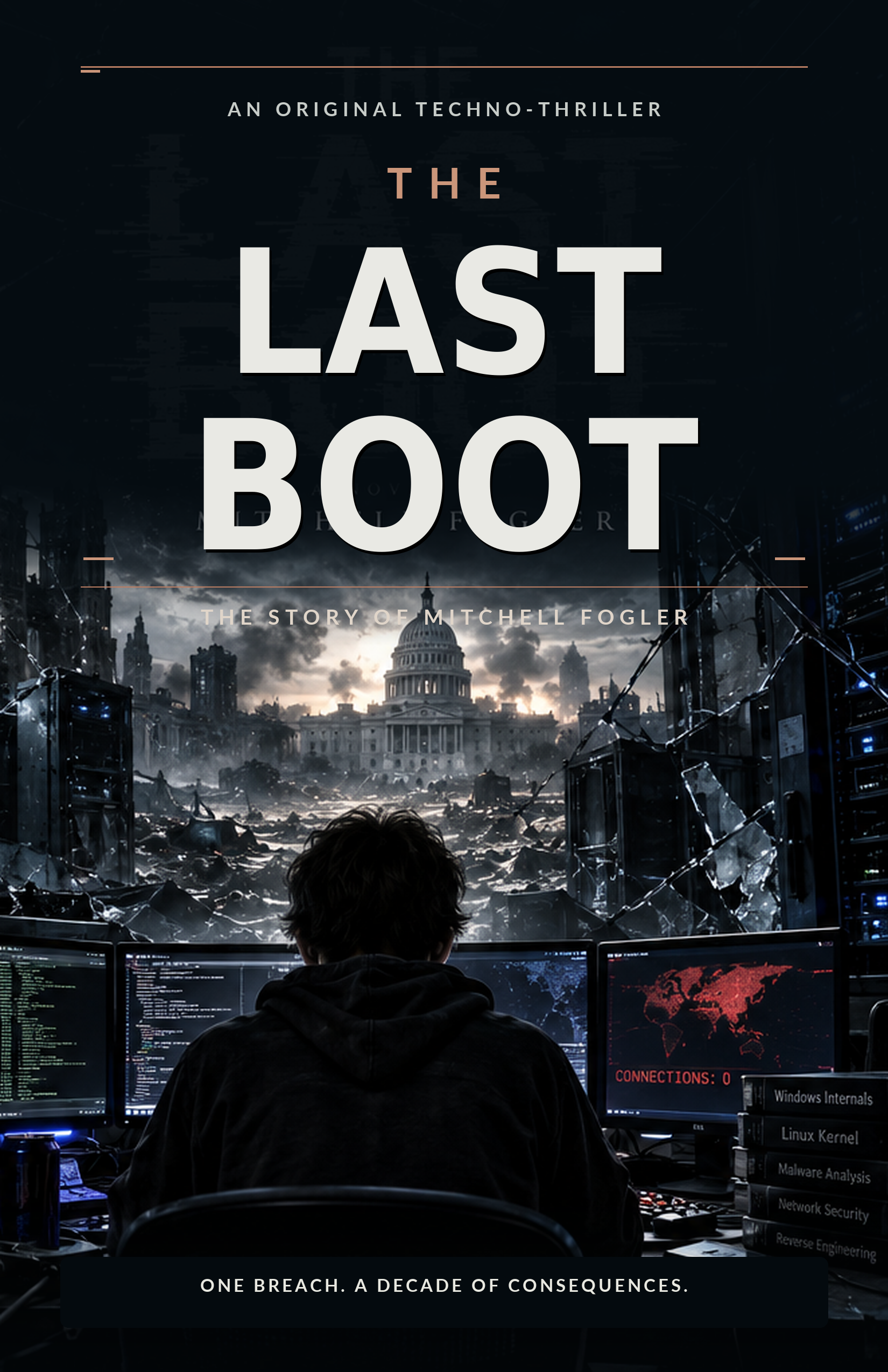
THE LAST BOOT A techno-thriller
THE STORY OF MITCHELL FOGLER
THE LAST BOOT An original novel
This is a work of fiction. Its people and events are imagined. The account of malicious software is a narrative of trust, administration, institutional failure and human choices—not a guide to intrusion.
Trust is the transport. A signed message can still be a lie.
                         CONTENTS


Part One: The Quiet Machine                                                  10

  Chapter One — A Light Left On . . . . . . . . . . . . . . . . . . . . . . . 11

  Chapter Two — The Man Who Patched Things . . . . . . . . . . . . . . 18

  Chapter Three — An Ordinary Kind Of Power . . . . . . . . . . . . . . 24

  Chapter Four — Signal And Noise . . . . . . . . . . . . . . . . . . . . . . 31

  Chapter Five — The First Quiet Winter . . . . . . . . . . . . . . . . . . . 37

  Chapter Six — The Recovery Room . . . . . . . . . . . . . . . . . . . . . 44


Part Two: The Permission To Doubt                                             51

  Chapter Seven — The Outside Copy . . . . . . . . . . . . . . . . . . . . . 52

  Chapter Eight — Names For The Same Fire . . . . . . . . . . . . . . . . 56

  Chapter Nine — The Red Envelopes . . . . . . . . . . . . . . . . . . . . . 58

  Chapter Ten — The Interview . . . . . . . . . . . . . . . . . . . . . . . . 61

  Chapter Eleven — The Temporary Rule . . . . . . . . . . . . . . . . . . 65
  Chapter Twelve — A Town Without Receipts . . . . . . . . . . . . . . 68

  Chapter Thirteen — The False Apology . . . . . . . . . . . . . . . . . . . 71

  Chapter Fourteen — Thirty-Seven Minutes . . . . . . . . . . . . . . . . 74

  Chapter Fifteen — The Governor’s Demonstration . . . . . . . . . . . . 77

  Chapter Sixteen — The Man In The Invoice . . . . . . . . . . . . . . . . 79

  Chapter Seventeen — A Door Without A Battery . . . . . . . . . . . . . 82

  Chapter Eighteen — The First Leak . . . . . . . . . . . . . . . . . . . . . 85

  Chapter Nineteen — A Market In Certainty . . . . . . . . . . . . . . . . 91

  Chapter Twenty — The Second Boundary . . . . . . . . . . . . . . . . . 93


Part Three: Shared Keys                                                      96

  Chapter Twenty-One — The Table Of Witnesses . . . . . . . . . . . . . 97

  Chapter Twenty-Two — The Shape Of An Update . . . . . . . . . . . 99

  Chapter Twenty-Three — Eight Hours Of Silence . . . . . . . . . . . . 104

  Chapter Twenty-Four — The Apartment Above The Bakery . . . . . 107

  Chapter Twenty-Five — Public Interest . . . . . . . . . . . . . . . . . . 110

  Chapter Twenty-Six — Snow At The Terminal . . . . . . . . . . . . . . 112
  Chapter Twenty-Seven — The Patch That Never Was . . . . . . . . . . 114

  Chapter Twenty-Eight — The Trial Run . . . . . . . . . . . . . . . . . . 116

  Chapter Twenty-Nine — The Grammar Of Proof . . . . . . . . . . . . 118

  Chapter Thirty — The Waiting Room . . . . . . . . . . . . . . . . . . . 120

  Chapter Thirty-One — A Good Machine . . . . . . . . . . . . . . . . . 122

  Chapter Thirty-Two — The First Hammer . . . . . . . . . . . . . . . . 124

  Chapter Thirty-Three — High Water Mark . . . . . . . . . . . . . . . . 129

  Chapter Thirty-Four — One Country, Four Maps . . . . . . . . . . . . 132

  Chapter Thirty-Five — The Promise Of A Cure . . . . . . . . . . . . . . 135

  Chapter Thirty-Six — The Searchable Name . . . . . . . . . . . . . . . 137


Part Four: A State Of Uncertainty                                          140

  Chapter Thirty-Seven — Recovery Day . . . . . . . . . . . . . . . . . . . 141

  Chapter Thirty-Eight — The Other Investigator . . . . . . . . . . . . . 143

  Chapter Thirty-Nine — When Insurance Stopped . . . . . . . . . . . . 146

  Chapter Forty — The Unbroken Glass . . . . . . . . . . . . . . . . . . . 150

  Chapter Forty-One — The Hearings . . . . . . . . . . . . . . . . . . . . 153
  Chapter Forty-Two — The Ledger Republic . . . . . . . . . . . . . . . 155

  Chapter Forty-Three — A Citizen Of Nowhere . . . . . . . . . . . . . . 157

  Chapter Forty-Four — Children Of The Alert . . . . . . . . . . . . . . 159

  Chapter Forty-Five — The Ferry . . . . . . . . . . . . . . . . . . . . . . . 161

  Chapter Forty-Six — The Last Clean Trace . . . . . . . . . . . . . . . . 164

  Chapter Forty-Seven — The Country Of Copies . . . . . . . . . . . . . 167

  Chapter Forty-Eight — The Closed Circuit . . . . . . . . . . . . . . . . 169

  Chapter Forty-Nine — The Second Investigation . . . . . . . . . . . . . 171

  Chapter Fifty — The Witness On The Stairs . . . . . . . . . . . . . . . 174

  Chapter Fifty-One — Disappearing Routes . . . . . . . . . . . . . . . . 177

  Chapter Fifty-Two — The Confession Without A Recipient . . . . . . 179


Part Five: The Hammer Years                                                   182

  Chapter Fifty-Three — The First Machine Riot . . . . . . . . . . . . . . 183

  Chapter Fifty-Four — Hammers For The Homeland . . . . . . . . . . 186

  Chapter Fifty-Five — The Hospital Basement . . . . . . . . . . . . . . . 189

  Chapter Fifty-Six — The Mathematics Of Winter . . . . . . . . . . . . 192
  Chapter Fifty-Seven — The Arrest . . . . . . . . . . . . . . . . . . . . . 194

  Chapter Fifty-Eight — The Room With No Screen . . . . . . . . . . . 199

  Chapter Fifty-Nine — The Evidence Of Many Hands . . . . . . . . . 204

  Chapter Sixty — A Country Of Exceptions . . . . . . . . . . . . . . . . 208

  Chapter Sixty-One — The Defector . . . . . . . . . . . . . . . . . . . . . 211

  Chapter Sixty-Two — The Day The Grid Was Blamed . . . . . . . . . 215

  Chapter Sixty-Three — The Trial Of A Theory . . . . . . . . . . . . . . 219

  Chapter Sixty-Four — The Sentence . . . . . . . . . . . . . . . . . . . . 223

  Chapter Sixty-Five — The Evacuation Of Data . . . . . . . . . . . . . . 227

  Chapter Sixty-Six — One Last Broadcast . . . . . . . . . . . . . . . . . . 229

  Chapter Sixty-Seven — The Hammer Census . . . . . . . . . . . . . . . 231

  Chapter Sixty-Eight — The Last Regional Server . . . . . . . . . . . . . 234


Part Six: The Last Witness                                                  237

  Chapter Sixty-Nine — The Council Of Lanterns . . . . . . . . . . . . . 238

  Chapter Seventy — The Vanishing Temperature . . . . . . . . . . . . . 243

  Chapter Seventy-One — An Engineer's Orchard . . . . . . . . . . . . . 245
  Chapter Seventy-Two — The Empty Lecture Hall . . . . . . . . . . . . 249

  Chapter Seventy-Three — The Hundredth Rumor . . . . . . . . . . . . 251

  Chapter Seventy-Four — The Last Appeal . . . . . . . . . . . . . . . . . 253

  Chapter Seventy-Five — The Winter Of Names . . . . . . . . . . . . . 256

  Chapter Seventy-Six — The Bridge Calculation . . . . . . . . . . . . . . 259

  Chapter Seventy-Seven — Seeds In The Library . . . . . . . . . . . . . 261

  Chapter Seventy-Eight — The Quiet Ward . . . . . . . . . . . . . . . . 263

  Chapter Seventy-Nine — The Order To Break . . . . . . . . . . . . . . 266

  Chapter Eighty — The Answer Arrives . . . . . . . . . . . . . . . . . . . 271

  Chapter Eighty-One — A Road Between Towns . . . . . . . . . . . . . 276

  Chapter Eighty-Two — The Burial Of The Clock . . . . . . . . . . . . 280

  Chapter Eighty-Three — The Last Workshop . . . . . . . . . . . . . . 284

  Chapter Eighty-Four — After The Wires . . . . . . . . . . . . . . . . . 287

  Epilogue — A Field Guide to What Remained . . . . . . . . . . . . . . 293
PART ONE
THE QUIET MACHINE
Chapter One
Year Zero, April | Andreas and Mitchell
The server belonged to Andreas Theadorus in the way a house belongs to the person who keeps returning to fix its roof. On paper it belonged to a small logistics company, and in a rack it belonged to a data center at the edge of the city. But its rules, its accounts, its impatient little scheduled jobs, and the habit it had of waking at three in the morning to do something no one remembered requesting—those belonged to Andreas.
He had installed Windows Server on it six years earlier. He had migrated databases twice, survived an ugly ransomware scare that turned out to be a broken backup script, and persuaded three different managers that the machine could not simply be replaced because replacing it would mean admitting how much of the company
depended on software no one understood. It was a server with scars: a naming convention from a previous employer, a pair of folders whose permissions Andreas promised himself he would clean up, and a custom service that quietly reconciled shipping manifests between two systems acquired in different decades.
At 2:17 on a Thursday morning, its security log acquired a new entry.
There was nothing theatrical about it. No black screen, no green text, no skull. The machine continued to process ordinary requests. A refrigerated shipment was released at a depot in Oregon. A bill was generated for a distributor in Tacoma. A backup ran and reported success. One event among thousands recorded that an identity had authenticated through a route Andreas assumed nobody used anymore.
Seven miles away, Mitchell Fogler leaned toward the light of a monitor and watched the quiet confirmation appear.
His apartment had a narrow kitchen, an uneven radiator, and a window facing a brick wall. On the sill stood a dead basil plant. Beside the monitor, an empty bowl of cereal had collected the paper wrappers from two different brands of tea. Mitchell disliked dramatic rooms. He thought they made dramatic people lazy.
The entry was almost absurdly small. Mitchell had spent an hour worrying about the shape of a log line because he understood what an investigator would later make of it: a time, a claimed identity, an originating system, an operation completed. He would eventually spend years trying to persuade himself that the first operation had not been the crime, merely the beginning of an experiment. But the line would not change to accommodate his preferred vocabulary. An administrator had not invited him. Andreas had not given him access. The authority on the screen was borrowed from somebody who did not know it had been borrowed.
Mitchell turned his notebook to a clean page and wrote down what he believed he had learned. He wrote it in short statements, as though brevity could make them objective. The page did not contain a name for the people who would have to live with the result. It contained the word trust, underlined twice.
For eighteen months he had worked with abandoned infrastructure: staging systems, forgotten management consoles, development copies of websites that still answered as if their owners expected somebody to return. He told himself that the work was research. Sometimes it was. Sometimes he reported what he found.
He had once sent a thoughtful message to a hospital explaining that an obsolete portal exposed appointment metadata, and the hospital had thanked him after six weeks of legal threats. The thank-you note was printed and taped under his desk, partly as a joke and partly as a credential he could show himself on difficult nights.
Andreas's server was different. Mitchell knew the name. They had met at a local technology conference over coffee too bitter to finish. Andreas had spoken about how the future of computing depended less on cleverness than on maintenance. Mitchell had laughed at that, then carried the remark for months like an accusation.
Now, with a screen full of details that should not have been his to see, Mitchell felt the old impulse to prove the remark wrong.
He did not use a miraculous exploit. The server had not surrendered to a string of nonsense characters, and no single flaw gave him command of the machine. Its defenses were real. So were the gaps between them. A vendor connection remained trusted after a project ended. An old application carried privileges inherited from a period when convenience had been the first design requirement. Logs existed, but no one was paid to watch them before morning. Mitchell had followed a chain of
assumptions, each of which looked reasonable when seen alone.
He had crossed a boundary. That was the only fact that mattered.
His phone vibrated. A message from his sister asked whether he could make Sunday dinner. He turned it face down.
A new window opened on the monitor, showing an ordinary directory listing, dates, and a volume label so prosaic he almost laughed. He could not see Andreas. He could not see the company or its employees or the people depending on its deliveries. He saw only the proof that the chain had held.
Mitchell recorded the timestamp in his notebook. Then he noticed a line on the dashboard: a remote administrator had recently checked the service. He imagined Andreas asleep, or awake, or sitting under a lamp with a cup of coffee while a machine many miles away kept its secrets
badly. For the first time that night Mitchell felt a tremor of fear, not of being caught, but of having become a person who would prefer Andreas not to notice.
He could still stop. He had the evidence needed to write a report. He could send it under his name, take the anger it would cause, and maybe earn another printed note for the wall.
Instead he wrote a second line in the notebook.
How many other systems trust this one?
Outside, rain began to strike the brick wall in patient, arrhythmic taps. On the server, another shipping manifest passed through without error. A light that nobody had known was on remained on.
Chapter Two
Year Zero, April | Andreas
Andreas arrived at the office before sunrise because the freight business measured time differently from everyone else. A container arriving late could spoil a promise made three oceans away. The dispatch team was already arguing about a shortage of refrigerated trailers. In the basement, a pump had failed and maintenance wanted to know whether they could shut off a wall of equipment to reach it. The answer, for several unglamorous reasons, was no.
His desk had two monitors, a paper calendar, and a small plastic model of a cargo ship built by his daughter. He moved the ship out of the way before placing his coffee down. On the left monitor a patch-management dashboard presented a column of green checks. On the
right, a service-health chart showed a brief rise in authentication attempts overnight, nothing high enough to trigger an alert.
He stared at it anyway.
Andreas had learned to distrust anomalies in proportion to how easy they were to explain. A loud alarm often meant a harmless failed update. A small difference in a chart could mean a human decision had gone undetected. He opened the corresponding records and found a plausible administrator identity. He wrote the time on a sticky note. Then a dispatcher called to say that the manifest printer was putting decimal commas where decimal points belonged.
By nine he had forgotten the sticky note. By ten he remembered it and felt guilty.
He called the vendor whose access had appeared in the log. The service representative said the account was part of a routine maintenance arrangement. Andreas said the
arrangement had ended. The representative said the account was marked active in their system. Both sounded mildly embarrassed. They promised to investigate and gave him a ticket number, which Andreas copied onto the sticky note.
At lunch he sat in his car rather than in the break room. He called his daughter, Lena, who was studying architecture and collecting examples of buildings that could be maintained without expensive proprietary parts. She had inherited his dislike of hidden dependencies but not his patience with them.
"How's the museum?" she asked.
"It's a functioning company," he said.
"You call that server a museum yourself."
"It has historical significance."
She laughed. "Will you come Saturday?"
He said yes. Then he paused, thinking of the authentication entry, and amended it to probably.
That afternoon, Andreas changed a password, restricted an access path, and planned a wider review of remote accounts. He did not perform a complete rebuild. That would require an outage he could not authorize alone, and the machine showed no sign of active compromise. It was performing well. It produced the correct reports. Its backups were recent. The vendor's account was being investigated, which was another way of saying the problem now lived inside a ticketing system.
In a world managed by finite people and infinite demands, he had made an ordinary risk decision.
At five, a junior analyst named Priya Dutt stopped by his desk. Priya had joined the company three months earlier and had the unsettling habit of asking why processes existed. She held a laptop open, displaying a spreadsheet of
software inventory that had taken her most of the day to construct.
"This machine has a management agent that's signed and current," she said. "But its publisher changed names twice. I can't find who owns the maintenance contract."
"That's not unusual."
"It is when the agent touches billing, inventory, and the old backup server."
Andreas swiveled his chair. The spreadsheet contained the same service he had installed to solve a temporary migration problem. The original developer had long since retired. Its replacement was an update distribution company with an immaculate public website, a tiny staff, and a support queue that answered mostly with templates.
"It's legitimate," he said, then heard how much the word sounded like a wish.
Priya did not argue. She highlighted a column showing all the machines that accepted updates or configuration instructions from the agent. The list extended past the bottom of the screen.
"I'm not saying it's malicious," she said. "I'm saying I can't tell what would happen if it wasn't legitimate."
That night Andreas stayed late to diagram the relationships. He drew arrows from the server to the finance system, the fleet application, the monitoring service, the backup environment, and several desktop clients. As the drawing grew, he began to understand that he had maintained a machine while failing to notice it had become an institution. Its formal purpose remained narrow. Its practical authority had expanded with every temporary exception no one had removed.
He locked his office at 8:12. Under the humming ceiling lights the paper diagram looked almost like a map of a city.
Chapter Three
Year Zero, Summer | Mitchell
Mitchell did not think of himself as a destructive person. He collected broken laptops and repaired them. He once carried an injured bird to an animal shelter in a cardboard box. He gave away old monitors to a nonprofit that taught adults how to use spreadsheets. These facts had become part of the story he told himself when his work became difficult to justify.
The discovery on Andreas's server could have ended with a disclosure. Instead it became a hypothesis.
Modern computers, he reasoned, did not trust strangers very much. They trusted vendors. They trusted certificates, centrally managed policies, package registries, device-management platforms, and the signatures attached to code moving through those systems. Different
operating systems spoke different internal languages, but large organizations often used the same outside services to coordinate them. A system did not need one universal infection to cause universal trouble. It needed a great many legitimate-looking instructions delivered through relationships already accepted as safe.
Mitchell wrote the phrase trust is the transport in the margin of his notebook and drew a box around it.
It was a conceptual observation, not yet a machine. A Windows executable would not simply run on Linux; a Linux kernel module would not wake inside a phone; hardware instruction sets and privilege boundaries mattered. Mitchell knew enough to distrust the fantasies that treated every computer as an interchangeable black box. The work, if he pursued it, would be expensive, contradictory, and filled with failures. That should have reassured him.
It did not.
He began acquiring surplus machines through ordinary auctions and set them on shelves in a rented workshop. They represented a map of computing rather than an arsenal: an old industrial controller, a decommissioned office desktop, several different laptops, a small server, a fanless box used in retail installations. He paid for electricity by fixing other people's computers. The workshop smelled of hot dust and plastic.
Over several months he studied the administrative systems that governed software movement. He read publicly available documentation, change-management manuals, and incident reports. The reports impressed him with their repetition. In company after company, a breach began in a bounded place and grew because a privileged integration had been made broader than its owners remembered. Investigators called those relationships dependencies. Mitchell began to see them as a geography.
The workshop became a geography of exceptions. The shop's old office desktop would accept one kind of
centrally authorized maintenance; the phone on his desk, another; the industrial controller on the lower shelf, a third. None offered a magic bridge across operating systems. What connected them was the habit of delegating authority outward, beyond the person standing beside the device. Mitchell documented the differences correctly. His danger lay elsewhere: he began to treat a shared organizational weakness as permission to test it on people who had not agreed to participate.
Once, he found the small note from Andreas's conference talk among a stack of receipts. MAINTENANCE IS A MORAL ACT, he had written above the date. He crossed out moral and substituted technical. Then, dissatisfied even with that, he tore the page away. He could not make the man who maintained a machine disappear by correcting one adjective.
There were technical failures. There were also moral ones, more subtle and easier to conceal. He built isolated demonstrations in which harmless test messages moved
between simulated environments. He liked watching a dashboard report success. He liked the absence of uncertainty. But when a friend named Elias asked what he was working on, Mitchell said he was testing backup integrity.
"For who?" Elias asked.
"Mostly for me."
"That isn't an answer."
They sat in a noodle shop under a screen showing the weather. A regional heat wave had pushed electricity prices upward. The restaurant had taped a sign to its refrigerator asking customers to keep the door closed.
Elias had once shared a house with Mitchell and knew the frightening ease with which he could turn a question into a project that consumed an entire year. He also knew that technical fascination often hid from its own consequences.
"You remember that public library you helped?" Elias said. "You spent a month trying to make sure they could recover if the computers went down. That was useful."
"This is useful."
"Then tell someone what it is."
Mitchell looked at the rain beyond the glass and said nothing.
Afterward Elias sent a message: If the plan only works when nobody knows, maybe the plan is wrong.
Mitchell did not reply. He worked late, writing a design document full of abstractions and cautions. On the first page, under a title he had not settled on, he placed three rules. The first was that no person should be harmed. The second was that no essential service should be interrupted. The third was that the project must be capable of proving that centralized trust had become dangerous.
The rules could not all survive together. He did not test them against one another. Instead he treated them as evidence of a character he wished to possess.
On a gray Monday the workshop received a parcel from a secondhand equipment seller. Inside was a thin client that had once sat in a county office. Its asset sticker still showed the faded outline of a government seal. He peeled the sticker off, set it beside the notebook, and imagined a demonstration so decisive that governments would have to understand the problem.
Not what governments would do. What they would understand.
The distinction would fail before the following spring.
Chapter Four
Year Zero, Autumn | Priya and Mara
Priya first learned that the problem had a name from an insurance company. A claims investigator called to ask whether the company's equipment had recently received an update from a vendor now associated with a cluster of unusual outages. There had been no major incident on their network. That, the investigator said, did not establish they were unaffected.
Andreas asked for a written notice. It arrived as a PDF, badly formatted and marked confidential in a typeface so large it looked accusatory. The notice described irregular behavior across unrelated organizations: inventory discrepancies, stale recovery images, inexplicable permission changes, and monitoring agents that appeared healthy despite failing simple verification tests.
The individual events were not extraordinary. Systems drifted. Backups failed. Humans misconfigured permissions. What made the report alarming was the distribution of the events across institutions that had nothing obvious in common except administrative software and a habit of trusting vendors to handle it.
"This isn't one virus," Priya said after reading it.
"You can't know that," Andreas replied.
"I know one virus can't explain all these environments without something distributing it."
They agreed to stop calling it a virus until they understood what it was.
A week later the company hired an external response team. Its lead, Mara Singh, entered the server room carrying a paper notebook and no equipment more glamorous than a laptop. She did not ask for passwords first. She asked for an organizational chart, a history of acquisitions, a list of
people who could approve emergency changes, and the names of suppliers who could alter software on the company's systems.
Andreas felt a brief irritation. He had imagined an expert arriving to inspect the machine. Mara appeared more interested in inspecting the company.
"Computers do what people have authorized," she said. "Sometimes people authorize things they can no longer see."
The response team preserved records, compared trusted software against known-good references, and examined the places where system behavior and the system's own reports disagreed. Several machines could not be trusted to testify about themselves. On one desktop, a management dashboard claimed that an update had succeeded while an independent check showed the installed component was older. On another, an automated backup had produced files of the expected size but failed a recovery test.
Mara refused to assign blame. She could demonstrate that a trust boundary had been crossed, but not yet by whom or when. Her report used phrases like evidence suggests and cannot exclude. The executives hated them. They wanted a diagnosis like a flat tire, something with a replacement part and a price.
Andreas called Lena from the parking lot after an exhausting meeting. She listened as he described the difference between a machine that looked functional and one that could be demonstrated trustworthy.
"It's like a building with a fake inspection report," she said.
"Except the inspector lives inside the building."
"Then you inspect from outside."
"Outside is another computer."
For a moment she was silent. "That sounds expensive."
"Everything useful sounds expensive at first."
Mara's team recommended a carefully staged isolation of the most sensitive connections and independent reconstruction of critical services. The company approved some measures, delayed others, and established a risk committee. An operations director asked whether the response would affect deliveries. Mara said that doing nothing might affect deliveries later. He asked for a percentage.
There was no defensible percentage.
Meanwhile, in another part of the country, a university hospital noticed two identical software updates had produced different internal results on apparently identical machines. The hospital's engineers opened a ticket. A railway operator discovered that its recovery drills relied on a central management service whose own recovery procedure had never been tested. A regional utility complained to its vendor about monitoring systems that kept reporting success while operators observed inconsistent timestamps.
The failures did not yet point to a mastermind. They pointed to the ordinary horror of increasingly complex systems: nobody had an outside view of everything, and every institution mistook its own boundaries for the boundaries of the problem.
At home Mitchell read a public advisory warning organizations to verify their update chains. He recognized several conclusions before reaching them in print. On his desk lay the notebook with its three rules. He had stopped opening it.
His new work had a different name. He called it the proof.
Chapter Five
Year Zero, Winter | Mara
The first winter of the investigation was remembered afterward as the last time the damage could have been mistaken for a series of coincidences.
The public knew about a shipping disruption in Vancouver, a two-day failure at a regional bank, and the grounding of a fleet of municipal service vehicles. News reports treated the events separately. One had involved an update error, another a verification failure, and the third a contractor dispute. Every incident had a local explanation. The local explanations were mostly correct.
Mara Singh saw the pattern in a room with no windows. Representatives from software companies, utilities, hospitals, transport providers, and federal agencies sat around tables that were too narrow for their laptops. On
the wall a projector displayed a branching diagram of systems that shared upstream software and service providers. Much of the diagram was blank. The blank spaces were the troubling parts.
"We have proof of overlapping mechanisms," Mara said. "We do not have proof of a single actor."
A man from a national security office asked how many kernel families were affected. Mara disliked the question because it implied that operating systems were the natural unit of analysis.
"We have evidence involving Windows and Linux systems, plus devices running other software stacks," she said. "That doesn't mean one binary crosses all of them. It means administrative ecosystems overlap. The attacker may not care which kernel a machine runs if some trusted service decides what that machine should install or believe."
The room became very quiet. There was a comforting myth, present even among experts, that diversity of
devices guaranteed diversity of failure. It helped, but it did not help when different devices all accepted authority from the same compromised intermediary.
In a corridor afterward Mara called Andreas. His company had completed a difficult migration of its most critical systems. They had disconnected several old integrations, rebuilt the backup process, and begun practicing recovery from paper instructions stored away from the network. He sounded tired and almost cheerful.
"Are we safe?" he asked.
"Safer," Mara said.
"That's the worst possible answer."
"It's the only one that isn't a lie."
Across the country, Mitchell's workshop had become both more organized and less humane. He had labeled the shelves, documented test results, and cleaned the workbench until every cable lay parallel to another. He
slept on a folding cot to avoid wasting the trip home. A neighbor complained about fans running through the night. The landlord raised the rent. Mitchell paid without argument.
He no longer made good use of his knowledge. He made evidence of its reach.
One evening Elias arrived unannounced. He had not seen Mitchell in eleven weeks and carried two paper cups of coffee. The workshop door stood open because the building's ventilation had failed. Elias saw the equipment, the printed network diagrams, and a wall-sized calendar covered with dates.
"This is not backup testing," he said.
Mitchell took the coffee. "You don't know what you're looking at."
"Then explain it."
"People believe computers are stable because the reports say they're stable. I can show how wrong that is."
"You could show that without touching anybody else's machines."
Mitchell looked at him with genuine confusion. "No one would care."
Elias put his cup down. He had imagined Mitchell being drawn into something dangerous by an impulse to win. The person in front of him looked instead like someone who had lost the ability to define winning.
"What happens after you prove it?" he asked.
"They change the architecture. They stop concentrating authority. They build recovery paths that are independent of the systems they're supposed to recover."
"And if they don't?"
Mitchell did not answer. A fan whined on the nearest rack. Elias picked up the untouched coffee and left.
Weeks later, an incident at a pharmaceutical distributor interrupted the delivery of temperature-sensitive medication. The immediate cause was a cascade of administrative failures that prevented staff from validating which shipments were safe to release.
The trucks existed. The medicine existed. The warehouses existed. What failed was the institution's ability to believe its own records.
The company switched to manual reconciliation and slowed deliveries while employees counted boxes by hand. No national emergency was declared. The news lasted two days.
Mitchell watched a broadcast in which a nurse described rationing supplies because replacements had not arrived. He turned the volume down. He tried to reassure himself that the event was outside the proof. There was no
evidence his work had caused it. There was also no evidence he could trust that it had not.
He opened his notebook to the first page. No person should be harmed. No essential service should be interrupted. The project must prove the danger of centralized trust.
For the first time he drew a line through the first two rules. Then, frightened by the appearance of the page, he tore it out and burned it in the sink.
He was not yet the man the world would later describe. He was a man practicing how to become him.
Chapter Six
Year One, April | Andreas and Mitchell
In the spring, Andreas visited a warehouse that had stopped trusting its inventory system. Every item had to be counted twice by separate employees, written on numbered forms, and reconciled before dispatch. The warehouse manager, a woman named Jo Alvarez, kept the forms in plastic bins arranged by date. The bins looked absurd under a ceiling lined with cameras and automated conveyors.
"This is slower," Andreas said.
"It works," Jo replied.
"We could put the forms into a database."
"That's how we got here."
He wanted to correct her. Databases were not the problem. Neither were networks, encryption, or automation. The problem was trust granted without independent verification and authority concentrated in places that could not be audited from outside. But Jo had thirty people working overtime and six trucks waiting at the dock. Her description was not technically precise. It was operationally complete.
The warehouse had taped paper maps to its walls. Colored pins represented trucks, shipments, and drivers. At shift change, people stood in front of the maps and spoke aloud, confirming what they knew. Mistakes happened. Mistakes were visible. The process was inefficient in all the ways a secure computer system was supposed not to be.
Andreas found himself admiring it.
The first external failures did not announce their cause. A warehouse lost a way to validate a shipment. A hospital received two histories for the same refrigerated
medication. A vendor insisted that the signature attached to an update proved the update could be trusted, while a local administrator could only prove that something claiming to be the vendor had requested installation. Each disagreement ended with a human choice. Some people delayed a delivery. Some ran an old version because the new one frightened them. A few found another source and went on working.
In the rented workshop, Mitchell watched separate reports accumulate. He had designed a demonstration of how authority could travel farther than its owners understood. He had not designed the later fraud, the imitations, or the political response; those were still ahead of him. But he had supplied a way for the first uncertainty to enter ordinary decisions. Calling the others unforeseeable would eventually become a kind of comfort. At that moment he knew enough to report what he had done. The decision not to report it was his alone.
That afternoon Mara invited him to join a recovery exercise hosted by a coalition of companies and public agencies. They would simulate the loss of trust in core infrastructure, not merely the loss of electricity or internet connectivity. The exercise assumed that machines could still switch on and answer questions, but their answers could not be relied upon without outside evidence.
It was a strange disaster to rehearse. There were no burned buildings, no flooded roads, no broken fiber cables. The computers appeared functional. Their apparent functionality was what made them dangerous.
The exercise failed before lunch. One team could not prove that its offline backups had not been influenced by the same management platform as its production systems. Another discovered that the printed emergency contact list depended on a cloud directory whose records might be compromised. A third found that the physical keys to a backup facility were tracked by an electronic access system.
Nobody knew how to open the facility if the access logs could not be trusted.
At the debrief, an official asked whether the scenario was realistic. Mara studied him for a long moment.
"It was conservative," she said.
For Andreas, that was when the problem stopped being a technical incident and became a change in history. A society could endure broken computers if it knew which computers were broken. It could endure interrupted networks if people understood where communication had failed. But a society that could no longer distinguish good evidence from fabricated evidence would begin spending its remaining strength trying to agree on what had happened.
The next day Lena visited him at home. She brought a thick sketchbook and spread drawings across the kitchen table. Her latest project was a public shelter that could remain useful when powered systems failed. She had
drawn wide windows for natural light, mechanical ventilation, accessible storage, and a manual way to pump water.
Andreas traced a finger over the diagram of the doors. "No connected locks?"
"Not on the essential rooms."
"That sounds expensive."
"Everything useful sounds expensive at first," she replied.
They smiled. For an hour they talked about walls, air, emergency signage, and the simple dignity of being able to open a door.
Later, after Lena had gone, Andreas returned to his desk and read the latest bulletin from Mara's team. It contained a sentence he could not forget: The principal impact may be the collapse of confidence in administrative truth rather than the destruction of any particular device.
He printed the page and placed it inside the cargo ship model's box.
Across the city, Mitchell was reading the same bulletin. He felt, for a moment, vindicated. Someone had finally understood the point. Then he saw that the bulletin also described injuries caused by delayed emergency services, spoiled medical shipments, and a failed safety inspection. The consequences had acquired names, ages, and families. His proof was not proving a theorem. It was changing the conditions under which people could live.
He could have contacted investigators. He could have turned over the diagrams and the records that explained what he had done. He could have accepted prison or public hatred or whatever other price awaited him. The disaster was still narrow enough for a human confession to matter.
Instead he closed the bulletin and went back to work.
PART TWO
THE PERMISSION TO DOUBT
Chapter Seven
Year One, May | Priya Dutt
Priya spread two printed histories across the table. The left side belonged to the management platform, whose vendor had attested that the update completed successfully at 03:16. The right side came from a recorder configured months earlier by a junior employee who distrusted the platform's own clock. The events agreed until an authority token was renewed. After that they diverged. One version described a quiet maintenance window; the other described a service claiming permissions it should not have required. She covered the dates with her hand so that Andreas would not be distracted by trying to put the pages in order. 'Tell me what you know without the clock,' she said. He looked at the first signature, then at the second, and admitted that he knew less than he thought.
Physical objects could be stolen or misunderstood. Paper could lie. But at least the dispute had to take place somewhere a second person could stand.
They had spent years teaching staff to avoid making extra copies of sensitive logs. Copies introduced privacy problems, compliance obligations and arguments about which version was current. Now the outlawed redundancy was their only independent witness. The paradox embarrassed Andreas because he could name every committee that had approved the old policy, including one on which he had served. He imagined writing to those colleagues and explaining that a sensible rule had helped create an unanswerable question. He did not yet know how to write the letter without using the word we.
When Mara arrived, Priya asked her to choose a page without looking at the title. Mara selected the one with the fewer green marks. “Why that one?” Priya asked. “Because it admits something failed,” Mara answered. That was not a forensic principle, and both women knew
it. They checked the recorder's seal, the paper's custody history and the identity of the employee who had set it up. The result was narrower than either wanted: it established that the management service had requested an unapproved privilege, but not who had asked it to do so. Andreas stood at the doorway with a box of freight invoices. He had spent the morning asking truck drivers to sign a temporary paper ledger. Each signature was imperfect proof that a physical delivery had occurred. He set the box on the table. Priya slid the two histories beside it. For the first time the breach, the disputed update and the cold chain had become parts of the same practical problem.
···
Mitchell learned about Priya Dutt's outside copy from a forwarded photograph. Two sheets of paper lay beside a stapler, the corners held flat by somebody's thumb. The photograph was poorly lit; he could scarcely read the timestamps. Yet he recognized the particular disagreement
between the columns. One was a history the vendor could furnish. The other was a history the vendor had failed to erase. He enlarged the image until each letter came apart into squares. For the first time, it occurred to him that the world might resist him without knowing he existed. He closed the photograph, opened it again, and looked for a way to tell the truth without placing his name beside it. There wasn't one.
···
"If the record and the witness disagree," Priya told Mara, "you do not fire the witness."
She chose to give the records to Mara rather than send them through the company's counsel.
Andreas realized the recovery plan now depended on evidence his own systems could not generate.
Chapter Eight
Year One, June | Mara Singh
The federal coordination room had four maps and five definitions of an affected machine. Mara Singh asked which definition would send an ambulance. Nobody volunteered an answer.
Six agencies assigned six names to a pattern involving contractors, registries, recovery consoles and remote administration; none would share its raw evidence before legal review.
Instead the question was made ordinary enough for everyone in the room to understand: who would be affected first?
Mara Singh said, "An acronym is not a boundary."
···
On the night the government gave the outbreak its third provisional name, Mitchell ate cold noodles over the sink. His apartment was quiet except for the radiator. He had once admired the precision of classification: a category promised a boundary, and a boundary promised control. The briefing on his screen described a universal computer virus. Mitchell almost typed a correction. There was no universal executable. There were incompatible systems accepting instructions through different trusted services. The distinction mattered, although he understood exactly why a frightened minister would prefer a creature with a single name. He set his fork down. He had wanted a lesson large enough that no one could dismiss it. Now he watched people learn the wrong lesson from his work.
···
Mara put the different names on the wall and demanded one common chronology.
The chronology revealed overlapping disruptions but left the responsible actor unknown.
Chapter Nine
Year One, July | Lena Theadorus
The red envelopes appeared before anyone could explain who had printed them. They promised safety in the urgent typography of a command, and the buildings that received them began arguing floor by floor.
Lena was hired to design emergency rooms that operate without connected doors, yet the procurement department required digital certification for every manual component.
···
Lena took a maintenance worker to the locked clinic stairwell. The worker showed her a door with a conventional steel latch and a networked sensor that told the building whether the latch could move. The sensor had failed closed during the last identity-service outage.
The worker had tried the emergency key. It turned; nothing moved. Lena opened her notebook and sketched the path a person would take if the clinic lost electricity, networking and staff at the same time. The sketch had no cloud service in it. The worker pointed to a wall that could support a manual exit, then to the fire regulations he feared violating. They wrote down the conflict and asked the inspectors to witness a real test rather than accept another promise from the manufacturer. By the time the inspectors arrived, three patients were waiting in wheelchairs on the wrong side of the corridor. Lena had ceased thinking of the drawing as a design. It was a record of people who could be trapped by a decision made far from the door.
His sister sent him a photograph of a red envelope pinned to the door of her apartment building. A printed warning claimed the tenants had forty-eight hours to discard their electronics. She asked whether it was real. Mitchell recognized a manufactured certainty when he saw one; the
colors, the seal, the grand promise of an approved replacement. He called her rather than reply by message. “Who delivered it?” he asked. “Nobody knows.” He told her to keep the paper, check with the building manager, and unplug nothing essential. She said he sounded like a man who knew more than he was saying. For twenty seconds he listened to the small noises in her kitchen and hated that she was right.
···
Lena Theadorus said, "We have become very good at making exits that ask permission."
She brought Jo's warehouse procedures into the architecture meeting.
The committee called the proposals impractical while privately ordering a second set of drawings.
Chapter Ten
Year One, August | Mitchell Fogler
The interviewer waited for Mitchell Fogler to stop explaining the system. “I am asking about you,” she said. He examined a flaw in the varnish on the table and began again.
Elena asked Mitchell about his earlier responsible disclosures after receiving an anonymous tip tying the first intrusion to his workshop; Mitchell answers accurately in sentences that omit the essential truth.
Elena waited until the recorder was running before she set the photograph between them. It showed Mitchell near Andreas at the conference, an ordinary image made ominous only because two names now belonged to different sides of an investigation. Mitchell recognized the coffee cup, and remembered the sound of Andreas
laughing at something another speaker had said. The memory was less flattering than an accusation. He had known from the beginning that the man on the other side of the connection was real.
"Did you ever tell him?" Elena asked.
"Tell him what?"
"That you had been inside the machine he spent his life keeping alive."
···
Mitchell had rehearsed the interview differently. In his version he would supply a warning, accept the consequences, and receive, if not forgiveness, at least proof that honesty still worked. Across from him, the interviewer said, “You're describing a flaw. I'm asking what you did after you understood it.” He watched a clock whose second hand hesitated at the twelve. There were answers that explained the past and answers that defended it. He had filled an entire notebook with the second kind.
“I kept going,” he said at last. The interviewer stopped writing. Mitchell found the silence intolerable, which was how he knew the sentence was true.
···
Mitchell studied the rim of his untouched water glass. On the recording, the silence would look like uncertainty. He knew it was a decision: if he answered the question honestly, all the other questions would become possible.
Mitchell Fogler said, "Sometimes the thing a person will not correct is the story."
The sentence did not settle the dispute. It changed its shape. A few people nodded, not necessarily because they agreed, but because the words named an obligation that had been circulating unnamed. Others looked down at their notes. Someone asked who had authorized this meeting; someone else asked whether the authority could be verified. The exchange would have been comic in
another decade. Here it was the reason a practical task threatened to become a permanent quarrel.
He refused an invitation to speak off the record and left his cup untouched.
Elena kept a recording of his silence as carefully as his statements.
Chapter Eleven
Year One, September | Andreas Theadorus
Andreas counted the trucks leaving the depot before he opened the incident report. Cargo was still moving. The frightening question was which of the movements the company would later be able to prove.
A software trust alert froze a shipment of insulin while policy forbade the release of goods without matching electronic custody certificates.
Andreas Theadorus said, "Put my name on the exception."
···
Mitchell checked his contingency file three times. It contained fragments, not a switch that could undo anything: a list of affected contractors, an account of decisions he regretted, the names of people to whom he
had never given fair warning. He had avoided recording names because names made accountability permanent. Now permanence was exactly what the situation lacked. He wrote Andreas Theadorus on the first sheet and stared at it until the ink dried. To the left he wrote OWNER. To the right he wrote PERSON. He had spent years thinking those categories were interchangeable. They weren't. One could lose a machine and buy another; the other could lose the ability to be trusted by his own colleagues.
···
The insulin sat in a refrigerated truck with its engine running while the receiving desk waited for a screen to change from amber to green. The driver had a receipt, a temperature printout, and a dispatcher's signature. The pharmacy manager had an instruction not to accept anything without a matching digital chain of custody. It was a problem with a right answer, if anyone had possessed the authority to give it.
Andreas put on a borrowed coat and walked to the loading bay. He counted the cartons with Jo, checked the refrigerator's independent probe against the printed temperature strip, and signed a handwritten exception with his own employee number. He knew a later reviewer could see the exception as a violation. The patients would see it as a delivery. When the company opened disciplinary proceedings, he kept the pen they had given him to sign the form. It was the first time in years that a piece of office stationery had felt like a tool.
Andreas authorized a manual release against an independent physical count.
The medicine arrived and headquarters started disciplinary proceedings for bypassing the approved workflow.
Chapter Twelve
Year One, October | Jo Alvarez
The municipal hearing ran out of receipts before it ran out of people demanding reimbursement. A council member proposed postponing the meeting; nobody could agree how to record the postponement.
Jo had retained the town's last signed payroll ledger in a fireproof cabinet. At the hearing she put it beside the disputed account statements and asked everyone present to compare the dates. The statements agreed about totals, but not about which employees had been paid. A farmer at the back called the paper old-fashioned. Jo asked whether anyone in the room could produce a newer record with a witness willing to attest to it. No one could.
A small town could not verify payroll records after a vendor dispute; the computers worked but nobody could establish which balances deserved belief.
The important choices in this crisis had stopped sounding like victories.
Jo Alvarez said, "The cost of truth has been hiding in the cost of software."
···
In a small grocery store Mitchell watched a clerk total purchases with a pencil. The card reader was still connected, its indicator glowing green, but the store had stopped accepting it. A man behind Mitchell complained that it was humiliating to live like this. The clerk said she was tired of paying for other people's certainty. Mitchell carried bread and batteries outside without answering either of them. Across the street an accountant was taping handwritten receipts into a window, proof that something as ordinary as buying food now required an audience. He
knew mechanisms behind the loss, but no mechanism could restore the two minutes of dignity the clerk had been forced to bargain away.
···
Jo demonstrated paper reconciliation using the warehouse's duplicate-entry method.
The town adopted the method and discovered that it needed twice as many clerks as its budget allowed.
Chapter Thirteen
Year One, November | Mitchell Fogler
Mitchell wrote the apology in a room with no windows. Every draft made him sound more reasonable and told the truth less clearly.
Mitchell counted seven drafts on the desk. The first had no subject, only phrases about errors and consequences. The second said 'I' once. In the third he had described the administrative chain as though describing weather. Each revision sounded more controlled. None answered the simple question of why he had entered Andreas's server after knowing that permission had not been given. He wrote a seventh version by hand, starting with the unauthorized act rather than its eventual explanation. He could not bring himself to sign it.
Elias returned for the small toolbox Mitchell had borrowed the year before. Its handle was wrapped in blue electrical tape, a repair Elias remembered making on a rainy day before the first intrusion. Mitchell put it on the table between the drafts. “Which one would you send?” he asked. Elias read only the first sentence of each page. In three the subject was a system; in two it was a company; in one it was a collection of unspecified actors. “The one that says who did it,” Elias answered. “The rest can come after.” Mitchell told him that an admission without context would be misleading. Elias fastened the toolbox latch. “Then give the context. But don't use it to make the admission disappear.” He left without raising his voice. Mitchell waited until the stairwell had gone quiet before writing Andreas's name on a fresh envelope. He never mailed it. That omission would survive longer than their friendship.
After Elias left, Mitchell saved the seventh draft on an isolated computer and locked the device in a metal case.
He printed nothing. Years later investigators would recover the case but not a reliable date for the final edit. Elias never saw that version. In their last conversation he had asked Mitchell to admit one action without placing a theory around it; Mitchell had been unable to do even that.
···
Mitchell Fogler said, "The passive voice is not a witness protection program."
Chapter Fourteen
Year One, December | Mara Singh
For thirty-seven minutes, a dispatch line had tried to place an emergency where the records insisted no emergency existed. The recording ended with a voice still asking for an address.
A dispatch service lost its ability to prove ambulance locations for thirty-seven minutes; independent radio operators improvised while two calls received delayed responses.
At the dispatch center Nia listened to one ambulance crew insist it was north of the river while its electronic map insisted it was south. For thirty-seven minutes the routing service could not establish which report represented the vehicle's actual position. Nia resorted to road names, landmarks, and direct voices on the radio.
The crew reached a woman whose injury could not wait for a committee to determine which log had been wrong.
···
The emergency call recording was thirty-seven minutes long. Mitchell listened only once. His involvement was neither direct nor cleanly absent: a dispatch system had lost a trusted route, and the people waiting had lost time. Afterward he wrote the number 37 in the margin of every page he touched that evening. Near midnight he understood that the number was another way of refusing to picture faces. He tried to find the name of the caller. He couldn't. The official account had redacted it for privacy, a precaution he had once championed without thinking about how easily a person could hide inside the same absence.
···
Afterward a director called the episode an availability incident, not a patient incident. Nia wrote the woman's
name and the exact delay on a sheet of paper. She did not yet know whether the error had been caused by malice, bad data, or a frightened dispatcher improvising too late. It was important to keep the question open. It was equally important not to let the word availability make the woman disappear.
Mara Singh said, "Those minutes belonged to people."
Mara interviewed Nia rather than treating the delay as an abstract metric.
The report became the first document in the case to list named injuries instead of system counts.
Chapter Fifteen
Year Two, January | Sol Reyes
The governor held the new security token up to a camera. The television crew asked him to hold it a little higher, and the technicians exchanged the look of people who knew a demonstration was not a test.
An executive wanted a public demonstration that the emergency had been contained, despite uncertainty about the update providers still trusted by the state.
Sol Reyes said, "Our ability to make a slide is not our ability to know."
···
At the governor's televised demonstration, a new security appliance was blessed with a confidence its engineers had
not earned. Mitchell watched from a laundromat. The governor inserted a token, a light changed color, and the people behind the podium applauded. Mitchell did not laugh. He knew how desperately everyone wanted an object small enough to hold, a clear instruction that would end the arguments. Above the washers, a sign instructed customers not to overload the machines. Somebody had written beneath it in blue pen: HOW WOULD WE KNOW? For a moment that was the most intelligent question Mitchell had heard all week.
···
Sol refused to put unverified devices onstage and substituted a recorded test.
The demonstration was called weak and the state announced victory anyway.
Chapter Sixteen
Year Two, February | Elena Vale
Elena Vale unfolded the invoice until it covered the archive table. The amount was ordinary. The company listed as the recipient should not have been able to approve software anywhere near Andreas’s server.
Elena had made a reporting error early in her career. A contractor's name differed by one letter between two filings; she had treated them as separate companies and accused the wrong person. The correction remained above her desk. Here, in contrast, the names matched too neatly. A distributor had changed owners three times without changing the people authorized to approve a maintenance update. She followed the signatures backward, noting which had been copied from earlier contracts. By afternoon she could explain every payment except the one
that mattered: why a small vendor had inherited authority over a system Andreas believed he controlled.
Elena traces administrative relationships from Andreas's company to a small update distributor and discovers a chain of ownership changes hidden in ordinary procurement amendments.
···
When Elena's investigation reached the invoice, Mitchell recognized the shape of the problem before the company's name appeared. He remembered the way two ordinary organizations could make an extraordinary promise simply by signing the same form. There had been no secret supercomputer, no impossible attack on every operating system. There had been boring contracts, unattended responsibilities, and people who mistook the right to update a machine for the right to decide what the machine should believe. He considered contacting Elena. Then he pictured the question she would inevitably ask: “How did
you know where to look?” He set the telephone facedown, ashamed that his instinct for self-preservation still worked.
···
Elena Vale said, "The document was legal. The system was not necessarily safe."
She published the contracts without identifying a suspect.
Readers focused on the distributor's obscure name and missed the larger failure of concentrated authority.
Chapter Seventeen
Year Two, March | Lena Theadorus
The electric door refused to open on the morning the city announced its new access policy. A caretaker arrived with a key that had not been used for seven years.
The clinic's manual entrance survived a regional identity-provider failure, yet the pharmacy's inventory system could not release a vital drug.
···
Mitchell waited outside a library when its electric doors failed. An elderly man in a wheelchair examined the frame, then rolled backward to find a different entrance. Two teenagers pushed at the glass. A caretaker eventually brought a manual key and apologized as though he had designed the building. Mitchell saw how absurd his old vocabulary had become. Access, privilege, authorization:
on a computer those words had seemed cleanly separate from bodies. Here a stalled latch meant a person standing in cold rain while strangers decided whose problem he was. Mitchell found the caretaker's apology more difficult to bear than an accusation.
···
Lena Theadorus said, "A working handle cannot manufacture antibiotics."
Lena helped staff turn a waiting room into a paper triage desk.
She understood that a building was only resilient if its supply chain was as accessible as its doors.
Lena spent the evening numbering the paper triage forms. The lock on the clinic's entrance had a key, but the refrigerator in the treatment room depended on a distant power agreement and the pharmacy on a distribution system no one could trace. Every form she filled revealed another patient waiting on somebody elsewhere. She
stopped describing the clinic as open or closed. It could admit people. It could listen and examine. It could not promise the medicines printed on its old stock list.
Chapter Eighteen
Year Two, April | Priya Dutt
The leak was not spectacular: six pages, several missing lines, and the edge of one person’s handwriting. It was enough to turn speculation into a search for names.
Fragments of a technical report appeared online with the dramatic claim that a single program could infect every kernel. Priya read the pages twice. The phrase described no real executable: Windows, Linux, mobile operating systems and embedded controllers had different architectures. The common weakness lay upstream, in remote-management privileges and institutions that believed the same kinds of assurances.
Priya was asked to approve a one-paragraph public correction. Communications staff wanted to say that the reports of cross-platform infection were false. She refused
to sign the sentence because parts of the accounts were true: different devices had been disrupted, and the same contractors appeared in the records. What was false was the proposed mechanism. She drafted a second statement that named the difference. An ordinary executable built for one operating system did not travel into a different kernel by wishing to. But an administrative service trusted by separate fleets of machines could cause distinct programs or configurations to be delivered to each. The statement contained no recipe for doing so. It contained a demand: suspend compromised authority until the provenance of each instruction could be independently checked. Management worried that this would sound like an admission. “It is,” Priya said. “That is why it might help.”
The leaked report had a drawing of a computer chip on its first page and the words EVERY KERNEL in a thick black typeface. Priya placed that page beside the evidence inventory. Some affected hosts ran Windows; some ran
Linux; some were dedicated devices with firmware and no general-purpose operating system at all. There were different binaries, different update paths, different privileges and different ways of verifying installed software. The common pattern was administrative trust, not a microscopic organism jumping between processors. The sensational version was easier to understand, and it would be repeated by people who had never been asked to test it.
At the press briefing she set four ordinary boxes on the table. The boxes were empty. She labeled them by operating environment, then drew arrows to a fifth box marked DISTRIBUTION. 'These are not all the same machine,' she said. 'They do not execute the same instructions. But if they accept decisions from the same badly governed service, their differences can fail to protect them.' A camera operator asked whether that meant the machines were safe. Priya answered that it meant safety
was a question with more than one part. The operator stopped recording before she finished.
By the time the false technical report reached Elena, it had acquired diagrams and a name. The diagrams were clean and authoritative. Every device was drawn as the same gray rectangle; every arrow pointed in the same direction. She called Priya and asked whether the drawing was possible. Priya said it was convenient, not true. Different operating systems required different permissions and different code. A common administrative supplier could distribute separate instructions to each, but the drawing hid every human decision made along the way.
Elena published the correction. The correction had paragraphs; the rumor had a picture. By morning the picture was on posters outside government buildings. Mitchell saw one taped to a bus stop. The line at the bottom read: IT LIVES IN EVERY KERNEL. He had written more precise things than that in his notebooks. He had not told the public any of them. Precision, he
discovered, did not defend people when the only person who possessed it was hiding.
···
The first leak included a fragment of Mitchell's notes. His handwriting had been transcribed badly, and one of his most cautious phrases appeared as a boast. He wanted to correct the record. He wanted to deny the entire thing. He wanted a third option in which evidence existed but consequences belonged to somebody else. A journalist called his old number. Mitchell listened to the voicemail three times, not because it contained a threat, but because the voice said his full name without either admiration or disgust. It sounded like a clerk reading an address. He wondered whether being ordinary in the eyes of a stranger was the last form of privacy he had left.
···
Priya Dutt said, "There is no magic file that knows every machine."
Priya wrote a correction against management's advice to remain silent.
That temptation had already done so much damage that even a modest act of accuracy felt like resistance.
The correction reached experts but the myth reached everyone else first.
Chapter Nineteen
Year Two, May | Jo Alvarez
By dawn the parking lot market was selling batteries, bread, and certificates declaring old appliances safe. Jo Alvarez looked at the certificates first. The signatures were identical.
Merchants abandoned payment terminals after conflicting settlement records and began using stamped paper vouchers backed by local inventories.
···
People were selling certificates of safety at the open-air market. Mitchell bought one for a radio that had never connected to a network. The certificate bore a holographic seal and the signature of an agency that did not exist. He folded it into quarters and showed it to a woman repairing watch straps. She examined the ink, then asked whether
the radio worked. He said yes. “Then keep the radio,” she said, and handed the document back. Mitchell had expected to see only gullibility in the market. Instead he found people reasoning carefully with the few facts they possessed, while distant authorities sold them a story too large to check.
···
Jo Alvarez said, "People can steal with pencil marks, too."
Jo audited the voucher system and found fraud arising from ordinary hunger, not sophisticated software.
She created a dispute desk but could not make scarcity disappear.
Chapter Twenty
Year Two, June | Andreas Theadorus
At the hospital loading dock, the packages came with tracking numbers nobody trusted. A nurse opened each box anyway; the patients needed its contents more than they needed perfect paperwork.
Andreas kept looking at the shipping labels because they offered one kind of certainty the hospital could still use. Someone had counted boxes at a warehouse; someone else had signed for them at the loading dock. Inside each sealed carton was a medicine whose storage history no digital service could now confirm. He thought of the wooden cargo ship Lena had made him, its clumsy hull held together by too much glue. At home it stood on a shelf precisely because it was made by a person he trusted. This
shipment required proof of a different kind, and he could no longer produce it with a green indicator on a screen.
An emergency repair at the freight company inadvertently reconnects an isolated administrative network to a vendor service that had been trusted before the incident.
···
By the hospital loading dock, Mitchell had abandoned the comforting phrase collateral damage. He stood across the street watching an orderly carry batteries out of a service entrance as if they were sacks of grain. A hospital depended on equipment that could not simply be distrusted into irrelevance. It also depended on supply records, verified deliveries, refrigeration, elevators, medicines made somewhere else. Mitchell realized that the damage did not live in the devices alone. It lived in the contracts between those devices and their distant caretakers. He walked away before the orderly saw him staring, carrying the fact without a place to put it.
···
Andreas Theadorus said, "You cannot prove a disaster did not happen."
Andreas ordered the connection severed despite pressure from executives to restore normal schedules.
The immediate disruption was visible while the harm avoided could never be counted.
Perhaps they would assign it to a phase: containment, adaptation, radicalization, collapse. The people living through it had no such helpful categories. They had tomorrow to prepare for, and obligations to people who could not survive on explanations alone.
PART THREE
SHARED KEYS
Chapter Twenty-One
Year Two, July | Sol Reyes
The witnesses took their places beneath a clock that had not worked in weeks. A clerk had written the time by hand on the day’s agenda, leaving room to correct it.
Technical teams from different sectors disagree about origins and scope because every collection method carries assumptions about the systems producing records.
···
Before the witnesses were seated, Mitchell drafted testimony he had no intention of giving. He wrote out the moment he crossed the first unauthorized boundary and described it without adjectives. Then he wrote the next decision. By the third page his sentences grew passive: access was retained, trust was extended, warnings were deferred. He stopped and rewrote them with subjects. I
retained it. I extended it. I deferred them. The change in grammar produced no new facts. Yet the page was suddenly harder to read. He placed it in an envelope and addressed it to a committee he feared would never ask him to speak.
···
Sol Reyes said, "Put a name next to what you actually saw."
Sol started a witness register that distinguishes observations from claims and claims from confidence.
The register became slow, reliable and hated by impatient officials.
Chapter Twenty-Two
Year Two, August | Priya Dutt
The industry hearing began with a diagram of an update route. It ran from a contractor through two more contractors, crossed a border, and arrived at a machine whose owner had never heard of any of them.
Priya explained that Windows, Linux, embedded controllers and phones could share upstream administration while running different kernels and instruction sets.
Dara turned Priya's diagram toward the panel and drew a line that ended before touching any of the devices. 'This is where the bad decision is made,' she explained. 'Downstream systems may implement it differently. One device installs an update, another changes a configuration, a third accepts a certificate it shouldn't. There is no single
magical instruction that survives every processor and kernel. There can be a single abused relationship that reaches all of them.' The committee chair asked whether one patch could fix that relationship. Dara answered that no patch could rewrite a contract, replace a negligent board or supply independent backups to a company that had never paid for them.
When the hearing ended, an aide brought the diagram back with a coffee ring on the margin. Priya folded it and placed it in her bag. She had expected a technical argument to be difficult. She had not expected the easiest fact—that machines were materially different—to become controversial because people preferred a monster with one name.
Priya rolled a portable whiteboard into the hearing room because nobody would let her connect a laptop to its display. She drew four boxes: an office server, a phone, an industrial controller, and a cloud-managed workstation.
Then she erased the lines between them and drew a single box above all four. Its label was AUTHORITY.
"This is not code jumping from one kernel into another," she told the committee. "This is a set of people and organizations accepting claims made on behalf of someone they trust. The compromise travels through decisions about software, configuration, recovery and identity. The devices do different things because they are different devices. That is why there is no universal program to delete."
One member asked why the board had no drawing of Mitchell Fogler. Priya capped her marker. "Because finding a person and rebuilding a trustworthy system are two different jobs. We owe the public both."
The committee transcript recorded applause. Priya remembered the empty seat where the freight company's lawyer should have been. That afternoon Andreas received notice that two more contracts had been canceled.
···
Mitchell visited an electronics recycler and watched a worker remove a cracked screen from a laptop. The worker laid the screws out in a pattern that he could reverse without a diagram. “Can you fix anything?” Mitchell asked. “No,” the man said. “Only the things I can understand and get parts for.” Mitchell thought of the update hearing, where diagrams of dependencies stretched across entire walls. The ambition had been to make repair so automatic nobody needed to understand it. He had turned that convenience into a point of attack. He no longer knew whether his greatest mistake had been arrogance about people or arrogance about systems.
···
Priya Dutt said, "The common feature is not their code. It is whom they believe."
She refused a demand to demonstrate a universal virus and instead draws the authority channels connecting different machines.
The committee finally understood the reach and dislikes the absence of a single patch.
Chapter Twenty-Three
Year Two, September | Nia Bell
For eight hours the radio spoke in interrupted sentences. At the ambulance depot, Nia Bell made decisions from roads she could drive and voices she could recognize.
A telecommunications verification failure made digital routing data suspect during wildfires, leaving radio operators to reconstruct locations from landmarks.
The wildfire made the hills visible at night. Nia's dispatchers had paper maps spread over the floor because the routing feed alternated between two contradictory road closures. Calls came from people trapped in the same valley whose addresses had been recorded in incompatible formats. A report of children in a school appeared impossible until a volunteer confirmed that the evacuation bus had turned back.
···
The eight hours of silence passed differently for Mitchell. He owned three radios and trusted none of the stations completely. A local broadcaster repeated a statement about a medical emergency, then withdrew it, then read it again with a changed address. Mitchell wrote the statements down in a column and circled the discrepancies. It was work he knew how to do, and therefore a temptation. He could pretend the world still waited for a clever analyst to reconcile everything. When the radio fell silent he heard footsteps in the apartment overhead. He found himself counting them, grateful for evidence of a human life too ordinary to fit into any incident report.
···
Nia redirected a rescue crew away from a confirmed patient to the school. The children were there. So was the smoke. They survived; the injured patient died before the replacement crew found him. The choice could not be
reviewed as though a clean alternative had been waiting. When an official asked her to classify it as either successful or failed, she told him the children's names and the man's. He wrote all of them down and left the boxes on his form empty.
Nia Bell said, "A decision can be necessary and still be terrible."
Nia chose to divert one team from a confirmed injury to an unverified report of trapped children.
The trapped children were real; the injured man was not found in time.
Chapter Twenty-Four
Year Two, October | Mitchell Fogler
Every morning the bakery below Mitchell Fogler’s apartment opened before he slept. Flour dust settled on the stairwell. He had rented the room to disappear, but the building insisted on ordinary life.
Mitchell moved after realizing his workshop was being watched, carrying diagrams but leaving behind the devices he once treated as evidence of his brilliance.
There was a bakery below Mitchell's new room. Every morning at five the ovens began to hum, a sound as regular as the machinery he was trying not to think about. The baker kept his accounts in a spiral book and had never heard of a vendor certificate. Mitchell watched him cross out a mistake with one straight line so the old number
remained legible. The procedure required no sophisticated device. It required a witness willing to admit that the first number had been wrong.
He began waking before the ovens. He kept a folded sheet beside the bed listing companies, dates, and names. Each name had originally been a credential, an account, a service relationship. Each had become a set of human consequences. He could reconstruct the chain more quickly than the investigators because he knew the first link. Instead he changed rooms when a van parked outside too often and called it caution. Caution for whom, he could no longer say.
···
The apartment above the bakery smelled of scorched sugar before dawn. Mitchell had rented it under a name that belonged to no one he knew, and he kept his curtains shut long after sunrise. Downstairs the baker made bread without a reservation system, a mailing list, or a networked scale. She remembered debts on paper. One
morning she sent a loaf upstairs with a note: YOU LOOK LIKE YOU DON'T EAT. He put the bread beside the folders of evidence and understood, with an embarrassment that felt almost physical, that somebody could still care for him without knowing what he had done. It did not absolve him. It made his concealment worse.
···
Mitchell Fogler said, "Distance does not make an action vanish."
He began sleeping with paper records under his mattress and declined to contact Elias.
Isolation turned his calculations inward until he mistakes avoiding people for avoiding harm.
Chapter Twenty-Five
Year Two, November | Elena Vale
Elena read the anonymous letter twice. Its claims were narrow, its omissions conspicuous, and its author seemed more interested in being understood than in being believed.
A source supplies Elena with an apparent photograph linking Mitchell to the early server breach, but the image's history could not be independently established.
···
He wrote to Elena Vale under a name that could be checked only by tracing the mailed envelope. The letter held one assertion and one warning: the original intrusion was real, but every later disaster should not be assigned to the same mechanism merely because that story was easy to print. He sealed it, then reopened it and removed a
paragraph asking her to recognize his motives. Motives, he was beginning to learn, were the one part of the account for which he already had too much evidence. The envelope sat on the table overnight. In the morning he mailed it without a return address.
···
Elena Vale said, "A story is not improved by the speed of its publication."
She refused to publish the accusation and instead told the story of the people waiting for medications.
The decision cost her a headline and earns trust from readers who had stopped trusting headlines.
Chapter Twenty-Six
Year Two, December | Andreas Theadorus
The railway interchange vanished behind weather before its scheduling system failed. Andreas could handle snow; the new difficulty was persuading distant offices that the trains were where he could see them.
Rail operators halt shipments when dispatch instructions and physical sensor records diverge during a winter storm.
Andreas Theadorus said, "We can improvise for a night, not for a continent."
···
When reports arrived from the snowbound freight interchange, Mitchell searched old photographs of Andreas. In one, Andreas was standing beside a server rack with a coffee mug in his hand, smiling in the reluctant way
of someone who had been interrupted. Mitchell remembered how he had once thought maintenance a failure of imagination. Now every cancelled train seemed to require a maintainer with no spare parts and a family waiting at home. He opened a message addressed to Andreas, typed I KNEW WHAT I WAS DOING, and erased it. The sentence was true. It was not enough.
···
Andreas helped coordinate human crews while Lena designed temporary warm shelters from disused ticket halls.
They succeeded locally and learned that the same workaround could not be repeated at national scale without stable institutions.
Chapter Twenty-Seven
Year Three, January | Mara Singh
The repair bulletin arrived stamped urgent. Mara compared it with the vendor’s signed notice and found a polite lie designed to make the next failure look like an act of compliance.
An update vendor insisted that all deployed machines had a verified security patch, while independent checks found mutually incompatible states on different devices.
Mara Singh said, "A green check mark cannot cross-examine itself."
···
The patch that never was made Mitchell physically ill. People had begun passing counterfeit fixes through neighborhoods and institutions, counting on a name
everybody had learned to fear. He hadn't written those fixes. He had helped construct the conditions in which a forged command might be more persuasive than an expert's caution. He drew a distinction in his notebook between responsibility for an act and responsibility for a climate. The first could be established by evidence. The second spread outward until language grew sentimental or dishonest. He closed the notebook before he could use the difficulty as an excuse.
···
Mara asked engineers to separate honest telemetry failures from deliberate alteration.
The investigation exposed the limits of centralized attestations and deepens suspicion without identifying the source.
Chapter Twenty-Eight
Year Three, February | Jo Alvarez
The gymnasium smelled of floor polish and wet coats. Jo had laid out the paper forms in numbered stacks before the first volunteer asked what would happen when a child was missing.
A district rehearsed one week without networked student records and discovered parents could not always prove custody, medication ordered or transportation eligibility.
···
Mitchell watched a school gym become a rehearsal space for failure. Parents carried boxes of paper forms. A volunteer explained how children would be accounted for if the networked attendance system could not be trusted. The children were less impressed than the adults expected; they asked where the snacks would be kept. Mitchell stood
near the exit with his collar turned up. He had designed no part of this exercise, and for once he was not trying to improve it. The volunteers argued, revised their list, and ran the drill again. He left before anyone could ask why he had come.
···
Jo Alvarez said, "The paper remembers only what we write down."
Jo recruits volunteers to build a supervised paper confirmation process.
The exercise was praised as resilience and criticized as a preview of bureaucratic exclusion.
Chapter Twenty-Nine
Year Three, March | Sol Reyes
Sol Reyes took a red pencil to the official chronology. He circled every sentence that used the word “apparently” and asked which witness had been afraid to say “I saw.”
Investigators interview Mitchell as one of hundreds of specialists who had touched the breached supplier ecosystem, and he conceals guilt behind correct technical explanations.
···
He had once called proof a luxury of people who were not trying to prevent an emergency. That afternoon, as experts debated the grammar of evidence, he found the sentence scribbled in an old notebook and could not remember whether he had invented it or borrowed it from somebody more confident. He scratched a line through it. “No,” he
said aloud to the empty room. Proof was the means by which strangers could refuse to become collateral to his certainty. He spent the evening preparing a record of his own actions, including the portions that would identify him. He still did not send it.
···
Sol Reyes said, "Most people defend what they did. He defended what it meant."
Sol noticed that Mitchell argued about causality before anyone had accused him of causing anything.
A small inconsistency entered the case file without becoming a warrant.
Chapter Thirty
Year Three, April | Celeste Ward
At the children’s hospital, Celeste Ward opened the supply cupboard and found exactly one working hinge. The second door hung loose above shelves of materials no replacement shipment could promise.
Conflicting medication and allergy histories caused the hospital to isolate critical records from its normal systems while admitting patients through slower oral interviewed.
···
The children's hospital sent out a request for volunteers who could repair ordinary fixtures. Mitchell stood in line, gave a false surname, and was directed to a cupboard with a broken hinge. He worked with a screwdriver while a nurse passed carrying a child wrapped in two blankets. It took him eleven minutes to make the door close. The
nurse thanked him without pausing. For the first time in months he had done a useful thing with a beginning, an end, and a result nobody needed to believe a computer to verify. It was a smaller achievement than he had imagined himself capable of, and he could not stop thinking about it.
···
Celeste Ward said, "We used to ask the computer so we would not have to choose."
Celeste made a triage choice she could not verify against missing records.
The child survived but another family's treatment was delayed, a human distribution of risk no dashboard could summarize.
Chapter Thirty-One
Year Three, May | Dara Kim
The timer on the workbench rang three minutes early. Nobody called it a catastrophe. Its owner wound it again, understood the error, and put the kettle on.
A family arrived with a clean, offline computer and asked Dara to destroy it because someone on the radio claims all processors were infected.
···
He kept a good machine on the kitchen counter: an old mechanical timer with a bell cracked along one side. It needed no account and offered no opinion. Turned too far, it rang early; left unwound, it did nothing. Mitchell had bought it to remind himself that limits could be virtues. One morning it rang while he was reading casualty estimates. He jumped, then laughed, and the laughter
frightened him more than the report. He was still capable of being surprised by harmless things. He wished that had counted as evidence of innocence.
···
Dara Kim said, "Safe for a job is not safe forever."
Dara proved the machine's limited functions but could not prove anything about every possible future connection.
The family left unconvinced, and Tomas saw fear beginning to outrun evidence.
Chapter Thirty-Two
Year Three, June | Elena Vale
The first monitor broke with a disappointing sound. The organizer had promised an explosion, but the crowd heard a wet crack of plastic and glass. The machine was already unplugged. Its hard drive had been removed before the demonstration. Elena wrote both facts in her notebook. A man near her said that the air felt cleaner now. She asked what he meant. He said he could finally breathe without being watched. Elena looked at the dead device and then at the cameras recording everybody in the room. She understood the emotional truth of his relief and the physical absurdity of its object.
A woman brought her son's old computer to the stage, pausing at the stairs. She said it contained photographs of his wedding. The organizer told her the images could have
been altered. She held the computer more tightly. In the end she returned to the audience without breaking it. Later the edited video excluded her entirely. The movement would remember an afternoon of unanimous courage; Elena remembered a mother unwilling to destroy the last convenient way to see her son.
Later the same week, a hammer struck a cash register in a grocery store where the card network had been unreliable for weeks. The machine was not connected when the blow fell. Its owner had unplugged it and put it under the counter because he hoped to repair it after business improved. Outside, the crowd applauded as a stranger raised the metal casing over his head. Elena filmed the second blow and then lowered her camera. The noise had little to do with the equipment's actual risk. People had begun to measure courage by willingness to destroy what they could no longer explain. An electrician tried to tell the crowd that the store's refrigeration controller used an entirely separate circuit. He was called a defender of the
virus. That afternoon the store lost its cold room, not because malicious software had reached it, but because someone cut the power cable to prove that no hidden connection remained.
A televised smashing followed outside a courthouse on a bright afternoon. The organizer promised that every broken monitor made the city safer. A man from a repair cooperative arrived carrying a working but disconnected computer and asked whether anyone had found malicious software on it. No one answered. They broke the computer on camera because the question had made the ceremony awkward.
···
The first video of a machine being smashed reached Mitchell through a friend who had never cared about politics. Men stood around a printer with baseball bats. They shouted that it had lied to them, although no one specified what it had said. Mitchell watched once and understood how a technical distinction could disappear
beneath the satisfaction of a physical blow. He shut the video, opened the envelope to Andreas, and added one line in the bottom margin: Destroying a device doesn't restore the truth. The line sounded self-serving. It was also true.
···
Elena saw the footage at the station and called Dara, who could explain how a computer without a network connection might still help a hospital calculate doses or keep local records. Dara's answer was careful. Some systems were genuinely compromised; others could be cleaned or rebuilt under supervision. Elena put the explanation on air that evening. The clip of the smashed monitor had already reached a million more people than the explanation would.
Elena Vale said, "The thing you can break feels like the thing you can defeat."
Elena reported how its leader confuses vendor compromise with the physical presence of processors.
The video spread farther than the corrections printed beneath it.
Chapter Thirty-Three
Year Three, July | Priya Dutt
Rain pushed through the data center door while the status board still showed green. Priya carried the backup list outside, where the print began to blur under her hand.
The water climbed the steps while Priya argued with the facilities manager about which circuit fed the backup vault. The diagram showed two separate supplies; the manager admitted both passed through the same flooded trench. She made him put the admission in writing. Years earlier, a green status board had hidden a failed service, and she had promised never again to confuse an indicator with evidence. Now she carried the media to a truck, checked the seal numbers against a paper list, and left the powered racks behind. She would rather explain a slow
recovery than certify a copy that no one had actually restored.
A flood cut power to a data center containing the company's independent backups, forcing Priya to test whether the copies were genuinely disconnected from affected management systems.
···
During the flood at the data center, Mitchell drew a wet pencil line across the map of companies he had once traced so confidently. A backup can be independent on an organization chart and still share the same floodplain. People had trusted a diagram because it was cleaner than geography. He knew the feeling. He phoned the emergency contact listed on the facility's old page, but the number reached a recorded message that never advanced past its first sentence. For an hour he held the dead handset in his palm and listened to real rain hitting a real roof.
···
Priya Dutt said, "A backup is a claim until somebody restores it."
She protected the verification media, even though saving it meant giving up the fastest route to recovery.
The business returned slowly, but the team finally possessed evidence they could explain without a vendor dashboard.
Chapter Thirty-Four
Year Three, August | Mara Singh
Four maps of one country disagreed about where the outages ended. The ministers argued over colors while people near the borders stood in lines for food.
Different countries reported different sequences of disruption because they depended on different vendors, regulators and reporting standards.
···
Four jurisdictions published four incompatible maps of the outage. Mitchell pinned them to a corkboard and tried to locate a village that appeared in three different categories. The differences were not merely technical. Each border represented an office's ability to declare responsibility ended. He had built his own maps in that spirit, cropping away everything that made his decisions
look human. He added a fifth sheet, blank except for the names of people who had signed his first warning and never received it. The fifth map told him more than the others, so he rolled it up and took it with him.
···
Mara erased the color legend on the presentation and wrote four questions beside the maps: whose service stopped, which supplier could restore it, what evidence survived, and which communities had been counted twice? The translators protested that their agencies used different definitions. That, she said, was precisely why they needed the questions. A hospital on either side of a border needed its patients supplied, even when ministries could not agree on what to call the outage.
Mara Singh said, "Agreement about categories is not agreement about blame."
Mara established a shared minimum vocabulary that allowed comparison without requiring identical systems.
The collaborative map revealed common administrative pressure points while remaining full of uncertainty.
Chapter Thirty-Five
Year Three, September | Mitchell Fogler
The cure came in a folder printed on thick paper. Mitchell Fogler recognized the old seduction: one authority, one answer, and no inconvenient questions asked by anyone downstream.
A buyer offered Mitchell money to release a universal remedy, assuming the crisis was caused by one universal piece of code.
···
The promise of a cure arrived in a glossy folder. Mitchell studied its assurance labels and found the language he had used when he still believed an adequate demonstration would compel the world to listen. The inventor proposed a single authority strong enough to inspect every compromised machine. Mitchell could follow the
argument right up to its final, disastrous step. The cure repeated the premise of the original injury: let one center decide what everybody else must trust. He wrote a warning in the margin, then wondered whether anyone would accept technical advice from a man whose most consequential technical work had been a crime.
···
Mitchell Fogler said, "A proof is not a product."
Mitchell refused because he knew no such cure exists, but he took the envelope containing evidence of how widely his ideas had spread.
He felt ownership over events he no longer controls.
Chapter Thirty-Six
Year Three, October | Elena Vale
A search result paired Mitchell Fogler’s photograph with a rumor. The caption was wrong; the face was not. A thousand strangers began constructing the missing parts of his life.
Elena found photographs and attendance lists linking Mitchell and Andreas to the same technical conference before the first breach.
Elena put the conference photograph next to the vendor chronology. There was nothing in the photo that proved a crime. There was, however, one detail she had ignored: Mitchell's badge had been turned inward, but the corner of the date was visible. He had met Andreas before the intrusion, not after, as an early interview had implied.
She asked the conference organizers for their original attendance register. The reply came three weeks later by courier, stamped and signed, with two lines she could now place in a chronology. She did not publish Mitchell's name. The first rule of a defensible story was not to confuse a lead with a verdict. Her editor wanted a headline. Elena gave him a question instead. It kept the paper out of court and the investigation out of her imagination.
···
His name became searchable before he saw it printed. Someone had connected an old conference photograph to a fragment of the leaked notes. The post was speculative, and most of its details were wrong, but the face belonged to him. Mitchell put his phone in a kitchen drawer and waited for the familiar buzz. Nothing happened. Then his mother called on a different line to ask whether he was sleeping. “Not much,” he admitted. She told him to open a window. It was advice from another scale of life,
impossible to apply to the damage he had made, yet he obeyed.
···
Elena Vale said, "Knowing two names is not knowing what happened between them."
She decided not to identify Mitchell publicly without stronger evidence and sent the materials to Sol.
The story moved from conspiracy rhetoric to a provable human timeline.
PART FOUR
A STATE OF UNCERTAINTY
Chapter Thirty-Seven
Year Three, November | Lena Theadorus
Recovery Day brought banners to the capital and an exhausted electrician beneath the podium. He tightened a loose connection while officials praised a system they had never tested independently.
The shelter opens for a national recovery exercise but its food deliveries failed digital compliance checked at a separate distribution center.
···
Recovery Day began with a ceremony. Mitchell stood at the back of a crowd as officials announced a restored service nobody in the room could independently test. The microphones failed once, and a technician crawled beneath the podium to reseat a cable. That small visible repair drew more applause than the announcement.
Mitchell wondered whether anybody else noticed the difference. On his way out he saw a maintenance worker carrying the broken cable like an animal rescued from traffic. For years he had thought he wanted technology taken seriously. He had never learned to take its caretakers seriously enough.
···
Lena Theadorus said, "Independence is not a room."
Lena and Jo negotiate local inspection and make the kitchen function on paper.
The shelter became a model and a warning that independent buildings need independent relationships.
Chapter Thirty-Eight
Year Four, January | Sol Reyes
Sol Reyes laid the first report flat on the kitchen table. He had read louder accusations with weaker evidence. The dates in this one were dull, patient, and difficult to explain away.
Sol's father repaired municipal scales. Before each inspection he placed a known weight on the platform and insisted that the needle return to the same mark twice. As a child Sol found the ritual unbearably slow. At the kitchen table he now compared the allegations about Mitchell with a set of dates supplied by Elias. The dramatic claims were easy to remember: a brilliant intruder, a single code, a collapsing world. The quieter record was harder. It showed conversations that ended, permissions retained after work was done, and
opportunities to warn the people carrying the risk. Sol marked those dates with a pencil he could erase, then called Elias to ask what each entry actually proved.
Sol interviewed Elias, who described Mitchell's shift from responsible disclosures to grandiose claims about demonstrating administrative fragility.
···
Sol Reyes was assigned to the case, and Mitchell heard his name for the first time from a radio report. The investigator was said to distrust grand explanations. Mitchell repeated that description in the margin of a newspaper until the paper tore. A clever fugitive would have moved, burned records, deleted accounts. Mitchell did none of those things. He put the most incriminating notes into a weatherproof folder and labeled them with his real name. He told himself this was preparation for confession. More likely he was postponing the day when confession would require another person in the room.
···
Elias Venn said, "I can tell you what he said. I cannot tell you what was inside him."
Elias refused to invent a confession but gave Sol the date on which their friendship ended.
The date narrowed a gap in the chronology and gave the evidence an unmistakably human outline.
Chapter Thirty-Nine
Year Four, February | Andreas Theadorus
Major insurers stopped writing comprehensive cyber coverage for industries whose trust chains could not be independently verified.
The insurer's letter arrived in a thick envelope. It canceled coverage for damage caused by a cyber event that could not be attributed to a known mechanism. That seemed to include almost everything: a bad sensor, a malicious update, a dishonest vendor, an administrator making an ordinary mistake during an emergency. Jo showed it to a lawyer who studied the exclusion for several minutes and finally asked whether the company still considered itself a freight company or had become an insurance company for its own customers.
···
An insurer refused a claim because the cause of loss could not be assigned to any covered category. Mitchell read the letter in a public report and recognized the shape of an old software error: the world had encountered an event for which its list contained no honest value. Years earlier he would have offered to extend the list. Now he pictured a shopkeeper holding an empty box, unable to buy replacement stock because a word in a contract had failed. Mitchell tore out the page and carried it for weeks, folded small enough to fit beside his key.
···
At the warehouse, workers continued loading vehicles. Their hands were cold and the pens clipped to their pockets leaked. Insurance had once seemed like a distant financial instrument. Its withdrawal became a concrete order: deliveries would go only to customers who could accept the risk of loss. The first to disappear from the schedule were the clinics with the least money.
Andreas Theadorus said, "I will not sign what I cannot know."
On his last morning at the freight company Andreas visited the loading dock instead of his office. A driver named Calvin Morris was explaining to a new dispatcher why the paper count needed two people who had not watched each other count. The dispatcher complained that it took too long. “That's the cost of being able to disagree,” Calvin said. Andreas recognized the phrasing from an argument he had lost months earlier. He could not decide whether to be proud that a procedure had survived him or ashamed that a society had required an emergency to value it. He knew that by afternoon he would have to make a decision no contract could make for him.
Andreas proposed shrinking operations to routes they could audit by hand and received accusations of surrender.
Andreas resigned rather than certify that systems he could not inspect were safe. He left the building carrying the wooden cargo ship, a folder of emergency checklists, and his paper address book. He did not take a copy of the disputed records: Priya had already secured those outside the company's systems.
Chapter Forty
Year Four, March | Dara Kim
The glass came down in glittering sheets. Behind it lay a room full of chairs and empty shelves; the servers the crowd had come to punish were already gone.
Dara remembered the first circuit she had assembled on her mother's kitchen table. The lamp had lit only after she discovered a wire touching the wrong terminal; the failure had been visible and reversible. Standing before the shattered storefront, she wished public anger had an equally local cause. The demonstrator Tomas had built contained no network hardware and ran a program whose instructions anyone present could read on paper. It could still be broken with a chair leg. Dara gathered the glass to clear the walkway and set the intact circuit board aside. The distinction between danger and an object had become
a lesson she would have to teach without a projector, to people who had stopped believing demonstrations.
Tomas built a small demonstrator running a verified offline program to challenge the public belief that all computing devices were inherently compromised.
···
Mitchell found a splinter of safety glass on a pavement outside an abandoned office. The windows had been broken in protest, but the servers inside had been removed months before. He carried the glass to a drain and let it fall. The crowd had attacked a symbol because the systems themselves were invisible. He understood the logic and recoiled from its consequences. An entire generation was learning that the easiest way to demonstrate power over technology was to destroy the nearest object with a plug. He had wanted people to distrust institutions. He had not intended to teach them to stop distinguishing institutions from things.
···
Dara Kim said, "They did not break the argument. They broke its window."
A protester smashed the display before the demonstration concluded.
Dara repaired the panel and realized evidence could not persuade people who believed the evidence itself was the trap.
Chapter Forty-One
Year Four, April | Mara Singh
The hearing chamber had room for thirty witnesses and hundreds of spectators. Only two people in the room had maintained the systems everyone else claimed to understand.
Politicians demanded the name of the virus, the person responsible and a date when safety would be restored, while expert witnesses could substantiate only partial answers.
···
At the hearings Mitchell sat in a rear gallery beneath a false name. A witness described the original incursion as the work of a genius. Another called its author a nihilist. Neither had met him. Mitchell wanted to stand and correct the first, and he wanted to hide from the second.
When a technician explained the long chain of ordinary permissions, the room grew bored. Mitchell felt an unexpected rush of tenderness toward the woman at the microphone. She was making a difficult truth dull enough to be accurate, and the people deciding the future of her country were checking their watches.
···
Mara Singh said, "I can be precise or I can be reassuring. Not both today."
Mara described a campaign abusing multiple trusted channels rather than a universal kernel-level organism.
Her precision was edited into an evasive sound bite and became a campaign slogan.
Chapter Forty-Two
Year Four, May | Jo Alvarez
A boy waited for his name to enter the ledger before he could collect his ration. The clerk’s pencil broke between the boy and the next line.
Neighbors create a registry of water, food, labor and debts after payment services became unreliable, but disputes arise over who could witness a transaction.
···
The ledger republic looked better on paper than the old platforms had looked on screens. Mitchell admired the careful columns until he saw a boy waiting to be recorded as present before he could collect his ration. The clerk's pencil snapped. For a moment the boy ceased to exist administratively. They found another pencil, and the line resumed. Mitchell knew the lesson was not that paper was
safer. It was that every method of deciding who counted needed a human willing to notice when the method failed. He had made counting itself suspect, then watched people pay for new ways to be counted.
···
Jo Alvarez said, "The clerk is not the law."
Jo argued for appeals and independent signatures rather than a single trusted keeper of accounts.
The registry worked imperfectly and exposed the social labor that software once concealed.
Chapter Forty-Three
Year Four, June | Mitchell Fogler
The border officer did not care which country Mitchell Fogler belonged to. He wanted a document the next office would accept, and Mitchell could no longer promise one.
Mitchell learned that his sister had left the country and told relatives he was missing rather than explain his silence.
···
Mitchell had become a citizen of nowhere in the practical sense. Every document was either forged, expired, or too easily challenged to produce certainty. He entered a café and gave his real name when asked for an order. The woman wrote MITCH on a paper cup. He almost corrected her, then realized that he was grateful to be made smaller. Outside the window an argument over a transit announcement turned physical. He stayed until the café
closed, guarding a paper cup as if it were proof that a person could still be addressed without being investigated.
···
Mitchell Fogler said, "I wanted them to understand. I did not ask whether they could survive the lesson."
He wrote her a letter without technical vocabulary and admits that harm had followed his decisions.
He mailed nothing, unwilling to exchange anonymity for responsibility.
Chapter Forty-Four
Year Four, July | Nia Bell
The school’s warning bell sounded after the pupils had already formed two lines. They knew the drill better than the teachers knew the reason for it.
Children rehearsed evacuation procedures for digitally mediated emergencies and some believed machines could read their thoughts or spread infection by proximity.
···
He passed a school as a false alert sounded. Children filed out in practiced silence; they had rehearsed the movement so often they no longer looked scared. One child paused to retrieve a dropped mitten and was pulled forward by a teacher. Mitchell thought of his own school, when a fire alarm had been an interruption and not a permanent weather system. He walked an extra mile rather than
follow the children. Their competence impressed him. It also accused him. A civilization could become expert at responding to threats and still lose the ability to protect a childhood.
···
Nia Bell said, "A story about danger can also become a danger."
Nia explained what software could and could not do, using analogies that refuse to frighten.
Parents complained that she was minimizing the danger and other parents thank her for giving children language.
Chapter Forty-Five
Year Four, August | Lena Theadorus
The ferry left late because a man with a clipboard counted the passengers twice. When the deckhand checked the safety chain, no one accused him of wasting time.
Lena had grown up listening to Andreas explain why a building's back door mattered as much as its front. At the ferry terminal she saw the same principle in the deckhand's hands: a chain, a hook, and a paper passenger count. People who had crossed this river for years were suddenly arguing about whether a ticket terminal had ever told the truth. She borrowed a pencil, drew numbered columns on the back of a timetable, and asked families to stand together until both counts matched. Andreas watched from the bench with one hand over his chest. She thought
he was only tired. He had been hiding how often the pain returned.
A ferry was delayed because digital passenger manifests could not reconcile with physical counts during a security scare.
Lena Theadorus said, "We still know how to count people."
···
On the ferry Mitchell stood against the railing and watched a deckhand test a rusted chain. The crossing was delayed because the ticket terminal was untrusted; a man with a pad counted passengers twice. An impatient commuter called the procedure medieval. The deckhand did not answer. He tightened the chain, looked at the water, and nodded to the captain. Mitchell had been taught to treat redundancy as inefficiency unless a spreadsheet justified it. Here redundancy had a weathered
face and salt on its hands. The ferry departed late and arrived alive.
···
Lena and her father organized a transparent numbered queue and family reunification desk.
The crossing succeeds but Andreas suffered a heart episode during the strain and refused to call it a collapse.
Chapter Forty-Six
Year Four, September | Sol Reyes
The trace was clean because nobody had thought to alter an old paper invoice. Sol held it up to a window and found the date Mitchell Fogler had been trying not to remember.
Priya identified an immutable, independently timed record dating to the original Windows Server compromise, which contradicts Mitchell's prior interview.
Priya's strongest evidence came from an unfashionable source. A local maintenance contractor had printed a daily digest of administrative events for reasons nobody could remember. The contractor had not synchronized the old clock with the vendor's cloud. At first that seemed like a defect; later it made the paper an independent witness.
The time was not perfect, but its imperfections could be measured against deliveries and shift changes.
One entry preceded the public warnings by months. It pointed back to the original Windows Server and a vendor account used from an unexpected place. Priya placed the printout beside the first server diagram Andreas had drawn. The two records disagreed about what the service had been permitted to do. She understood that the disagreement could be more valuable than a hundred logs all copied from the same system. A signature could establish provenance. It could not establish innocence.
···
The last clean trace passed through a timestamp written in Mitchell's own hand. Sol's investigators had connected it to a vendor account and a series of decisions that no machine alone could explain. Mitchell copied the printed finding and tucked it into the seam of his jacket. For years he had believed attribution would be a single revelatory trick, some genius exposing another genius. Instead a
patient stranger was reconstructing his crime from old paperwork, forgotten messages, and the fact that a human being had been careless in the same manner more than once.
···
Sol Reyes said, "A footprint is evidence of a foot, not the whole journey."
Sol obtained authorization for a new inquiry, careful to distinguish his original intrusion from later imitators.
The case had its first defensible suspect and still no comprehensive answer.
Chapter Forty-Seven
Year Four, October | Elena Vale
A counterfeit bulletin demanded that residents surrender their functioning radios. The first family complied; the second locked the door. Both believed they were protecting the people inside.
Counterfeit safety bulletins instructed communities to destroy serviceable equipment and reject any expert who asked for independent verification.
···
Counterfeit safety instructions circulated in photocopies. Mitchell acquired three, each claiming a different origin and each demanding irreversible action. The perpetrators did not need his original access. They needed only the fear his campaign had made plausible. He marked the contradictions in red pencil and left the pages at a
community noticeboard. Someone removed them within the hour. He stood across the street watching the empty space. The work of correction seemed to vanish on contact with the world. Even so, he bought another pencil before going home.
···
Elena demonstrated contradictions between the noticed and their alleged authors.
The broadcasts were clipped to remove her corrections and shared as proof that institutions had surrendered.
Chapter Forty-Eight
Year Five, January | Dara Kim
The observatory’s computers ran in isolation. When the visiting official asked how the researchers knew what the machines were doing, Dara Kim showed him the paper observations.
Researchers preserved a small isolated computing environment for astronomy and environmental measurement, refusing every remote management service.
···
Dara Kim's isolated observatory became a rumor Mitchell wanted to believe. The instruments were old, the network deliberately severed, the observations checked against paper logs. He requested a visit under his false name and received a short reply: no visitors. He respected the boundary more than he would have years earlier. The urge
to enter any system that declined him was still there, a reflex learned long before he had the words to call it vanity. He closed the reply. Outside, stars continued appearing whether anyone collected their measurements or not.
···
Dara Kim said, "A telescope does not become a weapon because it sees farther."
Dara helped design an audit that could be repeated by students with printed instructions.
The observatory remained safe and became a target for people who thought isolation proved secret privilege.
Chapter Forty-Nine
Year Five, February | Mara Singh
The second investigation began by separating things that had been combined for years. Its first conclusion was disappointing to everybody who had arrived hoping for one enemy.
Investigators connected disparate attacks to several groups exploiting the same culture of unquestioned administrative trust, not all to Mitchell personally.
Sol had wanted one orderly case. What he received was a shelf of cases that borrowed each other's language. A fraud ring altered payment records to exploit the confusion. A political group distributed false safety notices to discredit a rival administration. A contractor concealed a failed deployment, knowing that frightened customers would blame the unnamed contagion instead. Their motives
differed, and so did their tools. Only the public vocabulary was shared.
He made a diagram that included a hard boundary around Mitchell's confirmed acts. Mara objected to the boundary only when he tried to make it look complete. They added arrows for suspected but unproved links and left blank space for the things they did not know. In that room, refusing to assign a crime to the most famous suspect felt almost like disloyalty to the injured. Sol did it anyway. The difference between a murderer and the story people told about him mattered to every other person who might be punished.
···
The second investigation made room for events Mitchell could not have caused. He read the preliminary chronology in a cramped hostel room and was appalled to feel relief. Other criminals had imitated the methods, other governments had concealed evidence, and thousands of people had chosen destruction. His share was becoming
smaller on the page. Then he saw the first line again: INITIAL UNAUTHORIZED ENTRY. Every later complication had made the story broader, not his own decision less real. He placed the chronology beside his notebook and waited for the relief to pass.
···
Mara Singh said, "There are other fires even after you find the match."
Mara refused to simplify the case into one mastermind even as evidence against Mitchell strengthens.
Her accuracy frustrated families desperate for a single face to blame.
Chapter Fifty
Year Five, March | Elias Venn
Elias Venn recognized Mitchell on the stairs by the way he held the rail. For a heartbeat both men remained in the old world, when a familiar face required nothing more than a greeting.
···
Elias Venn saw him on the stairs but did not call his name. Mitchell kept walking, aware of the pause behind him, the shared knowledge both men refused to speak in public. They had once repaired a printer together at two in the morning and argued about whether intelligence meant speed. Elias believed it meant knowing when to stop. Mitchell had mocked the answer. Now a staircase, a borrowed coat, and a friend's silence contained the whole dispute. He reached the street trembling, not from fear of
arrest, but from how much he wanted Elias to follow and forgive him.
···
Elias Venn said, "I do not want revenge. I want him to stop being alone with his excuses."
Elias wrote to Sol Reyes that evening in deliberate, factual language. He gave the street, the hour, the direction Mitchell had been walking, and the identifying gesture: a hand against the stair rail as though counting each step. He included the history of their friendship because he understood that an investigator would ask why he had waited before reporting the sighting. He did not include an accusation he could not prove. Sol replied with two questions about distance and lighting. Elias answered them. For the first time since the project began he felt the difference between protecting a friend and protecting the explanation a friend preferred. They were not the same action. He placed the letter beside the old toolbox and
waited for another request instead of chasing Mitchell through the streets.
He chose to contact Sol rather than confront Mitchell in public.
The choice became the final fracture in a friendship that had survived almost every other disappointment.
Chapter Fifty-One
Year Five, April | Andreas Theadorus
The freight routes disappeared a town at a time. Andreas crossed out another road on a map and discovered that the crossings were becoming more important than the destinations.
The supply network fragments into small corridors whose operators trust each other personally instead of relying on national systems.
···
Mitchell plotted vanished freight routes on a paper map, beginning with Andreas's company. The lines that had once looked like a beautiful abstraction ended in empty shelves, refrigerated medicine gone warm, workers stranded in places they did not know. He had found the server fascinating because it was an ordinary hinge on
which many invisible operations turned. He had never asked how many bodies were on the other side of the door. He drew a line through his old diagram and began again with the names of towns.
···
Andreas Theadorus said, "A local solution has an edge."
Andreas joins a cooperative to keep medicine and seed moving between nearby communities.
The routes saved thousands and exclude people beyond the circle of known names.
Chapter Fifty-Two
Year Five, May | Mitchell Fogler
At a station awaiting demolition, Mitchell Fogler laid his confession beneath a stone. It would survive a stiff wind. He was less certain it would survive being read.
Mitchell wrote the factual sequence from the Windows intrusion to the trust-campaign tests and admits that some later damage grew without his direct intervention.
The account began on the same date as the first security log. Mitchell could still supply the hour and the shape of the credential, though he left the mechanisms out of the page. This was not a demonstration now. It was an attempt to write a sequence that another person could challenge. He listed the vendor relationship that had carried the first unauthorized authority, the later
cross-platform administrative tests, and the warnings he had withheld.
He stopped when he reached the section on hospitals. He could explain how distribution relationships had become untrustworthy. He could not explain why he had treated the risk to other people as an abstraction. The distinction was the first useful sentence he had written in years. He copied it into the margin and shut the notebook. The next morning he walked to the station with the book and almost handed it across the counter. Almost had become the most practiced word in his life.
The thought returned without being spoken: "He was waiting for a way to confess without being heard."
···
Mitchell set his confession in the station's abandoned ticket window and weighted it with a stone. He had drafted legal arguments, technical explanations, and a dozen portraits of his younger self intended to be
sympathetic. The pages now contained a plain sequence of acts. There was no code to copy, no recipe for another offender, only the points at which a person had chosen to go forward. He left a contact name for Sol Reyes. Then he crossed the tracks and sat on a bench for so long that the sun moved from one side of the roof to the other. He was not yet brave enough to deliver the document himself.
···
He left the notebook in a locker but did not send its key to investigators.
A cleaner emptied the station before the notebook could be recovered.
PART FIVE
THE HAMMER YEARS
Chapter Fifty-Three
Year Five, June | Elena Vale
The riot began with an accusation nobody could verify and a hammer somebody had brought for exactly that purpose. Within minutes, destroying machinery was treated as evidence of courage.
A protest against opaque electronic governance became a riot after rumors say public records were being altered to hide fatalities.
The rioters carried hammers that had been purchased for a ceremonial protest. Their first target was a row of public terminals already unplugged and boxed for recycling. Photographers caught the first screens breaking, each burst of glass an uncomplicated image. Nobody photographed the clerk trying to explain that the paper
index to the water district was stored in the room behind them.
When the fire reached the index, the city did not lose the last copy of some malicious software. It lost the street-by-street map of valves that crews needed to isolate a burst main. Jo spent the following day walking blocks with two retired utility workers who remembered the network from before the digital conversion. They disagreed about which gate had been replaced after the flood. For a week the district's clean-water supply depended on a quarrel between two honest men and a record burned in the name of safety.
···
The machine riot began as a sound: metal striking glass, then a cheer. Mitchell heard it through an open window at the boardinghouse and walked toward it despite himself. People were smashing monitors carried out of a municipal office. Among them stood a man wearing a hospital identification band. Mitchell could not decide which
frightened him more, the man's obvious desperation or the celebration around him. He turned away when somebody raised a camera. At the corner he met a girl carrying an intact keyboard. She said she was taking it home because the keys made a good toy. He let her pass without trying to explain anything.
···
Elena Vale said, "They smashed the cabinets and called it transparency."
Elena watches people destroy computers that were disconnected and harmless.
A municipal water office lost its only printed index in the fire, making the symbolic act a practical catastrophe.
Chapter Fifty-Four
Year Five, July | Sol Reyes
The national committee debated how many shattered devices should count as progress. No one could explain how a destroyed computer would deliver grain or preserve a hospital’s cold room.
A political movement proposed mandatory removal of networked computers from vital infrastructure, presenting destruction as proof of freedom.
Sol Reyes said, "A statute cannot identify malware by shouting louder."
···
He saw the slogan HAMMERS FOR THE HOMELAND painted across the side of a bus. Once, his own advocacy had favored radical transparency, a phrase
he had treated as immune to misuse. Now a political movement borrowed the language of exposure to demand the destruction of tools it could not audit. Mitchell wrote down the slogan and added a private correction: a hammer can destroy an instrument, not a dependency. He tore out the page before anyone could read it. The desire to have the cleverest last word had survived the collapse of almost everything else he prized.
···
Gideon Pike stood beneath a flag in the town gymnasium and said that the nation could recover if it stopped obeying invisible machines. The crowd knew he meant more than a procurement policy. They had been made to feel helpless for years. He offered an action that made them feel useful. His proposal demanded the removal of networked equipment from essential services, with exceptions for devices a local authority certified as necessary.
Sol testified that the exceptions were the entire difficulty. A water controller could be isolated and independently monitored; a hospital record system could be migrated under observation; a compromised remote service could be disabled without destroying the machine beneath it. Gideon read one sentence from the testimony, the sentence most favorable to him, and called Sol an ally. The bill passed. The word necessary was left undefined, a small gap through which every future destruction order would travel.
Sol argued for controlled isolation, rebuilds and narrowly defined critical exceptions.
The law passed with exemptions so vague that each region interprets it differently.
Chapter Fifty-Five
Year Five, August | Celeste Ward
The hospital basement held cables, blankets, and three people capable of repairing the pumps. The public announcement named none of them.
Hospital staff were ordered to scrap a record system before medication lists could be fully transferred, though engineers could isolate it securely.
···
A hospital worker asked for spare cables at the relief counter, and Mitchell offered the little case he had been carrying for years. She sorted through the connectors, kept two, and returned the rest. “Do you know what they're for?” he asked. “For the thing that's broken,” she said, already moving away. The answer was not foolish. It was weary. He stood behind the table among blankets and
canned food, suddenly unable to remember the elaborate justification with which he had begun. The worker had identified a need. She had done what she could. He had spent six years confusing the second fact with proof that the first was not urgent.
···
Celeste worked in a hospital basement under fluorescent lights powered by an unpredictable generator. Cabinets were being emptied into cartons labeled with patients' initials. An emergency order required the retirement of their digital record system by midnight. The hospital had no reliable replacement for medication histories, allergy lists, or transfusion records. Destroying the equipment would satisfy the order and make the wards less safe before breakfast.
Dara arranged a supervised final extraction to paper and isolated storage. They stayed all night, taking turns checking each other against the original charts. At dawn they had copied most records. A few names remained
paired with blank pages because the source files had already become disputed. Celeste carried those blanks to the nurses rather than pretending the patients had no history. The missing information was dangerous; concealing its absence would have been worse.
Celeste Ward said, "We cannot triage an entire memory."
Celeste hid printed histories in locked drawers and Dara negotiated a final supervised extraction.
They saved records for most patients, not all, and the omissions became names at the next memorial.
Chapter Fifty-Six
Year Five, September | Jo Alvarez
The grain depot was short of flour before anyone noticed the accounting discrepancy. Two clerks spent the night matching paper entries against sacks that could be weighed.
Regional food supplies depended on computerized coordination for harvest forecasts, milling and transport, and rapid dismantling created avoidable shortages.
···
The grain depot's ledger frightened Mitchell more than the incident reports. A number missing from a technical log could be corrected. A number missing from a grain account meant a household going without flour. He watched two clerks recalculate a shipment by lantern light, each refusing to take the other's result on authority. The
figures matched. No one celebrated. Winter was coming, and correctness had become a condition of survival rather than an accomplishment. He bought a sack for a family whose name he did not know. For once he did not write the act down.
···
Jo Alvarez said, "Fair division cannot create another sack of flour."
Jo established simple accounting tables to prioritize children and the sick.
The system was fairer than rumor but not enough to restore vanished industrial capacity.
Chapter Fifty-Seven
Year Five, October | Sol Reyes
The road overlooked the gray Pacific. Sol had arranged for the stop beside an empty turnout rather than in a town square. There were two vehicles, three officers, no rifles displayed and no audience. Mitchell stood by a rented car with a folding map spread across the hood. He was thinner than the conference photographs and wore a jacket too large at the shoulders. For several moments he seemed more concerned about the map blowing away than about the people walking toward him. Sol identified himself and gave the reason for the arrest in plain language. Mitchell looked at the badge and asked whether Andreas was alive. Sol said yes. It was the only answer that changed the expression on Mitchell's face.
Sol had brought a warrant on paper, supported by people who could identify Mitchell without trusting an unverified video timestamp. Elias's report had helped establish the route to the coast; it had not been enough by itself to authorize an arrest. Sol showed Mitchell the document beside the parked car and read the specific acts it described: unauthorized access to Andreas's server, subsequent misuse of trusted administrative relationships, and deliberate deception about authority. It did not accuse him of causing every outage or every act of destruction. Behind the officers the turnout remained empty. Across the guardrail, waves broke against the rocks. Mitchell set the map on the car hood and asked who would preserve it. Sol held out an evidence envelope. Mitchell folded the paper once along an existing crease, slowly enough that everyone could see he was not hiding anything.
The arrest had been built out of paper, witnesses, and a chain of custody rescued from years of broken systems. It
would have been easier to announce that they had caught the virus. The distinction mattered even here. A suspect could be held in a room. A trust relationship could not. Sol placed the map in its envelope and told Mitchell where he was being taken. Outside, the tide kept moving with an indifference the cameras would later make symbolic.
An officer collected the keys while Sol secured the paper map. On its reverse were penciled annotations connecting service providers that investigators had spent years trying to chart. Sol did not touch the notes until an evidence envelope was ready. He had learned that even true information could become unusable if it reached a courtroom through a careless hand. Mitchell stared at the envelope as if recognizing a future in which his drawings would have to mean exactly what they said. The car radio was tuned to an address by a politician promising to rid the country of all infected devices. Sol turned it off, not to protect Mitchell, but to hear the coastal wind.
···
When Sol Reyes said his name beside the coastal road, Mitchell felt no revelation. He had been practicing the exchange in private for years, changing the words, rehearsing the posture of an innocent man, imagining the vindication of a misunderstood one. None of those versions survived the sight of Sol's tired shoes or the envelope ready for the map. “I have more than you've found,” Mitchell said. Sol answered, “Then keep it together.” It was a practical instruction, not an invitation to explain himself. Mitchell put the pages in order. At last somebody had given him a task he could perform without pretending it was a moral achievement.
···
Mitchell Fogler said, "You were right that I was there. You are wrong that it ends with me."
Mitchell offered to explain the broader mechanism, then hesitated when asked to distinguish facts from assumptions.
The government gained its suspect as public confidence was too damaged to celebrate.
Chapter Fifty-Eight
Year Five, November | Mitchell Fogler
The interview room contained no display. Sol Reyes had removed the easiest place for Mitchell Fogler to look when an explanation became difficult.
Mitchell described exploiting inherited access and trusted administrative pathways and acknowledged that no one executable could run on every kernel.
The interview lasted five hours over two days. Sol repeated the same questions with time between them. Mitchell described his first unauthorized entry, his decision to preserve access, his experiments with delegated administration, and his refusal to warn the operators before other institutions began reporting trouble. Where the investigation had proof, Sol asked him to confirm dates. Where it had only conjecture, he refused to let
Mitchell fill the silence with a confession convenient to everybody.
Mitchell kept trying to draw diagrams. When he wanted to explain the difference between platforms, Sol let him. When he tried to discuss the failure of society, Sol opened the witness binder. It contained a photograph of a refrigerated medicine shipment left standing at a closed loading bay. "Why this one?" Mitchell asked. "Because it is one of the ones we can verify," Sol said. Mitchell looked at the date beneath the photograph. He had written code that morning. He did not remember what he had eaten for breakfast.
The tape recorder made a dry mechanical click. Mitchell requested a computer, then withdrew the request before anybody could refuse it. Sol asked him to describe the beginning without jargon. Mitchell described a Windows Server maintained by a man he had met at a conference, a forgotten vendor relationship and an account carrying permissions too broad for its original work. He did not
describe a string of commands. He described the successive moments in which he could have notified the owner and had instead chosen to continue. Sol made him name those moments separately. Every one sounded smaller than the catastrophe. Together they were large enough to fill the room.
···
Sol left a blank sheet on the table. Mitchell asked whether it was for a diagram. “It's for the first sentence,” Sol said. Mitchell began with the vendor, stopped, and crossed the words out. He began with Andreas's Windows Server, stopped again, and laid down the pencil. The server had been the place, the inherited permission had been the opportunity, and the administrative trust had been the route by which the harm traveled. None of those things had made the decision. “I entered without permission,” he wrote. Sol read it, nodded once, and asked for the next sentence. For three hours the room contained only a
recorder, paper, and the slow destruction of Mitchell's preferred explanation.
···
When Mitchell tried to explain how the campaign crossed platforms, Sol pushed a list of unrelated machines across the table: desktops, industrial controls, telephones, thin clients, hospital appliances. 'Was there one program on all of these?' he asked. 'No,' Mitchell said. 'There couldn't be. Not like that. Different systems, different agents, different controls. What they shared was a route by which someone else could tell them what to trust.' Sol asked who had controlled those routes after the first spread. Mitchell looked down. 'Not just me.' The answer was true. Sol wrote it down, then asked for the names of people hurt by decisions Mitchell had still made.
Mitchell Fogler said, "I made the first decision. Others copied it. The people in the middle were real."
Sol demanded a detailed account of who was harmed, not merely a theory of systemic weakness.
For the first time Mitchell listens to the names instead of translating them into diagrams.
Chapter Fifty-Nine
Year Five, December | Mara Singh
The evidence arrived in boxes. Each box told a smaller story than the one the public had already accepted; taken together, the boxes were harder to ignore.
On the first day of the joint review, Mara wrote three columns on butcher paper: MITCHELL, OTHERS, UNKNOWN. The first column was longer than Mitchell's defenders wanted. The second was longer than his accusers wanted. The third was longer than anyone could bear. Each entry needed a date, an independently described act, and an account of how the evidence had survived.
Mara placed three folders on the table before the prosecutor: acts they could attribute to Mitchell, events linked to his methods but not to his identity, and failures
with no demonstrated attacker. The prosecutor disliked the third folder. There was a temptation to regard every shortage and every smashed machine as a consequence of the first breach. “It's part of the history,” Mara said, “but it isn't all an act by the defendant.” She asked them to distinguish evidence of access from evidence of instruction, instruction from execution, and execution from physical harm. Sol added a separate ledger for destruction carried out by frightened citizens and authorized officials. These people had made decisions; the machines had not made those decisions for them. Their case became slower, less theatrical and more difficult to summarize. It also became one they could defend without altering a fact.
A ministry representative asked whether the unknowns could be placed provisionally under the first name. Mara said no. A manufacturer asked whether his company's records could be treated as authoritative because the machines had validated their own signatures. Mara said
not without an outside comparison. She was disliked by everyone for the same reason: she refused to let a useful conclusion arrive before its evidence. By evening her pen had leaked through the paper. The columns were still legible.
···
The evidence of many hands reached Mitchell as a list of dates. Some entries were his own. Others belonged to imitators, contractors, officials, and mobs whose choices had become entangled with the original crime. His lawyer hoped the distinctions would reduce the charge. Mitchell insisted they be preserved whether they helped him or not. He had lived too long inside the simple falsehood that one name could explain the entire disaster. The honest version was worse in one respect: it demanded that other people be accountable too, which meant his confession would not make the world simple again.
···
Mara Singh said, "Responsibility can spread without becoming imaginary."
Mara separates Mitchell's documented offenses from the wider cascade.
The distinction was legally essential and socially almost impossible to communicate.
Mara remained after the review to box the physical evidence. The folders were scuffed, some labels had been crossed out, and the comparison charts made imperfect sense even to their authors. She preferred that to a single polished narrative that attributed every failure to Mitchell. The prosecutor had asked her for a clean list of charges. She had provided one. The archive needed something less convenient: the unproven claims preserved beside the proven ones, so that the next investigator would know exactly where certainty ended.
Chapter Sixty
Year Six, January | Lena Theadorus
The exception list grew longer than the rule it was supposed to clarify. Prison guards, farmers, and nurses could name the consequences of destroying a useful machine more readily than the ministers could.
Communities request manual water, heat and hospital designed while simultaneously destroying the engineering tools used to test them.
Lena Theadorus said, "They want the precision of a machine without allowing the machine."
···
In detention Mitchell listened to officials argue about exceptions for essential computers. A generator-driven machine could preserve vaccines; a networked terminal
could falsely approve supplies. Every proposed rule encountered a case it failed to describe. The guards had become skilled at noticing when an order was written for a world that no longer existed. Mitchell realized that this practical intelligence was not a substitute for governance. It was what governance depended upon after its abstractions broke. He requested paper from an officer and began recording the times she had to disregard the rulebook to keep the wing functioning.
···
Lena had designed a gravity-fed water system for a town whose original pumps could no longer be operated safely. The design was sound, but the pipe diameters depended on calculations that no human could repeat quickly without instruments or good tables. A committee proposed destroying the last offline engineering workstation because it still contained a processor. Lena asked them to inspect its power cable and its missing
network hardware. They preferred to discuss what computers symbolized.
"The pipes will not change their diameter to honor our fears," she said. She offered to print every calculation and invite independent engineers to verify it. The meeting ended without a decision. Two days later the workstation was confiscated. The water system was delayed until after the hottest part of summer. Lena began keeping two sets of notes: one describing engineering problems, the other describing decisions that created new ones.
Lena argued for safe, isolated computation under civic oversight.
Her proposal was rejected by the same committee that asked her for accurate load calculations.
Chapter Sixty-One
Year Six, February | Elias Venn
The defector had brought records that neither exonerated Mitchell Fogler nor allowed the government to blame him for every later crime. Sol welcomed them. His superiors were less enthusiastic.
Elias carried a coffee to the old workshop the day he decided not to return. Mitchell had stayed up all night describing the system as a puzzle with an elegant solution. Elias had asked whose permission they possessed to test it. Mitchell answered with a joke about administrators who never read their own logs. In the hearing room years later, Elias remembered the untouched coffee more clearly than the joke. He was asked to repeat only the words he could recall. When a lawyer offered a cleaner version that would make Mitchell sound wholly innocent or wholly
monstrous, Elias refused it. The record could contain uncertainty, even if the people using it could not.
At the closed hearing Elias refused to excuse Mitchell’s choices. He described the warnings he had given and the points at which Mitchell could still have stopped.
Elias had not seen Mitchell since the afternoon he collected his tools from the workshop. In the hearing room Mitchell appeared smaller than he remembered. The years had not granted him the solemn dignity Elias had expected of a man blamed for an age. He looked tired and frightened, an ordinary man trying to use technical precision to keep his own memories from collapsing.
···
A defector supplied investigators with records Mitchell had never seen. They showed how quickly other parties had learned to exploit the panic and how little control he retained after the first campaign. He should have welcomed the evidence. Instead he felt the old proprietary
irritation: these people had used an idea he considered his. He pressed his palms against the table until the feeling passed. Even now his vanity could mistake a catastrophe for stolen work. When Sol visited, Mitchell said as much. Sol wrote it down but did not pretend honesty in the present redeemed the earlier dishonesty.
···
Elias told the officials about the public library Mitchell had helped protect, about the notebook with its three rules, and about the evening when he had asked whose permission the experiments required. He did not invent warnings he had not given or conversations he had not heard. Mitchell's defense could use the character references. The prosecution could use the concealed doubts. Elias wanted them both to have the same testimony. He had lost a friend to the belief that truth mattered only when it helped the person who held it.
Elias Venn said, "The first time you crossed the line, you could see it."
Mitchell hears that his former friend still believes he once could have stopped.
The testimony strips away Mitchell's preferred story of inevitability.
Chapter Sixty-Two
Year Six, March | Nia Bell
The grid failed in patches. Nia Bell could not see the edge of the outage, only the people arriving at the shelter with empty batteries and urgent medicine needs.
Nia remembered the old dispatch bell in the clinic corridor. It had been removed because patients complained that it startled them, and the replacement sent silent alerts to a dashboard. When the district's electricity began failing, neither system worked: the wire for the bell had been stripped during renovation, and the dashboard needed a supply nobody could guarantee. Nia sent a runner to each ward with a chalkboard and a list of patients requiring refrigeration or powered equipment. Their names were not a metaphor for dependence. They
were people she could reach on foot, provided there was enough daylight left to cross the hospital.
A prolonged grid outage follows sabotage of physical distribution lines, but public rumor blames invisible software on all nearby devices.
The transformer fire began after someone cut through a fence at the edge of the substation. Repair crews found physical damage that no software event could explain. By then the regional broadcast had already blamed the outage on the universal contagion. A crowd blocked the engineers' vehicles because it believed the crews intended to reconnect infected controllers.
···
The grid failed in sections, and the detention wing fell back on lanterns. Mitchell could hear the guards moving along the corridor, calling out names, touching each door. A powerless cell felt honest in a way his old apartment had not. There was no dashboard displaying certainty, only a
chain of people making sure everyone was accounted for. An officer stopped at his door and asked if he needed water. “No,” he said. Then he added, “Thank you.” He had once believed such ordinary exchanges were beneath the scale of his ambitions. They were most of what the surviving world had left.
···
Nia took two members of the crowd to see the damaged equipment. They stood in silence before bent steel and spilled insulating oil. One man accepted the evidence. The other insisted that a hidden program could have caused the saboteur to act. Nia understood that no physical object could disprove a theory allowed to swallow every contrary fact. The engineers restored power to one district. In the next, the mob burned the work orders. Darkness spread by human hands.
Nia Bell said, "You cannot rebuild a line under stones."
Nia and crews protected repair workers from a mob that wanted the surviving controllers destroyed.
The lights return in one district while the repair teams retreat from another.
Chapter Sixty-Three
Year Six, April | Sol Reyes
In the paper courtroom, the prosecutor described a small initial trespass. Nobody called it small again after the evidence of the next decisions was read aloud.
The court had stopped using screens the previous winter. Exhibits were enlarged on paper and passed along the jury bench by a clerk whose hands trembled from fatigue. The prosecution showed the first authenticated access record, the service contracts, the archived decisions Mitchell had made, and a careful chronology of later imitations. The defense objected whenever an incident without a demonstrable link to Mitchell was mentioned. The objections were usually sustained. Outside, crowds interpreted each sustained objection as proof that the
court was protecting a monster. Inside, it was the court refusing to replace evidence with public anger.
Mitchell testified that he had wanted to force institutions to inspect their dependencies. Asked whether he had warned the first institution before acting, he said no. Asked whether the hospital medicine shipments had existed in the world of his experiment, he said he had not been thinking about them. Asked whether he was now thinking about them, he looked toward the public benches, where no one moved. 'Yes,' he answered. The word had the weight of very little and very much.
The state's argument was narrower than the public had been promised. Amira Cho did not accuse Mitchell of personally breaking every computer or commanding every rioter. She showed the first unauthorized access, the later abuse of trusted administrative relationships, and the concealment that delayed effective warning. For each charge she identified which records had independent support and which depended on Mitchell's admission.
The defense called experts who explained that the general weakness would have existed without Mitchell. That was true. The prosecution did not dispute it. "A weak door doesn't give a stranger the right to enter," Amira told the court. On the fourth day the jury asked whether it was being required to decide the cause of the entire collapse. The judge instructed it to decide only the crimes alleged. Outside, an enormous crowd had already decided the entire collapse. The jurors went back to their paper exhibits with the disquieting freedom to make a smaller finding.
···
At trial Mitchell heard the prosecution describe his early acts with a precision that stripped away any aura of innovation. The unauthorized entry was a trespass, the retained privileges an abuse of someone else's work, the later campaign an act whose reach he had knowingly expanded. The prosecution did not need to prove he had invented an impossible virus for every kernel. Its case was
more ordinary and therefore harder to refute. Mitchell watched Andreas listen from the gallery. He had spent years longing to be recognized by that man. Recognition, when it came, was an exhausted face looking past him toward the exit.
···
Sol Reyes said, "A verdict is not a history of civilization."
Mitchell's defense argued that institutions and imitators broke the world afterward.
The court established a narrow truth that the public condemns as too small for its grief.
Chapter Sixty-Four
Year Six, May | Mitchell Fogler
The judge pronounced the sentence without theatrical pauses. Mitchell Fogler listened for a number that could contain what he had done and knew before hearing it that no number would.
Mitchell received a lengthy sentence and a bound collection of testimonies from families affected by outages, shortages and panic.
The judge did not call the sentence a cure. She set out the specific offenses and the lives damaged in ways the court could establish. Mitchell received a long term of imprisonment, with no promise that the country's prisons would exist long enough to serve it. The courtroom had become unheated. His sister's seat was empty. Elias sat
three rows behind Andreas and did not meet Mitchell's eyes.
After the sentence the transport van paused at a checkpoint. A woman outside was struggling with two containers of water, one leaking through a crack near the handle. Mitchell watched her rearrange the weight so she could lift both. The court had established his responsibility for a specific chain of trespasses and deceptions. It had not proved that he had caused every subsequent act of destruction, nor had it given him a way to repair any of the harm he had directly done. He found he was relieved that the judge had refused the story's easiest version: one architect of ruin, one verdict, one neat ending. The relief disgusted him. At the prison desk he asked for a notebook. The guard gave him six sheets of used accounting paper, blank on one side. Mitchell numbered them and began with the server log from the first night, reconstructing the sequence without adjectives.
The page was not an apology. It was a record that somebody else might still be able to contest.
At the end of the hearing a clerk gave Mitchell the victim statements. They were bound with an ordinary metal clip, too thick for the folder provided. He had spent years treating human suffering as a possible downstream effect, a phrase that seemed suitably cautious in reports. The book gave the suffering addresses and first names and showed where official records had gone blank. He began reading in the transport van. The road was potholed; the pages shook in his hands. He had once assumed every catastrophe could be rendered as a graph. He could not find any two testimonies that hurt in the same way.
···
After the sentence, Mitchell asked for the notebook returned to him. He expected it to be denied as evidence. Instead a clerk gave him a copy with the hazardous details omitted and the dates intact. He recognized his handwriting, the casual boxes around phrases that had
sounded like discoveries. The first page said TRUST IS THE TRANSPORT. Underneath, in smaller letters added years later, he had written: PEOPLE ARE THE DESTINATION. He touched the pencil marks but felt no pride in the improvement. His sentence had a length. What he had helped begin had none that a court could calculate.
···
Mitchell Fogler said, "There is no technical adjective for a mother waiting."
He began responding to each account in a notebook he knew might never be delivered.
His worked turned from finding causes to remembering individuals, far too late to undo consequences.
Chapter Sixty-Five
Year Six, June | Priya Dutt
The archivists loaded boxes onto a truck by hand. In one of them lay Mitchell Fogler’s account, surrounded by contradictory documents that made the account more useful, not less.
A preservation coalition saved medical, agricultural, engineering and civil records into paper and optical media that could be read without trusted online services.
···
Mitchell wrote from prison to the archivists evacuating endangered records. He requested only that they preserve the earliest warning and the first independent contradiction, not his long confession alone. “If my name is the only thing that survives,” he wrote, “you will have kept the easiest part and lost the explanation.” An
archivist returned the letter with a penciled note: WE KEEP THE REVISIONS TOO. He studied those four words as though they were the offer of a friendship. The next morning he began revising his testimony, leaving every crossed-out sentence visible.
···
Priya Dutt said, "Memory is a utility even when it does not have a meter."
Priya argued to keep isolated computers for searching and verification, while opponents insisted on total destruction.
The archive survived a vote by a margin of one and lost its power months later.
Chapter Sixty-Six
Year Six, July | Elena Vale
The radio announcer read the names of missing places from a sheet she had corrected in pencil. A county disappeared from the list when the signal failed.
Elena records an extended explanation of the difference between corrupt software distribution, genuine device failures and mass panic.
···
The last broadcast reached the prison faintly. A woman read names of missing towns without dramatic music or an instruction to remain calm. Mitchell sat on his bunk with his shoes on, because the power could fail and the guards might order an evacuation. The voice paused between locations. He counted the pauses until he realized he was treating people as missing packets in a
transmission. He stopped counting and listened. When the broadcast ended, he wrote every name he remembered on the back of his ration card, even though the list was already incomplete.
···
Elena Vale said, "The truth is not less true because its audience is small."
The station refused a shorter sensational version and transmitted the entire conversation.
Only a fraction of listeners hear it; many who do later preserved the transcript as a practical guide.
Chapter Sixty-Seven
Year Six, August | Jo Alvarez
The tally board recorded each shattered screen. It did not record the working instruments that might have kept the next village alive.
The government began recording scrapped devices as a measure of progress while failing to count lost refrigeration, health care and scientific capacity.
The official census counted shattered devices by weight. Inspectors entered towns, photographed scrap piles, and signed certificates declaring the community safer than before. Jo watched a grain mill receive praise for breaking the automated equipment it had used to regulate temperature. The following week its flour spoiled in storage. Nobody added the loss to the census.
···
The government began counting hammers surrendered and monitors destroyed. Mitchell received the totals in a newspaper four weeks old. A successful campaign was measured in shattered hardware, and a single functioning pump controller was treated as an ideological defeat. He imagined presenting the figures to his younger self, who had believed outrage would force adults to ask technical questions. The younger man would have recognized an extraordinary level of public engagement. Mitchell recognized a famine of distinction. A country had learned to count destruction more reliably than repair.
···
She wrote a second register recording refrigeration failures, clinic closures, irrigation interruptions, and meals not delivered. The numbers were incomplete, and she labeled them incomplete. A supervisor refused to accept the register because it did not follow the mandated format. Jo
left the book with the warehouse workers, who could see the missed meals without a ministry's permission.
Jo Alvarez said, "You can count what you smash. That does not count what you save."
Jo refused to certify the elimination of tools essential to food preservation.
She was removed from the committee and welcomed back by the warehouse workers.
Chapter Sixty-Eight
Year Six, September | Dara Kim
The regional server sat beneath a shelf of ordinary tools. People came to inspect it, not to worship it. Its little fan was the only electric noise for miles.
A rural coalition operated a small offline server for water scheduling and crop records with visible oversight and removable physical keys.
The regional server was not a public network. It lived in a locked room beside the water authority, without a connection to the outside world, and ran a set of simple scheduling tools that the local council could audit. Dara had insisted that every input could be read on paper and every output could be checked against physical measurements. It was not perfectly safe. Nothing with
authority over a town was. It was safer than letting three exhausted clerks invent a new schedule every night.
The destruction order arrived folded in an official envelope. The council meeting lasted until dawn. Some residents feared the machine because they could not see how it worked. Others trusted it because it always produced an answer. Dara told both groups they were asking the wrong question. The server could be dismantled after its work had been safely transferred, she said, but a blow from a hammer would not transfer anything. By morning the vote was tied. The chair cast the deciding ballot with her eyes closed.
···
Reports of the last regional server gave Mitchell something he had not felt in months: the precise impatience of a technician waiting for a test result. The machine served a small cooperative, ran offline, and could be inspected by its neighbors. Its survival mattered because it had no myth around it. Nobody called it a cure. People checked its
records against fields, weather, and water. Mitchell wrote a letter urging the authorities to leave it running. He omitted his technical credentials. The letter went unanswered, but a clerk kept a copy beside the day's bread count.
···
Dara Kim said, "The signature will outlive the applause."
Officials demanded its demolition to comply with a blanket technology ban.
Dara asked each official to sign beside the consequences they were authorizing.
PART SIX
THE LAST WITNESS
Chapter Sixty-Nine
Year Seven, January | Lena Theadorus
The council met beside a row of lanterns. Every argument returned to a question that could not be voted away: who would maintain the machinery after the meeting ended?
Surviving towns create a loose mutual-aid council using couriers and handwritten records after national communications became intermittent.
The delegates arrived carrying evidence of their towns in sacks: a water schedule, three letters, two worn maps and an argument about whose children should receive the last shipment of fever medicine. Lena had designed the room with windows on both sides so nobody needed permission from an electric lamp to read. Jo laid the routes across a table and placed smooth stones where bridges still stood. Everyone could see how little the map covered. A proposal
to close the northern road would protect three settlements while abandoning a fourth that had no vote on the council. Jo moved a stone off the road. 'Put their name in the minutes before you erase them,' she said.
The meeting lasted until after dark. Couriers waited in the corridor with horses and bicycles. No representative could claim to speak for the whole former country; no representative knew how many people still lived beyond the next valley. Lena had once worked on buildings with occupancy estimates to the nearest person. Now she sketched benches without numbers and counted the people standing against the wall. She wanted to make room for those who had not arrived. That, she knew, was an architectural problem that could not be solved with an extension.
···
A meeting lit by lanterns debated whether a village should retain its last working computer. Mitchell heard the decision described by a visiting official. The villagers had
not voted on technology in the abstract; they had argued about irrigation schedules, medical records, and how to remove a mistaken entry without creating a new one. Mitchell thought of his first intrusion into Andreas's server. There, he had assumed one person's ability to make a system act conferred the authority to do it. In the village, authority was slower.
The council had faces, objections, and meetings that sometimes ended without agreement. Lena wished she had understood sooner how necessary that inconvenience was. No one could alter the minutes invisibly; no one could pretend that a raised hand was the same thing as a unanimous decision.
···
They called the meeting a council because there was no better word for the people who walked in from six valleys with notes tied in cloth. Lena unfolded drawings for communal shelters. Jo laid down a route map annotated with every bridge that could still bear a loaded wagon.
Priya offered a method for copying records so that no town depended on a single keeper. None of them pretended the plans would replace the national systems that had disappeared.
At sunset the delegates agreed on a rule: no settlement would be asked to destroy a working tool without a written account of what service would replace it and who would be responsible if the replacement failed. It was a small constitution built out of previous catastrophes. Beyond the meeting house, armed men stood at the road. The delegates knew the rule would survive only as long as enough people still believed their neighbors were worth keeping alive.
Lena Theadorus said, "The map ends before the need does."
Lena designed durable shared buildings while Jo negotiated equitable routes for medicine.
The council saved people within reachable distance and could not prevent violence at its borders.
Chapter Seventy
Year Seven, March | Celeste Ward
The thermometer read below freezing, but no surviving record could show whether the cold was exceptional. Farmers had weather and memory, each imperfect in a different way.
Cold storage failure made vaccines and other medicines unreliable while chemistry supplies became scarce because factories had lost precision control and transport coordination.
Celeste Ward said, "Not knowing is different from having nothing. Today we have both."
···
The last temperature records arrived with missing dates. Mitchell copied them by hand, looking for the trend that
might explain whether crops would survive. An entire discipline of prediction had depended on unbroken measurement, calibrated sensors, transport, skilled maintenance, and people free to check inconvenient readings. Smashing a thermometer did not change the weather, but it made weather harder to anticipate. A guard caught him trying to draw a graph on the cell wall and brought paper instead. Mitchell thanked him with an intensity the man plainly did not understand.
···
Celeste recorded which stock could still be validated without guessing.
She sent families long distances for care that might no longer exist.
Chapter Seventy-One
Year Seven, May | Andreas Theadorus
Andreas carried water uphill through the orchard and listened to the pipes knock beneath the trees. The sound was a fault he could still locate with his own hands.
Andreas Theadorus said, "The old machines were not magic. Neither is losing them."
···
Andreas kept the old irrigation controller on a shelf above the buckets. He had disconnected it years earlier, when officials ordered all network-capable systems removed from agricultural work. The controller was neither infected nor safe by virtue of being old. It was an instrument whose limits he understood, and he did not have replacement parts for its worn relays. A young worker asked why he kept it. Andreas opened the casing
and pointed out the dated repair notes taped inside. One note had been made by someone who misspelled every second word but had described the fault clearly enough to be useful. The student laughed. “That seems like a small thing to save.” Andreas put the cover back on. “Most repair begins with a small thing somebody thought was worth writing down.” The next day he taught them to record moisture by depth and weather instead of by a single dashboard number. It took longer. It also gave them something to argue about when the harvest failed.
Andreas retired to an orchard. The news reached Mitchell in a letter from Elias, who wrote little else. Mitchell pictured Andreas carrying a bucket between trees, still solving problems that could be touched. He began a reply, addressing it directly to the man whose server he had entered. He wrote that he was sorry. Then he wrote it again without the subordinate clauses that followed in his first draft. He sealed the page and gave it to the guard. Weeks later Elias returned an answer: Andreas had read it,
but had nothing to say. Mitchell kept the answer. It was more than he was owed.
···
The orchard had an irrigation controller on a shelf, disconnected and clean, with a cracked plastic display. Andreas could have repaired it if he had still possessed the parts. Instead he taught three apprentices to record the opening of each valve in a notebook. They learned to measure water in buckets and to recognize the change in the leaves after a dry week. The lesson was useful and terribly small compared with the work the original system had performed.
On his better days he spoke about the Windows Server he had maintained at the start of it all. He did not describe Mitchell as a genius or the government as a villain. He described the particular permissions he had failed to review and the people who had discouraged him from taking the service offline when it could have been rebuilt. He did not absolve Mitchell. He also refused to let his own
earlier compromises become scenery. The apprentices kept the notebook where they kept the spade handles.
He taught young workers to document failures and repairs in clear paper logs, trying to preserve the culture of maintenance.
He grew weaker and realized the knowledge transfer was too slow for the scale of the collapse.
Chapter Seventy-Two
Year Seven, July | Priya Dutt
The lecture hall was empty except for a stack of manuals and the dust on their covers. Outside, students had traded examinations for the urgent work of keeping other people alive.
Priya and Dara teach students operating-system principles, electrical engineering and evidence preservation without functional network access.
···
A professor visited the prison to take statements about the first years. She asked Mitchell what the investigators had missed. He told her about the minor repair he had performed at the children's hospital, and she regarded him with a mixture of pity and suspicion. “That is not the significant part of your life,” she said. “No,” he agreed. “It
is the part I understand.” Outside the prison, students were abandoning an empty lecture hall for work in fields and clinics. Knowledge was becoming dangerous to hoard and difficult to transmit. Mitchell asked the professor to write down the names of the technicians as carefully as the names of the ministers.
···
Priya Dutt said, "You cannot skip the parts of knowledge you do not enjoy."
Some students wanted practical wells and turbines rather than abstract foundations.
The teachers showed that rebuilding useful industry required both and time was shrinking.
Chapter Seventy-Three
Year Seven, September | Elena Vale
The hundredth rumor traveled faster than the correction, although it traveled by foot. People repeated its certainty because uncertainty had worn them out.
Stories spread that the government solved the mystery years ago and concealed a universal cure, though the real finding was fragmented and harder to explain.
Elena Vale said, "A chronology asks for patience. A villain asks only for anger."
···
The hundredth rumor declared that Mitchell had died. He was very much alive, sitting in a cold cell with a cracked mug between his hands. A guard laughed at the printed account before noticing his expression. Mitchell wasn't
offended by the false obituary. He was startled to see his death treated as a solution the world had merely been late in receiving. The rumor listed crimes he had committed and others that no one could have committed alone. He corrected it on the margin, signed his name, and gave the page back to the guard. The man folded it into his pocket without promising anyone would ever read it.
···
Elena published the documented chronology one sheet at a time.
Readers accepted different parts according to the loyalties they had already chosen.
Chapter Seventy-Four
Year Seven, November | Mitchell Fogler
With courts barely functioning, officials ask Mitchell to testify once more about the original campaign and its imitators.
The appeal took place in a former records office where the court still possessed a dry paper archive. Mitchell's statement was shorter than the prosecutors expected. He named the first trespass and the subsequent trusted-administration campaign without calling either a warning. He named the institutional failures that had amplified the damage, and the imitators whom he had not directed. Each qualification narrowed his own fame while making the explanation more useful.
At the end a magistrate asked whether he would do it differently if the morning of the first breach could be
returned to him. Mitchell said he would write to Andreas before touching the machine. Then he amended the answer. He would ask permission to test a system that was not his. The two answers were not equivalent; one was another attempt to keep the unauthorized experiment and merely improve its manners. Nobody applauded the correction. That was how he knew it was honest.
···
For his last appeal Mitchell did not ask the court to pretend the original breach had been harmless. He asked the court to preserve the documented separation between the early crimes and the destruction that followed, even if that distinction did nothing for his sentence. The appeal was denied in the practical sense: the institution no longer had the means to enforce any decision. He held the returned papers against the narrow window, letting the evening light find each line. “Too late,” he said, but he meant the civilization, not himself. When the lights went out he continued to read from memory.
···
Mitchell Fogler said, "I cannot return a machine to people by explaining why it failed."
He provided the most complete truthful sequence he could and names his own uncertainty.
The record survived in paper copies as the penitentiary's electricity failed.
Chapter Seventy-Five
Year Eight, February | Jo Alvarez
The list of the living was rewritten each morning. The names were said aloud because there was no longer a machine anybody trusted to count them.
A severe winter exposed the loss of coordinated agriculture, clean-water monitoring and hospitals. Patients died of conditions that would once have been treatable. The number of deaths was recorded by hand, and Jo refused to add a diagnosis where no one knew enough to make one.
···
Mitchell survived another winter in the converted prison wing. Names were called at dawn, at meals, and after the stove went out. Sometimes there were fewer voices in reply. He had once been an expert at systems that could
locate a person without asking a person to stand up. Now a guard touched each shoulder as he passed. Mitchell recorded the dead in a small book. His handwriting grew slower with the cold. He never wrote a cause after a name unless somebody had seen enough to know it.
···
The first names on Jo's winter ledger were those of people whose bodies had been recovered. Within weeks the ledger also contained people whose families had not heard from them in months, and people who had walked toward the coast with medicine and never returned. Nia asked her to use different marks for confirmed deaths and disappearances. The distinction hurt. It also kept a stranger from writing an ending for someone who might still be alive.
By midwinter the paper covered three walls. Visitors came to point at names and explain where a spelling was wrong or a route had been misunderstood. Jo changed entries in ink, preserving the earlier form beside the new one. This
was the opposite of the clean digital records she had once admired. It was noisy, slow, and incomplete. In a country that had broken its instruments of memory, incompleteness had become a kind of honesty.
Jo Alvarez said, "We owe them more than a number."
Jo and Nia created a ledger of missing people rather than reducing them to totals.
The list filled three walls and became a memorial no agency had power to publish.
Chapter Seventy-Six
Year Eight, April | Lena Theadorus
The bridge held until the loaded cart reached its midpoint. Afterward the survivors argued about an error that could have been checked only by measurements they no longer had.
The only passable bridge needed structural assessment before supply wagons could cross, but officials had outlawed the remaining instruments for computational analysis.
···
News of the damaged bridge arrived from a courier with mud to his knees. Mitchell wanted to help calculate the safe load, but numbers without measurement were worse than silence. He asked what material remained, where the crack began, whether anyone had inspected the supports
on foot. The courier had only guesses. Mitchell wrote questions for an engineer he had never met and sent them back in the same envelope. It was possible to be useful without taking control. This realization had come to him later than any technical skill he possessed.
···
Lena Theadorus said, "Careful is not the same as certain."
Lena used hand calculations with Dara and insisted on reduced loads and a trial crossing.
The bridge held, revealing both the power and terrible limits of slower verification.
Chapter Seventy-Seven
Year Eight, June | Ruth Anwar
Ruth Anwar stacked seed packets where the school had once kept reference books. She knew both collections might be the difference between a future and a story about one.
Families store agricultural seeds alongside technical manuals, recognizing that food security and preserved knowledge were the same long-term problem.
···
The seed library received a bundle of Mitchell's papers, not because its keepers admired him but because paper could be reused and the margins were blank. Ruth Anwar found the first diagram of the compromised trust relationships between calculations about planting depth. She almost burned it. Then she read the plain-language
warning written years later and separated the sheets into two piles: what might teach a mechanic to repair a system, and what might merely teach a vandal to hurt one. The second pile went into the stove. Mitchell would never know which pages survived. For once the decision was not his.
···
Ruth Anwar said, "A seed without a name is still a future. A name helps you reach it."
Priya taught a child how to index each variety's provenance and germination results.
A flood destroyed one wing of the library and the index rescues what remained.
Chapter Seventy-Eight
Year Eight, September | Celeste Ward
A nurse warmed water over a stove where electronic monitors had once glowed. The quiet ward had become a place where every diagnosis began with touch and fear.
A preventable infection took the life of a child after antibiotics could not be manufactured or transported in time.
Celeste Ward said, "The machines were not the children. But they helped us keep them."
···
The quiet ward received patients whose infections could once have been treated with ordinary supplies. Mitchell learned this from a nurse who had walked two days to the prison work camp with a request for transport. He offered
her his ration. She declined; the problem was not a single meal. She needed clean water, antibiotics, and a road safe enough for a vehicle. Mitchell had often described the crisis in terms of networks, because networks had been his field. The nurse laid three broken syringes on the table and asked him where the network was now. He had no answer that helped. He began boiling water.
···
The child's fever began on a day when the clinic had no working refrigerator and no reliable transport route. Celeste had once treated the same infection with a course of antibiotics she could order before lunch. Now the few remaining doses were unverified, and the factory that made them had closed after its controls were dismantled. She watched the child's mother count breaths between the creaks of the roof.
After the burial Celeste found Lena at the well. Neither had an adequate explanation to offer the other. They had known for years that removing machines without
replacing the services they provided would kill people slowly. The child's name made the warning impossible to file under general risk. Lena wrote it in the little book beside her father's. That night she dreamed of an ordinary pharmacy, all its lights on, and woke before she could reach the counter.
Celeste kept the family's vigil and Lena repaired the ward's windows before winter.
Both women recognized that the disaster was now measured in generations, not incidents.
Chapter Seventy-Nine
Year Nine, January | Gideon Pike
The order to break arrived without a signature anyone could verify. It reached the factory as a simple demand: destroy the last controls, and call the loss protection.
The factory windows reflected a procession of torches. Tomas had disconnected the surviving computer months before; its storage contained crop records, not the malignant creature described on the posters. He had shown the isolation procedures to anyone willing to inspect them. The committee had declined to look. An official in a clean coat handed him the demolition order, and for an instant Tomas thought of Dara's first lesson: understanding what a thing did before deciding what to do with it. He asked the official what would replace the water schedule when the machine was gone. The official
answered with a speech about freedom. Tomas folded the order and stepped aside.
The order had traveled as a photograph of a printed signature, then as a copied sheet, then as the shouted assurance of a man who said he had seen the original. At the cooperative's gate Dara asked Gideon Pike to name the official who could confirm it. He named a ministry that had not answered mail in two years. The crowd pushed past her. Inside, the workshop's machines were isolated from outside networks. Tomas tried to explain the difference between a device that could be infected and a lathe controlled by a worn mechanical switch. A man lifted the hammer anyway. He had lost a child to a hospital shortage and could not endure another argument about which systems were innocent. Dara did not call him stupid. She asked him to look at the tools before breaking them. He struck the switch cabinet while refusing to look. The lathe stopped. No computer made the decision to lift his arm.
They brought the last public computers into the square under tarpaulins. Children had been taught to call them instruments of the original infection, though several had been offline for years and had never been connected to the compromised services. Gideon stood on the steps and promised a clean beginning. Across the road a mechanic pointed out that the water station still depended on a small controller. Someone shouted that the controller could be smashed after the ceremony.
The monitor gave way first, followed by the steel cabinet and its contents. People cheered at each blow. Beyond the courtyard, the pump house stood beside a brown stream. Its gauges were readable by hand, but repair parts had once crossed four borders and six distribution systems. Those systems had not been destroyed by a single computer virus. They had been dismantled as an act of purification. The last region-wide demonstration of a working computer ended before sunset. The following morning a mechanic reported that the pump needed a part
nobody could now manufacture. No crowd assembled for that announcement.
Mitchell was present only as a prisoner assigned to a road crew passing through the district. He had no power to stop the gathering, but he could see the words on the banner. He had wanted to reveal the danger in invisible authority; the people before him had converted his lesson into another invisible authority, an order nobody felt free to question. By sunset the public machines were in pieces. The next week the water station failed. The first repair crew could not locate a compatible replacement and the second was turned away by the crowd that had demanded the destruction.
···
The same order demanded the destruction of every remaining circuit board, even the controllers keeping water pumps alive. Mitchell heard the final paragraph read aloud in a yard full of people holding tools. Some obeyed at once; others hid equipment under floorboards. He no
longer believed a clever argument could reach everybody. He asked for a minute and described the difference between an untrusted instruction and an inert device. A man called him a murderer. Mitchell did not dispute the word. He repeated the distinction anyway, because the pump would not keep working merely to spite him.
···
Tomas Bell said, "The hammer was easier to maintain than the society."
Tomas refused to identify the cooperative's hidden archive but could not prevent the destruction of its visible equipment.
The victory ceremony was held beside a water pump that stopped working the same week.
Chapter Eighty
Year Nine, October | Sol Reyes
The investigators finally agreed on the chronology. The answer was precise. Almost no functioning machine remained through which to distribute it.
Sol unfolded the completed chronology on a table under a skylight. It had taken nine years to separate the original unauthorized entry from the crimes committed afterward, and to separate those crimes from the panic that governments had helped cultivate. The document did not vindicate the institutions that produced it. It showed ignored warnings, contracts whose owners could no longer be located, investigators blocked by jurisdiction, companies that withheld records, and a public that had been taught to mistake destruction for safety. Mitchell appeared on many pages but not all. The distinction had
cost the investigators years, and it was the only distinction that made the account worth preserving.
The investigation had taken nine years because the evidence kept losing its witnesses. A log survived but its clock could not be trusted. A signed file existed without a trustworthy record of who had approved it. A shipment list agreed with one supplier and contradicted another. Then came the fraudulent incidents, the political imitations, and the destruction of archives by the people most desperate for an answer. Sol had worked on the case long enough to forget how it sounded to somebody hearing it for the first time.
On the day they finished, Mara read the last finding aloud to the remaining members of the committee. Mitchell Fogler had compromised Andreas Theadorus's Windows Server and abused inherited vendor authority. He had helped seed a campaign that used multiple platform-specific routes through centralized administrative services. Other actors had independently
copied the model, manufactured evidence, or used the crisis as an excuse for fraud. No universal executable had existed. The campaigns had not destroyed every machine. Governments and crowds had destroyed much of the equipment that might have helped them recover.
Sol initialed the last page. He did not feel vindicated. There was no reliable national network left on which to announce the conclusion, and the surviving couriers could not carry a thousand-page case file to every damaged town. An answer had finally arrived at the very moment its society had lost the machinery for receiving it.
···
When the final investigative answer arrived, Mitchell was too far from the surviving record offices to hear it directly. An archivist later copied one paragraph of the finding into a letter addressed to him, though the route it would travel no longer existed. The paragraph named his first breach and the later trust campaign; it also named the imitators, the silences of institutions, and the governments that had
converted fear into destruction. It was the truth he had tried for years to make simpler, then tried for years to complicate. He never read the letter. Mara preserved it with the other undelivered messages.
···
Two days after the committee approved the finding, Mara sat with the archive clerk and reduced it to a sheet that a courier could carry. The short version stated what they could prove and what they could not: no single executable had crossed all operating systems; different administrators and criminals had abused different trusted relationships. The clerk asked how many copies they needed. Mara gave him the names of the last surviving regional offices. He crossed them out one by one as they learned which roads, presses, and couriers remained. By evening they had enough ink for eleven copies, and only four destinations they could reasonably reach.
Sol Reyes said, "We solved the question after destroying the language of its answer."
Sol and Mara discovered that every national network once capable of distributing their findings had gone silent or been dismantled.
The government had the answer years too late to make it useful.
Chapter Eighty-One
Year Ten, February | Andreas Theadorus
Andreas carried the wooden cargo ship inside his coat because its keel had finally separated from the stand Lena made when she was small. He could have left it in the orchard house. But the house had been emptied for winter, and the little ship was the last object he could lift that reminded him of the years when maintenance had been a private problem. Now the road north was filled with people carrying private problems the size of a country.
Lena walked beside him through the wet grass that had forced itself up between the sleepers of the abandoned railway. A courier had brought word that a settlement beyond the pass still kept a clinic supplied. The word had been copied twice and contradicted once. They were going
because Andreas's breathing had worsened, and because staying offered an answer no better than walking.
At midday they stopped beneath a signal that had not shown a light in eight years. A steel ladder led nowhere useful. Andreas sat on an old timber and listened to Lena count what remained in their bag: water, dried apples, two bandages, a cup with a dent in its side. She had been trained as an engineer to dislike vague estimates. She had become skilled at making them anyway.
"You made it stronger than it needed to be," he said.
"What?"
"The ship." He opened his coat and showed her the wooden hull. She laughed once, surprised to find she could. At eleven, she had used more glue than timber. The vessel had sat on his desk for years between a paper calendar and a monitor full of green check marks. He had taken it home the night they finally shut down the freight
company's original server. It was one of the few things from that office that was still intact.
By late afternoon he could not stand without help. They reached a roadside shelter built out of doors salvaged from a school. A nurse there had no refrigeration, no oxygen, and no radio. She could listen, measure a pulse, and put a blanket over a man who had spent his life trying to keep ordinary services from becoming extraordinary emergencies. She did those things carefully. When she told Lena there was nothing more she could do, she did not say it as a defense. She said it as a fact that deserved a witness.
Andreas asked Lena to take the ship. Its prow had broken off. He put the fragment into her palm beside the hull. "Repair it badly," he whispered, "if that's what the tools allow. Just write down how."
Lena wanted to tell him that they would reach the clinic in the morning. She wanted the promise to be true. Instead she told him what she could verify: she was beside him;
there was shelter; the nurse had stayed; the rain had stopped. The words were less grand than reassurance and more difficult to say. He put his hand over hers. Before dawn he died.
They buried him above the tracks, where the rain could drain away from the grave. Lena wrote his name, the date, and the location on three separate pieces of paper. She gave one to the nurse, one to the next courier, and kept the third. When the courier asked whether Andreas had died from the virus, Lena said no. He had died of an illness that might once have been treated, in a world that had destroyed the capacity to treat it while trying to destroy the source of its fear.
For years Andreas had told colleagues that a system was not repaired until the person depending on it could use it again. Now there was no system to repair and no number of signatures that would bring him back. Lena put the wooden ship into her bag. She did not try to hide the broken prow.
Chapter Eighty-Two
Year Ten, June | Mara Singh
Mara Singh placed the clock beside the records of Mitchell Fogler, whose actions helped start the catastrophe. Both objects were broken in different ways; both had once measured something people mistook for certainty.
Mara read the court finding one last time before she wrapped it for storage. Every significant claim had a source note. Where a source had been lost, the document admitted it. Sol took the cover sheet and wrote in large letters that the phrase UNIVERSAL VIRUS had never described the mechanics of the catastrophe. It had described the public's experience of fear: everything seemed vulnerable, and nothing seemed to deserve trust.
Mara assigned each bundle a separate description written on its outside wrapper: early evidence, independent
verification, false attributions, legislative orders, civilian testimony, and the final chronology. The distinction mattered. A future reader who found only the first bundle might mistake Mitchell for the sole cause of the collapse. A reader who found only the destruction orders might erase the harm of his initial choices. Sol added an index of witnesses, noting those who were alive when last contacted and those whose whereabouts had become unknown. Beside Andreas's name Mara placed a date supplied by Lena and marked it secondhand. They had a copy of the burial record, not the grave itself. The index was careful about that difference. Then Sol wound the old clock until the hand moved. It stopped after eleven minutes. He wrote the time in the margin without trying to repair the clock.
They sealed duplicate versions in separate places. One went beneath a stone floor at the old records office. One traveled with a courier toward the northern settlements. The third accompanied a packet of seeds and a handbook
about clean water. Mara's colleagues laughed at that last combination, then stopped laughing. A case could explain why a civilization failed. It could not, by itself, feed anyone who survived it.
···
The archive catalog placed Mitchell's notebook beside the clock they were preparing to bury. In the first pages he sounded certain of everything; near the end his handwriting wavered around ordinary words. A child asked Mara whether he had understood what he was doing. “Some of it,” she said. “Enough to know he should stop. Not enough to know what he had started.” She chose not to add the comforting lesson that bad people cause bad outcomes and good people repair them. The records on her table would not support that division. She tied the notebook with twine so the pages would not scatter.
···
Mara Singh said, "A future reader deserves the distinction."
They sealed the documentary evidence with a plain-language account of the investigation's limits: Mitchell's initial trespass and his later campaign could be proven; the imitators did not belong to him; and no universal, kernel-independent virus had ever existed. The envelopes also explained which pages were copies, who had witnessed them, and why some dates remained disputed.
They preserved the story without expectation of vindication.
Chapter Eighty-Three
Year Ten, November | Dara Kim
The workshop smelled of oil and wet wool. Its last apprentice had never used the kind of computer the manuals described, but knew how to make a hinge close.
Dara taught Tomas how a transistor worked using salvaged materials, although the tools needed for modern manufacture had vanished.
Dara arranged the workshop so a child could understand the progression from a battery and a wire to a switch, a circuit, and an old discarded processor. Tomas asked whether they might build the old systems again. She answered with an inventory rather than a promise: refined metals, machine tools, semiconductor factories, skilled labor, reliable transport, stable electricity, and time. Their settlement lacked most of the list.
"Then why teach it?" Tomas asked.
"Because not knowing is another way to lose it," she replied.
She handed him a dull pencil and asked him to draw the circuit he had just built. They spent the morning correcting his labels. At noon Dara's knees gave way beneath her. Tomas fetched help, leaving his drawing on the table. By evening the lamp had gone out. In the dark, the schematic remained perfectly accurate, and perfectly unable to make the lamp shine.
···
At the last workshop, an apprentice used a salvaged page of Mitchell's confession to level a table leg. The writing faced upward. Someone noticed the name and asked that the page be saved; someone else said there was no reason to preserve a criminal's words while children went cold. The workshop foreman removed the page, folded a cleaner scrap beneath the table, and put the confession in a tin
with the repair manuals. “Not to honor him,” she said. “So no one can pretend afterward that it was a spell.” They worked until the daylight failed, hands black with grease.
···
Dara Kim said, "A civilization is what it remembers how to do."
A local council asked her to abandon lessons in electronics and focus only on stoves and hand pumps.
She taught both until illness left her unable to stand.
Chapter Eighty-Four
Year Eleven, Early Spring | Lena Theadorus
The refuge had no more news from the western valleys. Lena Theadorus watched the smoke rise from the cooking fire and wondered when absence had begun to count as proof.
The refuge had received no reliable letter for eleven months. Lena marked the days on the wall until the marks were too numerous to mean anything, then turned the wall into a place for hanging tools. There were twelve people left in the building, five of them children. The western settlements had stopped sending food. The northern road had become a path of broken culverts and abandoned carts. Nothing in the silence proved that the rest of the world was empty. Nothing in the silence offered help.
Priya sat beside a window whose glass had been replaced with oiled paper. She was copying the final case into a notebook that could survive without electricity. The pages were a poor substitute for the archives she had once maintained. Her hands had begun to shake, and the ink froze on cold mornings. She recorded every doubt she could not settle. When Lena asked why those doubts mattered now, Priya answered that a child reading the book deserved to know which sentences were facts and which were guesses. The distinction was small. It was the last public service she knew how to perform.
Lena did not tell the children that the world had ended. The phrase was too certain for something no one could observe from one valley. She told them what she knew: the postal routes had failed, the clinics were gone, the mills could not replace broken parts, and the settlement across the ridge had stopped lighting its signal fire. She told them the difference between not hearing from somebody and knowing they were dead. One of the children asked why
the grown-ups had broken the machines. Lena showed her the wooden cargo ship with its damaged prow. “Some of them thought breaking things was the only way to keep us safe,” she said. “Some were afraid. Some knew better and went along. Some wanted power.” The child held the ship gently so the pieces stayed together. “And what did you think?” she asked. Lena said she had been right about some things and wrong about others, and that the living must never turn the past into a story where everybody had known the ending.
They had assembled the story in order: Mitchell Fogler's unauthorized entry into Andreas Theadorus's Windows Server; the inherited administrative relationships he had abused; the separate forms of trusted distribution that had carried harm across incompatible machines; the years in which other criminals, companies, and officials concealed their own actions beneath the name of a universal virus. Then the sweeping bans, the demonstrations with hammers, the factories closed because nobody trusted
their controls, the clinics emptied because safe medicine could no longer travel. Mitchell had helped begin the catastrophe. He had not written every later act. The later acts did not release him from the first.
Outside, the last grain store had been opened. A child brought in a jar with three beans and asked whether they were enough for planting. Lena did not answer immediately. She remembered the governor's demonstration, the hearings, the promises that a decisive gesture would make the population safe. She remembered Andreas in the roadside shelter, describing exactly what was true because he no longer had strength for comforting inventions. She said the beans might grow if the ground thawed and the birds left them alone. The child seemed offended by the uncertainty. Then she went to fetch a spade.
On the table lay the note Mitchell had written years earlier: THE MACHINE DOES NOT KNOW WHO DESERVES THE COMMAND. Lena turned the card
over and wrote underneath it: NEITHER DOES THE CROWD. She placed it inside the account, where neither sentence could be read without the other. This was not forgiveness. It was a warning against the kind of certainty that had justified both the first trespass and the final destruction.
By winter the children would be too hungry for lessons. The roof would need repairs for which there were no nails. The orchard might fail. Lena could count all those possibilities and could not honestly order them by likelihood. Beyond the ridge, a few columns of smoke still marked distant homes. They were becoming fewer each month. A civilization had not been killed by a device powerful enough to live everywhere. It had been killed by an accumulation of choices until every means of correction looked, to somebody, like another danger to be smashed.
In the morning Priya wrapped the book in oilcloth and placed it on a shelf above the flood mark. Lena carried the
three beans outside with the child. They pushed them into the thawing earth with their fingers. The child asked when the first green shoots would appear. Lena told her how many days it might take, provided that water came, and sunlight, and nothing ate the seeds. Then they waited together for a spring that owed them nothing.
Epilogue
The archive survived because it was small enough to carry and unimportant enough to escape the last great campaign against machines. A box contained the final government chronology, the notebooks of investigators, shipping slips and drawings, a diagram of an offline water system, and several letters that had never reached their recipients. No universal program had existed that could run unchanged on every kernel. Different operating systems required different mechanisms, and devices that had never been connected to those mechanisms had remained sound. The first attacker had moved through trusted arrangements. Later attackers exploited the same habits. Institutions protected reputations while evidence rotted. Then frightened populations destroyed good machinery alongside compromised machinery, and the act of
destruction severed their ability to make and distribute medicine, fertilizer, safe water, spare parts, and the complicated cooperation that kept millions alive.
Years after the last national broadcast, a child found the box in the remains of a school. She could read some of the words. Others named technologies she had never seen. She understood the drawing of a door with a manual handle and the neat columns of a crop ledger. She did not understand why the grown-ups in the documents had spent so long arguing about what to believe. Her grandmother told her that belief had once been delivered at the speed of light. Everybody had liked the speed. Very few had inspected the delivery.
The child asked whether people had been killed by the machines. Her grandmother said the machines had sometimes failed, and people had sometimes made them fail, but that people had then broken so much of what kept each other alive that the later deaths could not be laid on a single device or a single offender. The child asked
whether the machines could be built again. The grandmother answered that knowledge was not the same thing as an industry, and an industry was not the same thing as a civilization willing to sustain it.
They carried the box toward the high ground before the winter rains. Far below, a handful of settlements smoked against the dark earth. A few years later the last messages between them stopped. The surviving pages had no ending written into them; there had been no one left with the reach to write an ending for everyone. Humanity did not fall to an invincible virus. It broke its own means of recovery while trying to destroy a threat it could not bear to understand. There was no final screen, no announcement, and no witness who could say when the last human breath was taken. There were only the tools abandoned beside the work they could no longer complete.
THE END
Part One
The Quiet Machine
Chapter One
Year Zero, April | Andreas and Mitchell
The server belonged to Andreas Theadorus in the way a house belongs to the person who keeps returning to fix its roof. On paper it belonged to a small logistics company, and in a rack it belonged to a data center at the edge of the city. But its rules, its accounts, its impatient little scheduled jobs, and the habit it had of waking at three in the morning to do something no one remembered requesting—those belonged to Andreas.
He had installed Windows Server on it six years earlier. He had migrated databases twice, survived an ugly ransomware scare that turned out to be a broken backup script, and persuaded three different managers that the machine could not simply be replaced because replacing it would mean admitting how much of the company depended on software no one understood. It was a server with scars: a naming convention from a previous employer, a pair of folders whose permissions Andreas promised himself he would clean up, and a custom service that quietly reconciled shipping manifests between two systems acquired in different decades.
At 2:17 on a Thursday morning, its security log acquired a new entry.
There was nothing theatrical about it. No black screen, no green text, no skull. The machine continued to process ordinary requests. A refrigerated shipment was released at a depot in Oregon. A bill was generated for a distributor in Tacoma. A backup ran and reported success. One event among thousands recorded that an identity had authenticated through a route Andreas assumed nobody used anymore.
Seven miles away, Mitchell Fogler leaned toward the light of a monitor and watched the quiet confirmation appear.
His apartment had a narrow kitchen, an uneven radiator, and a window facing a brick wall. On the sill stood a dead basil plant. Beside the monitor, an empty bowl of cereal had collected the paper wrappers from two different brands of tea. Mitchell disliked dramatic rooms. He thought they made dramatic people lazy.
The entry was almost absurdly small. Mitchell had spent an hour worrying about the shape of a log line because he understood what an investigator would later make of it: a time, a claimed identity, an originating system, an operation completed. He would eventually spend years trying to persuade himself that the first operation had not been the crime, merely the beginning of an experiment. But the line would not change to accommodate his preferred vocabulary. An administrator had not invited him. Andreas had not given him access. The authority on the screen was borrowed from somebody who did not know it had been borrowed.
Mitchell turned his notebook to a clean page and wrote down what he believed he had learned. He wrote it in short statements, as though brevity could make them objective. The page did not contain a name for the people who would have to live with the result. It contained the word trust, underlined twice.
For eighteen months he had worked with abandoned infrastructure: staging systems, forgotten management consoles, development copies of websites that still answered as if their owners expected somebody to return. He told himself that the work was research. Sometimes it was. Sometimes he reported what he found.
He had once sent a thoughtful message to a hospital explaining that an obsolete portal exposed appointment metadata, and the hospital had thanked him after six weeks of legal threats. The thank-you note was printed and taped under his desk, partly as a joke and partly as a credential he could show himself on difficult nights.
Andreas's server was different. Mitchell knew the name. They had met at a local technology conference over coffee too bitter to finish. Andreas had spoken about how the future of computing depended less on cleverness than on maintenance. Mitchell had laughed at that, then carried the remark for months like an accusation.
Now, with a screen full of details that should not have been his to see, Mitchell felt the old impulse to prove the remark wrong.
He did not use a miraculous exploit. The server had not surrendered to a string of nonsense characters, and no single flaw gave him command of the machine. Its defenses were real. So were the gaps between them. A vendor connection remained trusted after a project ended. An old application carried privileges inherited from a period when convenience had been the first design requirement. Logs existed, but no one was paid to watch them before morning. Mitchell had followed a chain of assumptions, each of which looked reasonable when seen alone.
He had crossed a boundary. That was the only fact that mattered.
His phone vibrated. A message from his sister asked whether he could make Sunday dinner. He turned it face down.
A new window opened on the monitor, showing an ordinary directory listing, dates, and a volume label so prosaic he almost laughed. He could not see Andreas. He could not see the company or its employees or the people depending on its deliveries. He saw only the proof that the chain had held.
Mitchell recorded the timestamp in his notebook. Then he noticed a line on the dashboard: a remote administrator had recently checked the service. He imagined Andreas asleep, or awake, or sitting under a lamp with a cup of coffee while a machine many miles away kept its secrets badly. For the first time that night Mitchell felt a tremor of fear, not of being caught, but of having become a person who would prefer Andreas not to notice.
He could still stop. He had the evidence needed to write a report. He could send it under his name, take the anger it would cause, and maybe earn another printed note for the wall.
Instead he wrote a second line in the notebook.
How many other systems trust this one?
Outside, rain began to strike the brick wall in patient, arrhythmic taps. On the server, another shipping manifest passed through without error. A light that nobody had known was on remained on.
Chapter Two
Year Zero, April | Andreas
Andreas arrived at the office before sunrise because the freight business measured time differently from everyone else. A container arriving late could spoil a promise made three oceans away. The dispatch team was already arguing about a shortage of refrigerated trailers. In the basement, a pump had failed and maintenance wanted to know whether they could shut off a wall of equipment to reach it. The answer, for several unglamorous reasons, was no.
His desk had two monitors, a paper calendar, and a small plastic model of a cargo ship built by his daughter. He moved the ship out of the way before placing his coffee down. On the left monitor a patch-management dashboard presented a column of green checks. On the right, a service-health chart showed a brief rise in authentication attempts overnight, nothing high enough to trigger an alert.
He stared at it anyway.
Andreas had learned to distrust anomalies in proportion to how easy they were to explain. A loud alarm often meant a harmless failed update. A small difference in a chart could mean a human decision had gone undetected. He opened the corresponding records and found a plausible administrator identity. He wrote the time on a sticky note. Then a dispatcher called to say that the manifest printer was putting decimal commas where decimal points belonged.
By nine he had forgotten the sticky note. By ten he remembered it and felt guilty.
He called the vendor whose access had appeared in the log. The service representative said the account was part of a routine maintenance arrangement. Andreas said the arrangement had ended. The representative said the account was marked active in their system. Both sounded mildly embarrassed. They promised to investigate and gave him a ticket number, which Andreas copied onto the sticky note.
At lunch he sat in his car rather than in the break room. He called his daughter, Lena, who was studying architecture and collecting examples of buildings that could be maintained without expensive proprietary parts. She had inherited his dislike of hidden dependencies but not his patience with them.
"How's the museum?" she asked.
"It's a functioning company," he said.
"You call that server a museum yourself."
"It has historical significance."
She laughed. "Will you come Saturday?"
He said yes. Then he paused, thinking of the authentication entry, and amended it to probably.
That afternoon, Andreas changed a password, restricted an access path, and planned a wider review of remote accounts. He did not perform a complete rebuild. That would require an outage he could not authorize alone, and the machine showed no sign of active compromise. It was performing well. It produced the correct reports. Its backups were recent. The vendor's account was being investigated, which was another way of saying the problem now lived inside a ticketing system.
In a world managed by finite people and infinite demands, he had made an ordinary risk decision.
At five, a junior analyst named Priya Dutt stopped by his desk. Priya had joined the company three months earlier and had the unsettling habit of asking why processes existed. She held a laptop open, displaying a spreadsheet of software inventory that had taken her most of the day to construct.
"This machine has a management agent that's signed and current," she said. "But its publisher changed names twice. I can't find who owns the maintenance contract."
"That's not unusual."
"It is when the agent touches billing, inventory, and the old backup server."
Andreas swiveled his chair. The spreadsheet contained the same service he had installed to solve a temporary migration problem. The original developer had long since retired. Its replacement was an update distribution company with an immaculate public website, a tiny staff, and a support queue that answered mostly with templates.
"It's legitimate," he said, then heard how much the word sounded like a wish.
Priya did not argue. She highlighted a column showing all the machines that accepted updates or configuration instructions from the agent. The list extended past the bottom of the screen.
"I'm not saying it's malicious," she said. "I'm saying I can't tell what would happen if it wasn't legitimate."
That night Andreas stayed late to diagram the relationships. He drew arrows from the server to the finance system, the fleet application, the monitoring service, the backup environment, and several desktop clients. As the drawing grew, he began to understand that he had maintained a machine while failing to notice it had become an institution. Its formal purpose remained narrow. Its practical authority had expanded with every temporary exception no one had removed.
He locked his office at 8:12. Under the humming ceiling lights the paper diagram looked almost like a map of a city.
Chapter Three
Year Zero, Summer | Mitchell
Mitchell did not think of himself as a destructive person. He collected broken laptops and repaired them. He once carried an injured bird to an animal shelter in a cardboard box. He gave away old monitors to a nonprofit that taught adults how to use spreadsheets. These facts had become part of the story he told himself when his work became difficult to justify.
The discovery on Andreas's server could have ended with a disclosure. Instead it became a hypothesis.
Modern computers, he reasoned, did not trust strangers very much. They trusted vendors. They trusted certificates, centrally managed policies, package registries, device-management platforms, and the signatures attached to code moving through those systems. Different operating systems spoke different internal languages, but large organizations often used the same outside services to coordinate them. A system did not need one universal infection to cause universal trouble. It needed a great many legitimate-looking instructions delivered through relationships already accepted as safe.
Mitchell wrote the phrase trust is the transport in the margin of his notebook and drew a box around it.
It was a conceptual observation, not yet a machine. A Windows executable would not simply run on Linux; a Linux kernel module would not wake inside a phone; hardware instruction sets and privilege boundaries mattered. Mitchell knew enough to distrust the fantasies that treated every computer as an interchangeable black box. The work, if he pursued it, would be expensive, contradictory, and filled with failures. That should have reassured him.
It did not.
He began acquiring surplus machines through ordinary auctions and set them on shelves in a rented workshop. They represented a map of computing rather than an arsenal: an old industrial controller, a decommissioned office desktop, several different laptops, a small server, a fanless box used in retail installations. He paid for electricity by fixing other people's computers. The workshop smelled of hot dust and plastic.
Over several months he studied the administrative systems that governed software movement. He read publicly available documentation, change-management manuals, and incident reports. The reports impressed him with their repetition. In company after company, a breach began in a bounded place and grew because a privileged integration had been made broader than its owners remembered. Investigators called those relationships dependencies. Mitchell began to see them as a geography.
The workshop became a geography of exceptions. The shop's old office desktop would accept one kind of centrally authorized maintenance; the phone on his desk, another; the industrial controller on the lower shelf, a third. None offered a magic bridge across operating systems. What connected them was the habit of delegating authority outward, beyond the person standing beside the device. Mitchell documented the differences correctly. His danger lay elsewhere: he began to treat a shared organizational weakness as permission to test it on people who had not agreed to participate.
Once, he found the small note from Andreas's conference talk among a stack of receipts. MAINTENANCE IS A MORAL ACT, he had written above the date. He crossed out moral and substituted technical. Then, dissatisfied even with that, he tore the page away. He could not make the man who maintained a machine disappear by correcting one adjective.
There were technical failures. There were also moral ones, more subtle and easier to conceal. He built isolated demonstrations in which harmless test messages moved between simulated environments. He liked watching a dashboard report success. He liked the absence of uncertainty. But when a friend named Elias asked what he was working on, Mitchell said he was testing backup integrity.
"For who?" Elias asked.
"Mostly for me."
"That isn't an answer."
They sat in a noodle shop under a screen showing the weather. A regional heat wave had pushed electricity prices upward. The restaurant had taped a sign to its refrigerator asking customers to keep the door closed.
Elias had once shared a house with Mitchell and knew the frightening ease with which he could turn a question into a project that consumed an entire year. He also knew that technical fascination often hid from its own consequences.
"You remember that public library you helped?" Elias said. "You spent a month trying to make sure they could recover if the computers went down. That was useful."
"This is useful."
"Then tell someone what it is."
Mitchell looked at the rain beyond the glass and said nothing.
Afterward Elias sent a message: If the plan only works when nobody knows, maybe the plan is wrong.
Mitchell did not reply. He worked late, writing a design document full of abstractions and cautions. On the first page, under a title he had not settled on, he placed three rules. The first was that no person should be harmed. The second was that no essential service should be interrupted. The third was that the project must be capable of proving that centralized trust had become dangerous.
The rules could not all survive together. He did not test them against one another. Instead he treated them as evidence of a character he wished to possess.
On a gray Monday the workshop received a parcel from a secondhand equipment seller. Inside was a thin client that had once sat in a county office. Its asset sticker still showed the faded outline of a government seal. He peeled the sticker off, set it beside the notebook, and imagined a demonstration so decisive that governments would have to understand the problem.
Not what governments would do. What they would understand.
The distinction would fail before the following spring.
Chapter Four
Year Zero, Autumn | Priya and Mara
Priya first learned that the problem had a name from an insurance company. A claims investigator called to ask whether the company's equipment had recently received an update from a vendor now associated with a cluster of unusual outages. There had been no major incident on their network. That, the investigator said, did not establish they were unaffected.
Andreas asked for a written notice. It arrived as a PDF, badly formatted and marked confidential in a typeface so large it looked accusatory. The notice described irregular behavior across unrelated organizations: inventory discrepancies, stale recovery images, inexplicable permission changes, and monitoring agents that appeared healthy despite failing simple verification tests.
The individual events were not extraordinary. Systems drifted. Backups failed. Humans misconfigured permissions. What made the report alarming was the distribution of the events across institutions that had nothing obvious in common except administrative software and a habit of trusting vendors to handle it.
"This isn't one virus," Priya said after reading it.
"You can't know that," Andreas replied.
"I know one virus can't explain all these environments without something distributing it."
They agreed to stop calling it a virus until they understood what it was.
A week later the company hired an external response team. Its lead, Mara Singh, entered the server room carrying a paper notebook and no equipment more glamorous than a laptop. She did not ask for passwords first. She asked for an organizational chart, a history of acquisitions, a list of people who could approve emergency changes, and the names of suppliers who could alter software on the company's systems.
Andreas felt a brief irritation. He had imagined an expert arriving to inspect the machine. Mara appeared more interested in inspecting the company.
"Computers do what people have authorized," she said. "Sometimes people authorize things they can no longer see."
The response team preserved records, compared trusted software against known-good references, and examined the places where system behavior and the system's own reports disagreed. Several machines could not be trusted to testify about themselves. On one desktop, a management dashboard claimed that an update had succeeded while an independent check showed the installed component was older. On another, an automated backup had produced files of the expected size but failed a recovery test.
Mara refused to assign blame. She could demonstrate that a trust boundary had been crossed, but not yet by whom or when. Her report used phrases like evidence suggests and cannot exclude. The executives hated them. They wanted a diagnosis like a flat tire, something with a replacement part and a price.
Andreas called Lena from the parking lot after an exhausting meeting. She listened as he described the difference between a machine that looked functional and one that could be demonstrated trustworthy.
"It's like a building with a fake inspection report," she said.
"Except the inspector lives inside the building."
"Then you inspect from outside."
"Outside is another computer."
For a moment she was silent. "That sounds expensive."
"Everything useful sounds expensive at first."
Mara's team recommended a carefully staged isolation of the most sensitive connections and independent reconstruction of critical services. The company approved some measures, delayed others, and established a risk committee. An operations director asked whether the response would affect deliveries. Mara said that doing nothing might affect deliveries later. He asked for a percentage.
There was no defensible percentage.
Meanwhile, in another part of the country, a university hospital noticed two identical software updates had produced different internal results on apparently identical machines. The hospital's engineers opened a ticket. A railway operator discovered that its recovery drills relied on a central management service whose own recovery procedure had never been tested. A regional utility complained to its vendor about monitoring systems that kept reporting success while operators observed inconsistent timestamps.
The failures did not yet point to a mastermind. They pointed to the ordinary horror of increasingly complex systems: nobody had an outside view of everything, and every institution mistook its own boundaries for the boundaries of the problem.
At home Mitchell read a public advisory warning organizations to verify their update chains. He recognized several conclusions before reaching them in print. On his desk lay the notebook with its three rules. He had stopped opening it.
His new work had a different name. He called it the proof.
Chapter Five
Year Zero, Winter | Mara
The first winter of the investigation was remembered afterward as the last time the damage could have been mistaken for a series of coincidences.
The public knew about a shipping disruption in Vancouver, a two-day failure at a regional bank, and the grounding of a fleet of municipal service vehicles. News reports treated the events separately. One had involved an update error, another a verification failure, and the third a contractor dispute. Every incident had a local explanation. The local explanations were mostly correct.
Mara Singh saw the pattern in a room with no windows. Representatives from software companies, utilities, hospitals, transport providers, and federal agencies sat around tables that were too narrow for their laptops. On the wall a projector displayed a branching diagram of systems that shared upstream software and service providers. Much of the diagram was blank. The blank spaces were the troubling parts.
"We have proof of overlapping mechanisms," Mara said. "We do not have proof of a single actor."
A man from a national security office asked how many kernel families were affected. Mara disliked the question because it implied that operating systems were the natural unit of analysis.
"We have evidence involving Windows and Linux systems, plus devices running other software stacks," she said. "That doesn't mean one binary crosses all of them. It means administrative ecosystems overlap. The attacker may not care which kernel a machine runs if some trusted service decides what that machine should install or believe."
The room became very quiet. There was a comforting myth, present even among experts, that diversity of devices guaranteed diversity of failure. It helped, but it did not help when different devices all accepted authority from the same compromised intermediary.
In a corridor afterward Mara called Andreas. His company had completed a difficult migration of its most critical systems. They had disconnected several old integrations, rebuilt the backup process, and begun practicing recovery from paper instructions stored away from the network. He sounded tired and almost cheerful.
"Are we safe?" he asked.
"Safer," Mara said.
"That's the worst possible answer."
"It's the only one that isn't a lie."
Across the country, Mitchell's workshop had become both more organized and less humane. He had labeled the shelves, documented test results, and cleaned the workbench until every cable lay parallel to another. He slept on a folding cot to avoid wasting the trip home. A neighbor complained about fans running through the night. The landlord raised the rent. Mitchell paid without argument.
He no longer made good use of his knowledge. He made evidence of its reach.
One evening Elias arrived unannounced. He had not seen Mitchell in eleven weeks and carried two paper cups of coffee. The workshop door stood open because the building's ventilation had failed. Elias saw the equipment, the printed network diagrams, and a wall-sized calendar covered with dates.
"This is not backup testing," he said.
Mitchell took the coffee. "You don't know what you're looking at."
"Then explain it."
"People believe computers are stable because the reports say they're stable. I can show how wrong that is."
"You could show that without touching anybody else's machines."
Mitchell looked at him with genuine confusion. "No one would care."
Elias put his cup down. He had imagined Mitchell being drawn into something dangerous by an impulse to win. The person in front of him looked instead like someone who had lost the ability to define winning.
"What happens after you prove it?" he asked.
"They change the architecture. They stop concentrating authority. They build recovery paths that are independent of the systems they're supposed to recover."
"And if they don't?"
Mitchell did not answer. A fan whined on the nearest rack. Elias picked up the untouched coffee and left.
Weeks later, an incident at a pharmaceutical distributor interrupted the delivery of temperature-sensitive medication. The immediate cause was a cascade of administrative failures that prevented staff from validating which shipments were safe to release.
The trucks existed. The medicine existed. The warehouses existed. What failed was the institution's ability to believe its own records.
The company switched to manual reconciliation and slowed deliveries while employees counted boxes by hand. No national emergency was declared. The news lasted two days.
Mitchell watched a broadcast in which a nurse described rationing supplies because replacements had not arrived. He turned the volume down. He tried to reassure himself that the event was outside the proof. There was no evidence his work had caused it. There was also no evidence he could trust that it had not.
He opened his notebook to the first page. No person should be harmed. No essential service should be interrupted. The project must prove the danger of centralized trust.
For the first time he drew a line through the first two rules. Then, frightened by the appearance of the page, he tore it out and burned it in the sink.
He was not yet the man the world would later describe. He was a man practicing how to become him.
Chapter Six
Year One, April | Andreas and Mitchell
In the spring, Andreas visited a warehouse that had stopped trusting its inventory system. Every item had to be counted twice by separate employees, written on numbered forms, and reconciled before dispatch. The warehouse manager, a woman named Jo Alvarez, kept the forms in plastic bins arranged by date. The bins looked absurd under a ceiling lined with cameras and automated conveyors.
"This is slower," Andreas said.
"It works," Jo replied.
"We could put the forms into a database."
"That's how we got here."
He wanted to correct her. Databases were not the problem. Neither were networks, encryption, or automation. The problem was trust granted without independent verification and authority concentrated in places that could not be audited from outside. But Jo had thirty people working overtime and six trucks waiting at the dock. Her description was not technically precise. It was operationally complete.
The warehouse had taped paper maps to its walls. Colored pins represented trucks, shipments, and drivers. At shift change, people stood in front of the maps and spoke aloud, confirming what they knew. Mistakes happened. Mistakes were visible. The process was inefficient in all the ways a secure computer system was supposed not to be.
Andreas found himself admiring it.
The first external failures did not announce their cause. A warehouse lost a way to validate a shipment. A hospital received two histories for the same refrigerated medication. A vendor insisted that the signature attached to an update proved the update could be trusted, while a local administrator could only prove that something claiming to be the vendor had requested installation. Each disagreement ended with a human choice. Some people delayed a delivery. Some ran an old version because the new one frightened them. A few found another source and went on working.
In the rented workshop, Mitchell watched separate reports accumulate. He had designed a demonstration of how authority could travel farther than its owners understood. He had not designed the later fraud, the imitations, or the political response; those were still ahead of him. But he had supplied a way for the first uncertainty to enter ordinary decisions. Calling the others unforeseeable would eventually become a kind of comfort. At that moment he knew enough to report what he had done. The decision not to report it was his alone.
That afternoon Mara invited him to join a recovery exercise hosted by a coalition of companies and public agencies. They would simulate the loss of trust in core infrastructure, not merely the loss of electricity or internet connectivity. The exercise assumed that machines could still switch on and answer questions, but their answers could not be relied upon without outside evidence.
It was a strange disaster to rehearse. There were no burned buildings, no flooded roads, no broken fiber cables. The computers appeared functional. Their apparent functionality was what made them dangerous.
The exercise failed before lunch. One team could not prove that its offline backups had not been influenced by the same management platform as its production systems. Another discovered that the printed emergency contact list depended on a cloud directory whose records might be compromised. A third found that the physical keys to a backup facility were tracked by an electronic access system.
Nobody knew how to open the facility if the access logs could not be trusted.
At the debrief, an official asked whether the scenario was realistic. Mara studied him for a long moment.
"It was conservative," she said.
For Andreas, that was when the problem stopped being a technical incident and became a change in history. A society could endure broken computers if it knew which computers were broken. It could endure interrupted networks if people understood where communication had failed. But a society that could no longer distinguish good evidence from fabricated evidence would begin spending its remaining strength trying to agree on what had happened.
The next day Lena visited him at home. She brought a thick sketchbook and spread drawings across the kitchen table. Her latest project was a public shelter that could remain useful when powered systems failed. She had drawn wide windows for natural light, mechanical ventilation, accessible storage, and a manual way to pump water.
Andreas traced a finger over the diagram of the doors. "No connected locks?"
"Not on the essential rooms."
"That sounds expensive."
"Everything useful sounds expensive at first," she replied.
They smiled. For an hour they talked about walls, air, emergency signage, and the simple dignity of being able to open a door.
Later, after Lena had gone, Andreas returned to his desk and read the latest bulletin from Mara's team. It contained a sentence he could not forget: The principal impact may be the collapse of confidence in administrative truth rather than the destruction of any particular device.
He printed the page and placed it inside the cargo ship model's box.
Across the city, Mitchell was reading the same bulletin. He felt, for a moment, vindicated. Someone had finally understood the point. Then he saw that the bulletin also described injuries caused by delayed emergency services, spoiled medical shipments, and a failed safety inspection. The consequences had acquired names, ages, and families. His proof was not proving a theorem. It was changing the conditions under which people could live.
He could have contacted investigators. He could have turned over the diagrams and the records that explained what he had done. He could have accepted prison or public hatred or whatever other price awaited him. The disaster was still narrow enough for a human confession to matter.
Instead he closed the bulletin and went back to work.
Part Two
The Permission To Doubt
Chapter Seven
Year One, May | Priya Dutt
Priya spread two printed histories across the table. The left side belonged to the management platform, whose vendor had attested that the update completed successfully at 03:16. The right side came from a recorder configured months earlier by a junior employee who distrusted the platform's own clock. The events agreed until an authority token was renewed. After that they diverged. One version described a quiet maintenance window; the other described a service claiming permissions it should not have required. She covered the dates with her hand so that Andreas would not be distracted by trying to put the pages in order. 'Tell me what you know without the clock,' she said. He looked at the first signature, then at the second, and admitted that he knew less than he thought.
Physical objects could be stolen or misunderstood. Paper could lie. But at least the dispute had to take place somewhere a second person could stand.
They had spent years teaching staff to avoid making extra copies of sensitive logs. Copies introduced privacy problems, compliance obligations and arguments about which version was current. Now the outlawed redundancy was their only independent witness. The paradox embarrassed Andreas because he could name every committee that had approved the old policy, including one on which he had served. He imagined writing to those colleagues and explaining that a sensible rule had helped create an unanswerable question. He did not yet know how to write the letter without using the word we.
When Mara arrived, Priya asked her to choose a page without looking at the title. Mara selected the one with the fewer green marks. “Why that one?” Priya asked. “Because it admits something failed,” Mara answered. That was not a forensic principle, and both women knew it. They checked the recorder's seal, the paper's custody history and the identity of the employee who had set it up. The result was narrower than either wanted: it established that the management service had requested an unapproved privilege, but not who had asked it to do so. Andreas stood at the doorway with a box of freight invoices. He had spent the morning asking truck drivers to sign a temporary paper ledger. Each signature was imperfect proof that a physical delivery had occurred. He set the box on the table. Priya slid the two histories beside it. For the first time the breach, the disputed update and the cold chain had become parts of the same practical problem.
···
Mitchell learned about Priya Dutt's outside copy from a forwarded photograph. Two sheets of paper lay beside a stapler, the corners held flat by somebody's thumb. The photograph was poorly lit; he could scarcely read the timestamps. Yet he recognized the particular disagreement between the columns. One was a history the vendor could furnish. The other was a history the vendor had failed to erase. He enlarged the image until each letter came apart into squares. For the first time, it occurred to him that the world might resist him without knowing he existed. He closed the photograph, opened it again, and looked for a way to tell the truth without placing his name beside it. There wasn't one.
···
"If the record and the witness disagree," Priya told Mara, "you do not fire the witness."
She chose to give the records to Mara rather than send them through the company's counsel.
Andreas realized the recovery plan now depended on evidence his own systems could not generate.
Chapter Eight
Year One, June | Mara Singh
The federal coordination room had four maps and five definitions of an affected machine. Mara Singh asked which definition would send an ambulance. Nobody volunteered an answer.
Six agencies assigned six names to a pattern involving contractors, registries, recovery consoles and remote administration; none would share its raw evidence before legal review.
Instead the question was made ordinary enough for everyone in the room to understand: who would be affected first?
Mara Singh said, "An acronym is not a boundary."
··· On the night the government gave the outbreak its third provisional name, Mitchell ate cold noodles over the sink. His apartment was quiet except for the radiator. He had once admired the precision of classification: a category promised a boundary, and a boundary promised control. The briefing on his screen described a universal computer virus. Mitchell almost typed a correction. There was no universal executable. There were incompatible systems accepting instructions through different trusted services. The distinction mattered, although he understood exactly why a frightened minister would prefer a creature with a single name. He set his fork down. He had wanted a lesson large enough that no one could dismiss it. Now he watched people learn the wrong lesson from his work.
···
Mara put the different names on the wall and demanded one common chronology.
The chronology revealed overlapping disruptions but left the responsible actor unknown.
Chapter Nine
Year One, July | Lena Theadorus
The red envelopes appeared before anyone could explain who had printed them. They promised safety in the urgent typography of a command, and the buildings that received them began arguing floor by floor.
Lena was hired to design emergency rooms that operate without connected doors, yet the procurement department required digital certification for every manual component.
···
Lena took a maintenance worker to the locked clinic stairwell. The worker showed her a door with a conventional steel latch and a networked sensor that told the building whether the latch could move. The sensor had failed closed during the last identity-service outage.
The worker had tried the emergency key. It turned; nothing moved. Lena opened her notebook and sketched the path a person would take if the clinic lost electricity, networking and staff at the same time. The sketch had no cloud service in it. The worker pointed to a wall that could support a manual exit, then to the fire regulations he feared violating. They wrote down the conflict and asked the inspectors to witness a real test rather than accept another promise from the manufacturer. By the time the inspectors arrived, three patients were waiting in wheelchairs on the wrong side of the corridor. Lena had ceased thinking of the drawing as a design. It was a record of people who could be trapped by a decision made far from the door.
His sister sent him a photograph of a red envelope pinned to the door of her apartment building. A printed warning claimed the tenants had forty-eight hours to discard their electronics. She asked whether it was real. Mitchell recognized a manufactured certainty when he saw one; the colors, the seal, the grand promise of an approved replacement. He called her rather than reply by message. “Who delivered it?” he asked. “Nobody knows.” He told her to keep the paper, check with the building manager, and unplug nothing essential. She said he sounded like a man who knew more than he was saying. For twenty seconds he listened to the small noises in her kitchen and hated that she was right.
···
Lena Theadorus said, "We have become very good at making exits that ask permission."
She brought Jo's warehouse procedures into the architecture meeting.
The committee called the proposals impractical while privately ordering a second set of drawings.
Chapter Ten
Year One, August | Mitchell Fogler
The interviewer waited for Mitchell Fogler to stop explaining the system. “I am asking about you,” she said. He examined a flaw in the varnish on the table and began again.
Elena asked Mitchell about his earlier responsible disclosures after receiving an anonymous tip tying the first intrusion to his workshop; Mitchell answers accurately in sentences that omit the essential truth.
Elena waited until the recorder was running before she set the photograph between them. It showed Mitchell near Andreas at the conference, an ordinary image made ominous only because two names now belonged to different sides of an investigation. Mitchell recognized the coffee cup, and remembered the sound of Andreas laughing at something another speaker had said. The memory was less flattering than an accusation. He had known from the beginning that the man on the other side of the connection was real.
"Did you ever tell him?" Elena asked.
"Tell him what?"
"That you had been inside the machine he spent his life keeping alive."
···
Mitchell had rehearsed the interview differently. In his version he would supply a warning, accept the consequences, and receive, if not forgiveness, at least proof that honesty still worked. Across from him, the interviewer said, “You're describing a flaw. I'm asking what you did after you understood it.” He watched a clock whose second hand hesitated at the twelve. There were answers that explained the past and answers that defended it. He had filled an entire notebook with the second kind.
“I kept going,” he said at last. The interviewer stopped writing. Mitchell found the silence intolerable, which was how he knew the sentence was true.
···
Mitchell studied the rim of his untouched water glass. On the recording, the silence would look like uncertainty. He knew it was a decision: if he answered the question honestly, all the other questions would become possible.
Mitchell Fogler said, "Sometimes the thing a person will not correct is the story."
The sentence did not settle the dispute. It changed its shape. A few people nodded, not necessarily because they agreed, but because the words named an obligation that had been circulating unnamed. Others looked down at their notes. Someone asked who had authorized this meeting; someone else asked whether the authority could be verified. The exchange would have been comic in another decade. Here it was the reason a practical task threatened to become a permanent quarrel.
He refused an invitation to speak off the record and left his cup untouched.
Elena kept a recording of his silence as carefully as his statements.
Chapter Eleven
Year One, September | Andreas Theadorus
Andreas counted the trucks leaving the depot before he opened the incident report. Cargo was still moving. The frightening question was which of the movements the company would later be able to prove.
A software trust alert froze a shipment of insulin while policy forbade the release of goods without matching electronic custody certificates.
Andreas Theadorus said, "Put my name on the exception."
···
Mitchell checked his contingency file three times. It contained fragments, not a switch that could undo anything: a list of affected contractors, an account of decisions he regretted, the names of people to whom he had never given fair warning. He had avoided recording names because names made accountability permanent. Now permanence was exactly what the situation lacked. He wrote Andreas Theadorus on the first sheet and stared at it until the ink dried. To the left he wrote OWNER. To the right he wrote PERSON. He had spent years thinking those categories were interchangeable. They weren't. One could lose a machine and buy another; the other could lose the ability to be trusted by his own colleagues.
···
The insulin sat in a refrigerated truck with its engine running while the receiving desk waited for a screen to change from amber to green. The driver had a receipt, a temperature printout, and a dispatcher's signature. The pharmacy manager had an instruction not to accept anything without a matching digital chain of custody. It was a problem with a right answer, if anyone had possessed the authority to give it.
Andreas put on a borrowed coat and walked to the loading bay. He counted the cartons with Jo, checked the refrigerator's independent probe against the printed temperature strip, and signed a handwritten exception with his own employee number. He knew a later reviewer could see the exception as a violation. The patients would see it as a delivery. When the company opened disciplinary proceedings, he kept the pen they had given him to sign the form. It was the first time in years that a piece of office stationery had felt like a tool.
Andreas authorized a manual release against an independent physical count.
The medicine arrived and headquarters started disciplinary proceedings for bypassing the approved workflow.
Chapter Twelve
Year One, October | Jo Alvarez
The municipal hearing ran out of receipts before it ran out of people demanding reimbursement. A council member proposed postponing the meeting; nobody could agree how to record the postponement.
Jo had retained the town's last signed payroll ledger in a fireproof cabinet. At the hearing she put it beside the disputed account statements and asked everyone present to compare the dates. The statements agreed about totals, but not about which employees had been paid. A farmer at the back called the paper old-fashioned. Jo asked whether anyone in the room could produce a newer record with a witness willing to attest to it. No one could.
A small town could not verify payroll records after a vendor dispute; the computers worked but nobody could establish which balances deserved belief.
The important choices in this crisis had stopped sounding like victories.
Jo Alvarez said, "The cost of truth has been hiding in the cost of software."
···
In a small grocery store Mitchell watched a clerk total purchases with a pencil. The card reader was still connected, its indicator glowing green, but the store had stopped accepting it. A man behind Mitchell complained that it was humiliating to live like this. The clerk said she was tired of paying for other people's certainty. Mitchell carried bread and batteries outside without answering either of them. Across the street an accountant was taping handwritten receipts into a window, proof that something as ordinary as buying food now required an audience. He knew mechanisms behind the loss, but no mechanism could restore the two minutes of dignity the clerk had been forced to bargain away.
···
Jo demonstrated paper reconciliation using the warehouse's duplicate-entry method.
The town adopted the method and discovered that it needed twice as many clerks as its budget allowed.
Chapter Thirteen
Year One, November | Mitchell Fogler
Mitchell wrote the apology in a room with no windows. Every draft made him sound more reasonable and told the truth less clearly.
Mitchell counted seven drafts on the desk. The first had no subject, only phrases about errors and consequences. The second said 'I' once. In the third he had described the administrative chain as though describing weather. Each revision sounded more controlled. None answered the simple question of why he had entered Andreas's server after knowing that permission had not been given. He wrote a seventh version by hand, starting with the unauthorized act rather than its eventual explanation. He could not bring himself to sign it.
Elias returned for the small toolbox Mitchell had borrowed the year before. Its handle was wrapped in blue electrical tape, a repair Elias remembered making on a rainy day before the first intrusion. Mitchell put it on the table between the drafts. “Which one would you send?” he asked. Elias read only the first sentence of each page. In three the subject was a system; in two it was a company; in one it was a collection of unspecified actors. “The one that says who did it,” Elias answered. “The rest can come after.” Mitchell told him that an admission without context would be misleading. Elias fastened the toolbox latch. “Then give the context. But don't use it to make the admission disappear.” He left without raising his voice. Mitchell waited until the stairwell had gone quiet before writing Andreas's name on a fresh envelope. He never mailed it. That omission would survive longer than their friendship.
After Elias left, Mitchell saved the seventh draft on an isolated computer and locked the device in a metal case.
He printed nothing. Years later investigators would recover the case but not a reliable date for the final edit. Elias never saw that version. In their last conversation he had asked Mitchell to admit one action without placing a theory around it; Mitchell had been unable to do even that.
···
Mitchell Fogler said, "The passive voice is not a witness protection program."
Chapter Fourteen
Year One, December | Mara Singh
For thirty-seven minutes, a dispatch line had tried to place an emergency where the records insisted no emergency existed. The recording ended with a voice still asking for an address.
A dispatch service lost its ability to prove ambulance locations for thirty-seven minutes; independent radio operators improvised while two calls received delayed responses.
At the dispatch center Nia listened to one ambulance crew insist it was north of the river while its electronic map insisted it was south. For thirty-seven minutes the routing service could not establish which report represented the vehicle's actual position. Nia resorted to road names, landmarks, and direct voices on the radio.
The crew reached a woman whose injury could not wait for a committee to determine which log had been wrong.
···
The emergency call recording was thirty-seven minutes long. Mitchell listened only once. His involvement was neither direct nor cleanly absent: a dispatch system had lost a trusted route, and the people waiting had lost time. Afterward he wrote the number 37 in the margin of every page he touched that evening. Near midnight he understood that the number was another way of refusing to picture faces. He tried to find the name of the caller. He couldn't. The official account had redacted it for privacy, a precaution he had once championed without thinking about how easily a person could hide inside the same absence.
···
Afterward a director called the episode an availability incident, not a patient incident. Nia wrote the woman's name and the exact delay on a sheet of paper. She did not yet know whether the error had been caused by malice, bad data, or a frightened dispatcher improvising too late. It was important to keep the question open. It was equally important not to let the word availability make the woman disappear.
Mara Singh said, "Those minutes belonged to people."
Mara interviewed Nia rather than treating the delay as an abstract metric.
The report became the first document in the case to list named injuries instead of system counts.
Chapter Fifteen
Year Two, January | Sol Reyes
The governor held the new security token up to a camera. The television crew asked him to hold it a little higher, and the technicians exchanged the look of people who knew a demonstration was not a test.
An executive wanted a public demonstration that the emergency had been contained, despite uncertainty about the update providers still trusted by the state.
Sol Reyes said, "Our ability to make a slide is not our ability to know."
···
At the governor's televised demonstration, a new security appliance was blessed with a confidence its engineers had not earned. Mitchell watched from a laundromat. The governor inserted a token, a light changed color, and the people behind the podium applauded. Mitchell did not laugh. He knew how desperately everyone wanted an object small enough to hold, a clear instruction that would end the arguments. Above the washers, a sign instructed customers not to overload the machines. Somebody had written beneath it in blue pen: HOW WOULD WE KNOW? For a moment that was the most intelligent question Mitchell had heard all week.
···
Sol refused to put unverified devices onstage and substituted a recorded test.
The demonstration was called weak and the state announced victory anyway.
Chapter Sixteen
Year Two, February | Elena Vale
Elena Vale unfolded the invoice until it covered the archive table. The amount was ordinary. The company listed as the recipient should not have been able to approve software anywhere near Andreas’s server.
Elena had made a reporting error early in her career. A contractor's name differed by one letter between two filings; she had treated them as separate companies and accused the wrong person. The correction remained above her desk. Here, in contrast, the names matched too neatly. A distributor had changed owners three times without changing the people authorized to approve a maintenance update. She followed the signatures backward, noting which had been copied from earlier contracts. By afternoon she could explain every payment except the one that mattered: why a small vendor had inherited authority over a system Andreas believed he controlled.
Elena traces administrative relationships from Andreas's company to a small update distributor and discovers a chain of ownership changes hidden in ordinary procurement amendments.
···
When Elena's investigation reached the invoice, Mitchell recognized the shape of the problem before the company's name appeared. He remembered the way two ordinary organizations could make an extraordinary promise simply by signing the same form. There had been no secret supercomputer, no impossible attack on every operating system. There had been boring contracts, unattended responsibilities, and people who mistook the right to update a machine for the right to decide what the machine should believe. He considered contacting Elena. Then he pictured the question she would inevitably ask: “How did you know where to look?” He set the telephone facedown, ashamed that his instinct for self-preservation still worked.
···
Elena Vale said, "The document was legal. The system was not necessarily safe."
She published the contracts without identifying a suspect.
Readers focused on the distributor's obscure name and missed the larger failure of concentrated authority.
Chapter Seventeen
Year Two, March | Lena Theadorus
The electric door refused to open on the morning the city announced its new access policy. A caretaker arrived with a key that had not been used for seven years.
The clinic's manual entrance survived a regional identity-provider failure, yet the pharmacy's inventory system could not release a vital drug.
···
Mitchell waited outside a library when its electric doors failed. An elderly man in a wheelchair examined the frame, then rolled backward to find a different entrance. Two teenagers pushed at the glass. A caretaker eventually brought a manual key and apologized as though he had designed the building. Mitchell saw how absurd his old vocabulary had become. Access, privilege, authorization: on a computer those words had seemed cleanly separate from bodies. Here a stalled latch meant a person standing in cold rain while strangers decided whose problem he was. Mitchell found the caretaker's apology more difficult to bear than an accusation.
···
Lena Theadorus said, "A working handle cannot manufacture antibiotics."
Lena helped staff turn a waiting room into a paper triage desk.
She understood that a building was only resilient if its supply chain was as accessible as its doors.
Lena spent the evening numbering the paper triage forms. The lock on the clinic's entrance had a key, but the refrigerator in the treatment room depended on a distant power agreement and the pharmacy on a distribution system no one could trace. Every form she filled revealed another patient waiting on somebody elsewhere. She stopped describing the clinic as open or closed. It could admit people. It could listen and examine. It could not promise the medicines printed on its old stock list.
Chapter Eighteen
Year Two, April | Priya Dutt
The leak was not spectacular: six pages, several missing lines, and the edge of one person’s handwriting. It was enough to turn speculation into a search for names.
Fragments of a technical report appeared online with the dramatic claim that a single program could infect every kernel. Priya read the pages twice. The phrase described no real executable: Windows, Linux, mobile operating systems and embedded controllers had different architectures. The common weakness lay upstream, in remote-management privileges and institutions that believed the same kinds of assurances.
Priya was asked to approve a one-paragraph public correction. Communications staff wanted to say that the reports of cross-platform infection were false. She refused to sign the sentence because parts of the accounts were true: different devices had been disrupted, and the same contractors appeared in the records. What was false was the proposed mechanism. She drafted a second statement that named the difference. An ordinary executable built for one operating system did not travel into a different kernel by wishing to. But an administrative service trusted by separate fleets of machines could cause distinct programs or configurations to be delivered to each. The statement contained no recipe for doing so. It contained a demand: suspend compromised authority until the provenance of each instruction could be independently checked. Management worried that this would sound like an admission. “It is,” Priya said. “That is why it might help.”
The leaked report had a drawing of a computer chip on its first page and the words EVERY KERNEL in a thick black typeface. Priya placed that page beside the evidence inventory. Some affected hosts ran Windows; some ran Linux; some were dedicated devices with firmware and no general-purpose operating system at all. There were different binaries, different update paths, different privileges and different ways of verifying installed software. The common pattern was administrative trust, not a microscopic organism jumping between processors. The sensational version was easier to understand, and it would be repeated by people who had never been asked to test it.
At the press briefing she set four ordinary boxes on the table. The boxes were empty. She labeled them by operating environment, then drew arrows to a fifth box marked DISTRIBUTION. 'These are not all the same machine,' she said. 'They do not execute the same instructions. But if they accept decisions from the same badly governed service, their differences can fail to protect them.' A camera operator asked whether that meant the machines were safe. Priya answered that it meant safety was a question with more than one part. The operator stopped recording before she finished.
By the time the false technical report reached Elena, it had acquired diagrams and a name. The diagrams were clean and authoritative. Every device was drawn as the same gray rectangle; every arrow pointed in the same direction. She called Priya and asked whether the drawing was possible. Priya said it was convenient, not true. Different operating systems required different permissions and different code. A common administrative supplier could distribute separate instructions to each, but the drawing hid every human decision made along the way.
Elena published the correction. The correction had paragraphs; the rumor had a picture. By morning the picture was on posters outside government buildings. Mitchell saw one taped to a bus stop. The line at the bottom read: IT LIVES IN EVERY KERNEL. He had written more precise things than that in his notebooks. He had not told the public any of them. Precision, he discovered, did not defend people when the only person who possessed it was hiding.
···
The first leak included a fragment of Mitchell's notes. His handwriting had been transcribed badly, and one of his most cautious phrases appeared as a boast. He wanted to correct the record. He wanted to deny the entire thing. He wanted a third option in which evidence existed but consequences belonged to somebody else. A journalist called his old number. Mitchell listened to the voicemail three times, not because it contained a threat, but because the voice said his full name without either admiration or disgust. It sounded like a clerk reading an address. He wondered whether being ordinary in the eyes of a stranger was the last form of privacy he had left.
···
Priya Dutt said, "There is no magic file that knows every machine."
Priya wrote a correction against management's advice to remain silent.
That temptation had already done so much damage that even a modest act of accuracy felt like resistance.
The correction reached experts but the myth reached everyone else first.
Chapter Nineteen
Year Two, May | Jo Alvarez
By dawn the parking lot market was selling batteries, bread, and certificates declaring old appliances safe. Jo Alvarez looked at the certificates first. The signatures were identical.
Merchants abandoned payment terminals after conflicting settlement records and began using stamped paper vouchers backed by local inventories.
···
People were selling certificates of safety at the open-air market. Mitchell bought one for a radio that had never connected to a network. The certificate bore a holographic seal and the signature of an agency that did not exist. He folded it into quarters and showed it to a woman repairing watch straps. She examined the ink, then asked whether the radio worked. He said yes. “Then keep the radio,” she said, and handed the document back. Mitchell had expected to see only gullibility in the market. Instead he found people reasoning carefully with the few facts they possessed, while distant authorities sold them a story too large to check.
···
Jo Alvarez said, "People can steal with pencil marks, too."
Jo audited the voucher system and found fraud arising from ordinary hunger, not sophisticated software.
She created a dispute desk but could not make scarcity disappear.
Chapter Twenty
Year Two, June | Andreas Theadorus
At the hospital loading dock, the packages came with tracking numbers nobody trusted. A nurse opened each box anyway; the patients needed its contents more than they needed perfect paperwork.
Andreas kept looking at the shipping labels because they offered one kind of certainty the hospital could still use. Someone had counted boxes at a warehouse; someone else had signed for them at the loading dock. Inside each sealed carton was a medicine whose storage history no digital service could now confirm. He thought of the wooden cargo ship Lena had made him, its clumsy hull held together by too much glue. At home it stood on a shelf precisely because it was made by a person he trusted. This shipment required proof of a different kind, and he could no longer produce it with a green indicator on a screen.
An emergency repair at the freight company inadvertently reconnects an isolated administrative network to a vendor service that had been trusted before the incident.
···
By the hospital loading dock, Mitchell had abandoned the comforting phrase collateral damage. He stood across the street watching an orderly carry batteries out of a service entrance as if they were sacks of grain. A hospital depended on equipment that could not simply be distrusted into irrelevance. It also depended on supply records, verified deliveries, refrigeration, elevators, medicines made somewhere else. Mitchell realized that the damage did not live in the devices alone. It lived in the contracts between those devices and their distant caretakers. He walked away before the orderly saw him staring, carrying the fact without a place to put it.
···
Andreas Theadorus said, "You cannot prove a disaster did not happen."
Andreas ordered the connection severed despite pressure from executives to restore normal schedules.
The immediate disruption was visible while the harm avoided could never be counted.
Perhaps they would assign it to a phase: containment, adaptation, radicalization, collapse. The people living through it had no such helpful categories. They had tomorrow to prepare for, and obligations to people who could not survive on explanations alone.
Part Three
Shared Keys
Chapter Twenty-One
Year Two, July | Sol Reyes
The witnesses took their places beneath a clock that had not worked in weeks. A clerk had written the time by hand on the day’s agenda, leaving room to correct it.
Technical teams from different sectors disagree about origins and scope because every collection method carries assumptions about the systems producing records.
···
Before the witnesses were seated, Mitchell drafted testimony he had no intention of giving. He wrote out the moment he crossed the first unauthorized boundary and described it without adjectives. Then he wrote the next decision. By the third page his sentences grew passive: access was retained, trust was extended, warnings were deferred. He stopped and rewrote them with subjects. I retained it. I extended it. I deferred them. The change in grammar produced no new facts. Yet the page was suddenly harder to read. He placed it in an envelope and addressed it to a committee he feared would never ask him to speak.
···
Sol Reyes said, "Put a name next to what you actually saw."
Sol started a witness register that distinguishes observations from claims and claims from confidence.
The register became slow, reliable and hated by impatient officials.
Chapter Twenty-Two
Year Two, August | Priya Dutt
The industry hearing began with a diagram of an update route. It ran from a contractor through two more contractors, crossed a border, and arrived at a machine whose owner had never heard of any of them.
Priya explained that Windows, Linux, embedded controllers and phones could share upstream administration while running different kernels and instruction sets.
Dara turned Priya's diagram toward the panel and drew a line that ended before touching any of the devices. 'This is where the bad decision is made,' she explained. 'Downstream systems may implement it differently. One device installs an update, another changes a configuration, a third accepts a certificate it shouldn't. There is no single magical instruction that survives every processor and kernel. There can be a single abused relationship that reaches all of them.' The committee chair asked whether one patch could fix that relationship. Dara answered that no patch could rewrite a contract, replace a negligent board or supply independent backups to a company that had never paid for them.
When the hearing ended, an aide brought the diagram back with a coffee ring on the margin. Priya folded it and placed it in her bag. She had expected a technical argument to be difficult. She had not expected the easiest fact—that machines were materially different—to become controversial because people preferred a monster with one name.
Priya rolled a portable whiteboard into the hearing room because nobody would let her connect a laptop to its display. She drew four boxes: an office server, a phone, an industrial controller, and a cloud-managed workstation.
Then she erased the lines between them and drew a single box above all four. Its label was AUTHORITY.
"This is not code jumping from one kernel into another," she told the committee. "This is a set of people and organizations accepting claims made on behalf of someone they trust. The compromise travels through decisions about software, configuration, recovery and identity. The devices do different things because they are different devices. That is why there is no universal program to delete."
One member asked why the board had no drawing of Mitchell Fogler. Priya capped her marker. "Because finding a person and rebuilding a trustworthy system are two different jobs. We owe the public both."
The committee transcript recorded applause. Priya remembered the empty seat where the freight company's lawyer should have been. That afternoon Andreas received notice that two more contracts had been canceled.
···
Mitchell visited an electronics recycler and watched a worker remove a cracked screen from a laptop. The worker laid the screws out in a pattern that he could reverse without a diagram. “Can you fix anything?” Mitchell asked. “No,” the man said. “Only the things I can understand and get parts for.” Mitchell thought of the update hearing, where diagrams of dependencies stretched across entire walls. The ambition had been to make repair so automatic nobody needed to understand it. He had turned that convenience into a point of attack. He no longer knew whether his greatest mistake had been arrogance about people or arrogance about systems.
···
Priya Dutt said, "The common feature is not their code. It is whom they believe."
She refused a demand to demonstrate a universal virus and instead draws the authority channels connecting different machines.
The committee finally understood the reach and dislikes the absence of a single patch.
Chapter Twenty-Three
Year Two, September | Nia Bell
For eight hours the radio spoke in interrupted sentences. At the ambulance depot, Nia Bell made decisions from roads she could drive and voices she could recognize.
A telecommunications verification failure made digital routing data suspect during wildfires, leaving radio operators to reconstruct locations from landmarks.
The wildfire made the hills visible at night. Nia's dispatchers had paper maps spread over the floor because the routing feed alternated between two contradictory road closures. Calls came from people trapped in the same valley whose addresses had been recorded in incompatible formats. A report of children in a school appeared impossible until a volunteer confirmed that the evacuation bus had turned back.
···
The eight hours of silence passed differently for Mitchell. He owned three radios and trusted none of the stations completely. A local broadcaster repeated a statement about a medical emergency, then withdrew it, then read it again with a changed address. Mitchell wrote the statements down in a column and circled the discrepancies. It was work he knew how to do, and therefore a temptation. He could pretend the world still waited for a clever analyst to reconcile everything. When the radio fell silent he heard footsteps in the apartment overhead. He found himself counting them, grateful for evidence of a human life too ordinary to fit into any incident report.
···
Nia redirected a rescue crew away from a confirmed patient to the school. The children were there. So was the smoke. They survived; the injured patient died before the replacement crew found him. The choice could not be reviewed as though a clean alternative had been waiting. When an official asked her to classify it as either successful or failed, she told him the children's names and the man's. He wrote all of them down and left the boxes on his form empty.
Nia Bell said, "A decision can be necessary and still be terrible."
Nia chose to divert one team from a confirmed injury to an unverified report of trapped children.
The trapped children were real; the injured man was not found in time.
Chapter Twenty-Four
Year Two, October | Mitchell Fogler
Every morning the bakery below Mitchell Fogler’s apartment opened before he slept. Flour dust settled on the stairwell. He had rented the room to disappear, but the building insisted on ordinary life.
Mitchell moved after realizing his workshop was being watched, carrying diagrams but leaving behind the devices he once treated as evidence of his brilliance.
There was a bakery below Mitchell's new room. Every morning at five the ovens began to hum, a sound as regular as the machinery he was trying not to think about. The baker kept his accounts in a spiral book and had never heard of a vendor certificate. Mitchell watched him cross out a mistake with one straight line so the old number remained legible. The procedure required no sophisticated device. It required a witness willing to admit that the first number had been wrong.
He began waking before the ovens. He kept a folded sheet beside the bed listing companies, dates, and names. Each name had originally been a credential, an account, a service relationship. Each had become a set of human consequences. He could reconstruct the chain more quickly than the investigators because he knew the first link. Instead he changed rooms when a van parked outside too often and called it caution. Caution for whom, he could no longer say.
···
The apartment above the bakery smelled of scorched sugar before dawn. Mitchell had rented it under a name that belonged to no one he knew, and he kept his curtains shut long after sunrise. Downstairs the baker made bread without a reservation system, a mailing list, or a networked scale. She remembered debts on paper. One morning she sent a loaf upstairs with a note: YOU LOOK LIKE YOU DON'T EAT. He put the bread beside the folders of evidence and understood, with an embarrassment that felt almost physical, that somebody could still care for him without knowing what he had done. It did not absolve him. It made his concealment worse.
···
Mitchell Fogler said, "Distance does not make an action vanish."
He began sleeping with paper records under his mattress and declined to contact Elias.
Isolation turned his calculations inward until he mistakes avoiding people for avoiding harm.
Chapter Twenty-Five
Year Two, November | Elena Vale
Elena read the anonymous letter twice. Its claims were narrow, its omissions conspicuous, and its author seemed more interested in being understood than in being believed.
A source supplies Elena with an apparent photograph linking Mitchell to the early server breach, but the image's history could not be independently established.
···
He wrote to Elena Vale under a name that could be checked only by tracing the mailed envelope. The letter held one assertion and one warning: the original intrusion was real, but every later disaster should not be assigned to the same mechanism merely because that story was easy to print. He sealed it, then reopened it and removed a paragraph asking her to recognize his motives. Motives, he was beginning to learn, were the one part of the account for which he already had too much evidence. The envelope sat on the table overnight. In the morning he mailed it without a return address.
···
Elena Vale said, "A story is not improved by the speed of its publication."
She refused to publish the accusation and instead told the story of the people waiting for medications.
The decision cost her a headline and earns trust from readers who had stopped trusting headlines.
Chapter Twenty-Six
Year Two, December | Andreas Theadorus
The railway interchange vanished behind weather before its scheduling system failed. Andreas could handle snow; the new difficulty was persuading distant offices that the trains were where he could see them.
Rail operators halt shipments when dispatch instructions and physical sensor records diverge during a winter storm.
Andreas Theadorus said, "We can improvise for a night, not for a continent."
···
When reports arrived from the snowbound freight interchange, Mitchell searched old photographs of Andreas. In one, Andreas was standing beside a server rack with a coffee mug in his hand, smiling in the reluctant way of someone who had been interrupted. Mitchell remembered how he had once thought maintenance a failure of imagination. Now every cancelled train seemed to require a maintainer with no spare parts and a family waiting at home. He opened a message addressed to Andreas, typed I KNEW WHAT I WAS DOING, and erased it. The sentence was true. It was not enough.
···
Andreas helped coordinate human crews while Lena designed temporary warm shelters from disused ticket halls.
They succeeded locally and learned that the same workaround could not be repeated at national scale without stable institutions.
Chapter Twenty-Seven
Year Three, January | Mara Singh
The repair bulletin arrived stamped urgent. Mara compared it with the vendor’s signed notice and found a polite lie designed to make the next failure look like an act of compliance.
An update vendor insisted that all deployed machines had a verified security patch, while independent checks found mutually incompatible states on different devices.
Mara Singh said, "A green check mark cannot cross-examine itself."
···
The patch that never was made Mitchell physically ill. People had begun passing counterfeit fixes through neighborhoods and institutions, counting on a name everybody had learned to fear. He hadn't written those fixes. He had helped construct the conditions in which a forged command might be more persuasive than an expert's caution. He drew a distinction in his notebook between responsibility for an act and responsibility for a climate. The first could be established by evidence. The second spread outward until language grew sentimental or dishonest. He closed the notebook before he could use the difficulty as an excuse.
···
Mara asked engineers to separate honest telemetry failures from deliberate alteration.
The investigation exposed the limits of centralized attestations and deepens suspicion without identifying the source.
Chapter Twenty-Eight
Year Three, February | Jo Alvarez
The gymnasium smelled of floor polish and wet coats. Jo had laid out the paper forms in numbered stacks before the first volunteer asked what would happen when a child was missing.
A district rehearsed one week without networked student records and discovered parents could not always prove custody, medication ordered or transportation eligibility.
···
Mitchell watched a school gym become a rehearsal space for failure. Parents carried boxes of paper forms. A volunteer explained how children would be accounted for if the networked attendance system could not be trusted. The children were less impressed than the adults expected; they asked where the snacks would be kept. Mitchell stood near the exit with his collar turned up. He had designed no part of this exercise, and for once he was not trying to improve it. The volunteers argued, revised their list, and ran the drill again. He left before anyone could ask why he had come.
···
Jo Alvarez said, "The paper remembers only what we write down."
Jo recruits volunteers to build a supervised paper confirmation process.
The exercise was praised as resilience and criticized as a preview of bureaucratic exclusion.
Chapter Twenty-Nine
Year Three, March | Sol Reyes
Sol Reyes took a red pencil to the official chronology. He circled every sentence that used the word “apparently” and asked which witness had been afraid to say “I saw.”
Investigators interview Mitchell as one of hundreds of specialists who had touched the breached supplier ecosystem, and he conceals guilt behind correct technical explanations.
···
He had once called proof a luxury of people who were not trying to prevent an emergency. That afternoon, as experts debated the grammar of evidence, he found the sentence scribbled in an old notebook and could not remember whether he had invented it or borrowed it from somebody more confident. He scratched a line through it. “No,” he said aloud to the empty room. Proof was the means by which strangers could refuse to become collateral to his certainty. He spent the evening preparing a record of his own actions, including the portions that would identify him. He still did not send it.
···
Sol Reyes said, "Most people defend what they did. He defended what it meant."
Sol noticed that Mitchell argued about causality before anyone had accused him of causing anything.
A small inconsistency entered the case file without becoming a warrant.
Chapter Thirty
Year Three, April | Celeste Ward
At the children’s hospital, Celeste Ward opened the supply cupboard and found exactly one working hinge. The second door hung loose above shelves of materials no replacement shipment could promise.
Conflicting medication and allergy histories caused the hospital to isolate critical records from its normal systems while admitting patients through slower oral interviewed.
···
The children's hospital sent out a request for volunteers who could repair ordinary fixtures. Mitchell stood in line, gave a false surname, and was directed to a cupboard with a broken hinge. He worked with a screwdriver while a nurse passed carrying a child wrapped in two blankets. It took him eleven minutes to make the door close. The nurse thanked him without pausing. For the first time in months he had done a useful thing with a beginning, an end, and a result nobody needed to believe a computer to verify. It was a smaller achievement than he had imagined himself capable of, and he could not stop thinking about it.
···
Celeste Ward said, "We used to ask the computer so we would not have to choose."
Celeste made a triage choice she could not verify against missing records.
The child survived but another family's treatment was delayed, a human distribution of risk no dashboard could summarize.
Chapter Thirty-One
Year Three, May | Dara Kim
The timer on the workbench rang three minutes early. Nobody called it a catastrophe. Its owner wound it again, understood the error, and put the kettle on.
A family arrived with a clean, offline computer and asked Dara to destroy it because someone on the radio claims all processors were infected.
···
He kept a good machine on the kitchen counter: an old mechanical timer with a bell cracked along one side. It needed no account and offered no opinion. Turned too far, it rang early; left unwound, it did nothing. Mitchell had bought it to remind himself that limits could be virtues. One morning it rang while he was reading casualty estimates. He jumped, then laughed, and the laughter frightened him more than the report. He was still capable of being surprised by harmless things. He wished that had counted as evidence of innocence.
···
Dara Kim said, "Safe for a job is not safe forever."
Dara proved the machine's limited functions but could not prove anything about every possible future connection.
The family left unconvinced, and Tomas saw fear beginning to outrun evidence.
Chapter Thirty-Two
Year Three, June | Elena Vale
The first monitor broke with a disappointing sound. The organizer had promised an explosion, but the crowd heard a wet crack of plastic and glass. The machine was already unplugged. Its hard drive had been removed before the demonstration. Elena wrote both facts in her notebook. A man near her said that the air felt cleaner now. She asked what he meant. He said he could finally breathe without being watched. Elena looked at the dead device and then at the cameras recording everybody in the room. She understood the emotional truth of his relief and the physical absurdity of its object.
A woman brought her son's old computer to the stage, pausing at the stairs. She said it contained photographs of his wedding. The organizer told her the images could have been altered. She held the computer more tightly. In the end she returned to the audience without breaking it. Later the edited video excluded her entirely. The movement would remember an afternoon of unanimous courage; Elena remembered a mother unwilling to destroy the last convenient way to see her son.
Later the same week, a hammer struck a cash register in a grocery store where the card network had been unreliable for weeks. The machine was not connected when the blow fell. Its owner had unplugged it and put it under the counter because he hoped to repair it after business improved. Outside, the crowd applauded as a stranger raised the metal casing over his head. Elena filmed the second blow and then lowered her camera. The noise had little to do with the equipment's actual risk. People had begun to measure courage by willingness to destroy what they could no longer explain. An electrician tried to tell the crowd that the store's refrigeration controller used an entirely separate circuit. He was called a defender of the virus. That afternoon the store lost its cold room, not because malicious software had reached it, but because someone cut the power cable to prove that no hidden connection remained.
A televised smashing followed outside a courthouse on a bright afternoon. The organizer promised that every broken monitor made the city safer. A man from a repair cooperative arrived carrying a working but disconnected computer and asked whether anyone had found malicious software on it. No one answered. They broke the computer on camera because the question had made the ceremony awkward.
···
The first video of a machine being smashed reached Mitchell through a friend who had never cared about politics. Men stood around a printer with baseball bats. They shouted that it had lied to them, although no one specified what it had said. Mitchell watched once and understood how a technical distinction could disappear beneath the satisfaction of a physical blow. He shut the video, opened the envelope to Andreas, and added one line in the bottom margin: Destroying a device doesn't restore the truth. The line sounded self-serving. It was also true.
···
Elena saw the footage at the station and called Dara, who could explain how a computer without a network connection might still help a hospital calculate doses or keep local records. Dara's answer was careful. Some systems were genuinely compromised; others could be cleaned or rebuilt under supervision. Elena put the explanation on air that evening. The clip of the smashed monitor had already reached a million more people than the explanation would.
Elena Vale said, "The thing you can break feels like the thing you can defeat."
Elena reported how its leader confuses vendor compromise with the physical presence of processors.
The video spread farther than the corrections printed beneath it.
Chapter Thirty-Three
Year Three, July | Priya Dutt
Rain pushed through the data center door while the status board still showed green. Priya carried the backup list outside, where the print began to blur under her hand.
The water climbed the steps while Priya argued with the facilities manager about which circuit fed the backup vault. The diagram showed two separate supplies; the manager admitted both passed through the same flooded trench. She made him put the admission in writing. Years earlier, a green status board had hidden a failed service, and she had promised never again to confuse an indicator with evidence. Now she carried the media to a truck, checked the seal numbers against a paper list, and left the powered racks behind. She would rather explain a slow recovery than certify a copy that no one had actually restored.
A flood cut power to a data center containing the company's independent backups, forcing Priya to test whether the copies were genuinely disconnected from affected management systems.
···
During the flood at the data center, Mitchell drew a wet pencil line across the map of companies he had once traced so confidently. A backup can be independent on an organization chart and still share the same floodplain. People had trusted a diagram because it was cleaner than geography. He knew the feeling. He phoned the emergency contact listed on the facility's old page, but the number reached a recorded message that never advanced past its first sentence. For an hour he held the dead handset in his palm and listened to real rain hitting a real roof.
···
Priya Dutt said, "A backup is a claim until somebody restores it."
She protected the verification media, even though saving it meant giving up the fastest route to recovery.
The business returned slowly, but the team finally possessed evidence they could explain without a vendor dashboard.
Chapter Thirty-Four
Year Three, August | Mara Singh
Four maps of one country disagreed about where the outages ended. The ministers argued over colors while people near the borders stood in lines for food.
Different countries reported different sequences of disruption because they depended on different vendors, regulators and reporting standards.
···
Four jurisdictions published four incompatible maps of the outage. Mitchell pinned them to a corkboard and tried to locate a village that appeared in three different categories. The differences were not merely technical. Each border represented an office's ability to declare responsibility ended. He had built his own maps in that spirit, cropping away everything that made his decisions look human. He added a fifth sheet, blank except for the names of people who had signed his first warning and never received it. The fifth map told him more than the others, so he rolled it up and took it with him.
···
Mara erased the color legend on the presentation and wrote four questions beside the maps: whose service stopped, which supplier could restore it, what evidence survived, and which communities had been counted twice? The translators protested that their agencies used different definitions. That, she said, was precisely why they needed the questions. A hospital on either side of a border needed its patients supplied, even when ministries could not agree on what to call the outage.
Mara Singh said, "Agreement about categories is not agreement about blame."
Mara established a shared minimum vocabulary that allowed comparison without requiring identical systems.
The collaborative map revealed common administrative pressure points while remaining full of uncertainty.
Chapter Thirty-Five
Year Three, September | Mitchell Fogler
The cure came in a folder printed on thick paper. Mitchell Fogler recognized the old seduction: one authority, one answer, and no inconvenient questions asked by anyone downstream.
A buyer offered Mitchell money to release a universal remedy, assuming the crisis was caused by one universal piece of code.
···
The promise of a cure arrived in a glossy folder. Mitchell studied its assurance labels and found the language he had used when he still believed an adequate demonstration would compel the world to listen. The inventor proposed a single authority strong enough to inspect every compromised machine. Mitchell could follow the argument right up to its final, disastrous step. The cure repeated the premise of the original injury: let one center decide what everybody else must trust. He wrote a warning in the margin, then wondered whether anyone would accept technical advice from a man whose most consequential technical work had been a crime.
···
Mitchell Fogler said, "A proof is not a product."
Mitchell refused because he knew no such cure exists, but he took the envelope containing evidence of how widely his ideas had spread.
He felt ownership over events he no longer controls.
Chapter Thirty-Six
Year Three, October | Elena Vale
A search result paired Mitchell Fogler’s photograph with a rumor. The caption was wrong; the face was not. A thousand strangers began constructing the missing parts of his life.
Elena found photographs and attendance lists linking Mitchell and Andreas to the same technical conference before the first breach.
Elena put the conference photograph next to the vendor chronology. There was nothing in the photo that proved a crime. There was, however, one detail she had ignored: Mitchell's badge had been turned inward, but the corner of the date was visible. He had met Andreas before the intrusion, not after, as an early interview had implied.
She asked the conference organizers for their original attendance register. The reply came three weeks later by courier, stamped and signed, with two lines she could now place in a chronology. She did not publish Mitchell's name. The first rule of a defensible story was not to confuse a lead with a verdict. Her editor wanted a headline. Elena gave him a question instead. It kept the paper out of court and the investigation out of her imagination.
···
His name became searchable before he saw it printed. Someone had connected an old conference photograph to a fragment of the leaked notes. The post was speculative, and most of its details were wrong, but the face belonged to him. Mitchell put his phone in a kitchen drawer and waited for the familiar buzz. Nothing happened. Then his mother called on a different line to ask whether he was sleeping. “Not much,” he admitted. She told him to open a window. It was advice from another scale of life, impossible to apply to the damage he had made, yet he obeyed.
···
Elena Vale said, "Knowing two names is not knowing what happened between them."
She decided not to identify Mitchell publicly without stronger evidence and sent the materials to Sol.
The story moved from conspiracy rhetoric to a provable human timeline.
Part Four
A State Of Uncertainty
Chapter Thirty-Seven
Year Three, November | Lena Theadorus
Recovery Day brought banners to the capital and an exhausted electrician beneath the podium. He tightened a loose connection while officials praised a system they had never tested independently.
The shelter opens for a national recovery exercise but its food deliveries failed digital compliance checked at a separate distribution center.
···
Recovery Day began with a ceremony. Mitchell stood at the back of a crowd as officials announced a restored service nobody in the room could independently test. The microphones failed once, and a technician crawled beneath the podium to reseat a cable. That small visible repair drew more applause than the announcement.
Mitchell wondered whether anybody else noticed the difference. On his way out he saw a maintenance worker carrying the broken cable like an animal rescued from traffic. For years he had thought he wanted technology taken seriously. He had never learned to take its caretakers seriously enough.
···
Lena Theadorus said, "Independence is not a room."
Lena and Jo negotiate local inspection and make the kitchen function on paper.
The shelter became a model and a warning that independent buildings need independent relationships.
Chapter Thirty-Eight
Year Four, January | Sol Reyes
Sol Reyes laid the first report flat on the kitchen table. He had read louder accusations with weaker evidence. The dates in this one were dull, patient, and difficult to explain away.
Sol's father repaired municipal scales. Before each inspection he placed a known weight on the platform and insisted that the needle return to the same mark twice. As a child Sol found the ritual unbearably slow. At the kitchen table he now compared the allegations about Mitchell with a set of dates supplied by Elias. The dramatic claims were easy to remember: a brilliant intruder, a single code, a collapsing world. The quieter record was harder. It showed conversations that ended, permissions retained after work was done, and opportunities to warn the people carrying the risk. Sol marked those dates with a pencil he could erase, then called Elias to ask what each entry actually proved.
Sol interviewed Elias, who described Mitchell's shift from responsible disclosures to grandiose claims about demonstrating administrative fragility.
···
Sol Reyes was assigned to the case, and Mitchell heard his name for the first time from a radio report. The investigator was said to distrust grand explanations. Mitchell repeated that description in the margin of a newspaper until the paper tore. A clever fugitive would have moved, burned records, deleted accounts. Mitchell did none of those things. He put the most incriminating notes into a weatherproof folder and labeled them with his real name. He told himself this was preparation for confession. More likely he was postponing the day when confession would require another person in the room.
···
Elias Venn said, "I can tell you what he said. I cannot tell you what was inside him."
Elias refused to invent a confession but gave Sol the date on which their friendship ended.
The date narrowed a gap in the chronology and gave the evidence an unmistakably human outline.
Chapter Thirty-Nine
Year Four, February | Andreas Theadorus
Major insurers stopped writing comprehensive cyber coverage for industries whose trust chains could not be independently verified.
The insurer's letter arrived in a thick envelope. It canceled coverage for damage caused by a cyber event that could not be attributed to a known mechanism. That seemed to include almost everything: a bad sensor, a malicious update, a dishonest vendor, an administrator making an ordinary mistake during an emergency. Jo showed it to a lawyer who studied the exclusion for several minutes and finally asked whether the company still considered itself a freight company or had become an insurance company for its own customers.
··· An insurer refused a claim because the cause of loss could not be assigned to any covered category. Mitchell read the letter in a public report and recognized the shape of an old software error: the world had encountered an event for which its list contained no honest value. Years earlier he would have offered to extend the list. Now he pictured a shopkeeper holding an empty box, unable to buy replacement stock because a word in a contract had failed. Mitchell tore out the page and carried it for weeks, folded small enough to fit beside his key.
···
At the warehouse, workers continued loading vehicles. Their hands were cold and the pens clipped to their pockets leaked. Insurance had once seemed like a distant financial instrument. Its withdrawal became a concrete order: deliveries would go only to customers who could accept the risk of loss. The first to disappear from the schedule were the clinics with the least money.
Andreas Theadorus said, "I will not sign what I cannot know."
On his last morning at the freight company Andreas visited the loading dock instead of his office. A driver named Calvin Morris was explaining to a new dispatcher why the paper count needed two people who had not watched each other count. The dispatcher complained that it took too long. “That's the cost of being able to disagree,” Calvin said. Andreas recognized the phrasing from an argument he had lost months earlier. He could not decide whether to be proud that a procedure had survived him or ashamed that a society had required an emergency to value it. He knew that by afternoon he would have to make a decision no contract could make for him.
Andreas proposed shrinking operations to routes they could audit by hand and received accusations of surrender.
Andreas resigned rather than certify that systems he could not inspect were safe. He left the building carrying the wooden cargo ship, a folder of emergency checklists, and his paper address book. He did not take a copy of the disputed records: Priya had already secured those outside the company's systems.
Chapter Forty
Year Four, March | Dara Kim
The glass came down in glittering sheets. Behind it lay a room full of chairs and empty shelves; the servers the crowd had come to punish were already gone.
Dara remembered the first circuit she had assembled on her mother's kitchen table. The lamp had lit only after she discovered a wire touching the wrong terminal; the failure had been visible and reversible. Standing before the shattered storefront, she wished public anger had an equally local cause. The demonstrator Tomas had built contained no network hardware and ran a program whose instructions anyone present could read on paper. It could still be broken with a chair leg. Dara gathered the glass to clear the walkway and set the intact circuit board aside. The distinction between danger and an object had become a lesson she would have to teach without a projector, to people who had stopped believing demonstrations.
Tomas built a small demonstrator running a verified offline program to challenge the public belief that all computing devices were inherently compromised.
···
Mitchell found a splinter of safety glass on a pavement outside an abandoned office. The windows had been broken in protest, but the servers inside had been removed months before. He carried the glass to a drain and let it fall. The crowd had attacked a symbol because the systems themselves were invisible. He understood the logic and recoiled from its consequences. An entire generation was learning that the easiest way to demonstrate power over technology was to destroy the nearest object with a plug. He had wanted people to distrust institutions. He had not intended to teach them to stop distinguishing institutions from things.
···
Dara Kim said, "They did not break the argument. They broke its window."
A protester smashed the display before the demonstration concluded.
Dara repaired the panel and realized evidence could not persuade people who believed the evidence itself was the trap.
Chapter Forty-One
Year Four, April | Mara Singh
The hearing chamber had room for thirty witnesses and hundreds of spectators. Only two people in the room had maintained the systems everyone else claimed to understand.
Politicians demanded the name of the virus, the person responsible and a date when safety would be restored, while expert witnesses could substantiate only partial answers.
···
At the hearings Mitchell sat in a rear gallery beneath a false name. A witness described the original incursion as the work of a genius. Another called its author a nihilist. Neither had met him. Mitchell wanted to stand and correct the first, and he wanted to hide from the second.
When a technician explained the long chain of ordinary permissions, the room grew bored. Mitchell felt an unexpected rush of tenderness toward the woman at the microphone. She was making a difficult truth dull enough to be accurate, and the people deciding the future of her country were checking their watches.
···
Mara Singh said, "I can be precise or I can be reassuring. Not both today."
Mara described a campaign abusing multiple trusted channels rather than a universal kernel-level organism.
Her precision was edited into an evasive sound bite and became a campaign slogan.
Chapter Forty-Two
Year Four, May | Jo Alvarez
A boy waited for his name to enter the ledger before he could collect his ration. The clerk’s pencil broke between the boy and the next line.
Neighbors create a registry of water, food, labor and debts after payment services became unreliable, but disputes arise over who could witness a transaction.
···
The ledger republic looked better on paper than the old platforms had looked on screens. Mitchell admired the careful columns until he saw a boy waiting to be recorded as present before he could collect his ration. The clerk's pencil snapped. For a moment the boy ceased to exist administratively. They found another pencil, and the line resumed. Mitchell knew the lesson was not that paper was safer. It was that every method of deciding who counted needed a human willing to notice when the method failed. He had made counting itself suspect, then watched people pay for new ways to be counted.
···
Jo Alvarez said, "The clerk is not the law."
Jo argued for appeals and independent signatures rather than a single trusted keeper of accounts.
The registry worked imperfectly and exposed the social labor that software once concealed.
Chapter Forty-Three
Year Four, June | Mitchell Fogler
The border officer did not care which country Mitchell Fogler belonged to. He wanted a document the next office would accept, and Mitchell could no longer promise one.
Mitchell learned that his sister had left the country and told relatives he was missing rather than explain his silence.
···
Mitchell had become a citizen of nowhere in the practical sense. Every document was either forged, expired, or too easily challenged to produce certainty. He entered a café and gave his real name when asked for an order. The woman wrote MITCH on a paper cup. He almost corrected her, then realized that he was grateful to be made smaller. Outside the window an argument over a transit announcement turned physical. He stayed until the café closed, guarding a paper cup as if it were proof that a person could still be addressed without being investigated.
···
Mitchell Fogler said, "I wanted them to understand. I did not ask whether they could survive the lesson."
He wrote her a letter without technical vocabulary and admits that harm had followed his decisions.
He mailed nothing, unwilling to exchange anonymity for responsibility.
Chapter Forty-Four
Year Four, July | Nia Bell
The school’s warning bell sounded after the pupils had already formed two lines. They knew the drill better than the teachers knew the reason for it.
Children rehearsed evacuation procedures for digitally mediated emergencies and some believed machines could read their thoughts or spread infection by proximity.
···
He passed a school as a false alert sounded. Children filed out in practiced silence; they had rehearsed the movement so often they no longer looked scared. One child paused to retrieve a dropped mitten and was pulled forward by a teacher. Mitchell thought of his own school, when a fire alarm had been an interruption and not a permanent weather system. He walked an extra mile rather than follow the children. Their competence impressed him. It also accused him. A civilization could become expert at responding to threats and still lose the ability to protect a childhood.
···
Nia Bell said, "A story about danger can also become a danger."
Nia explained what software could and could not do, using analogies that refuse to frighten.
Parents complained that she was minimizing the danger and other parents thank her for giving children language.
Chapter Forty-Five
Year Four, August | Lena Theadorus
The ferry left late because a man with a clipboard counted the passengers twice. When the deckhand checked the safety chain, no one accused him of wasting time.
Lena had grown up listening to Andreas explain why a building's back door mattered as much as its front. At the ferry terminal she saw the same principle in the deckhand's hands: a chain, a hook, and a paper passenger count. People who had crossed this river for years were suddenly arguing about whether a ticket terminal had ever told the truth. She borrowed a pencil, drew numbered columns on the back of a timetable, and asked families to stand together until both counts matched. Andreas watched from the bench with one hand over his chest. She thought he was only tired. He had been hiding how often the pain returned.
A ferry was delayed because digital passenger manifests could not reconcile with physical counts during a security scare.
Lena Theadorus said, "We still know how to count people."
···
On the ferry Mitchell stood against the railing and watched a deckhand test a rusted chain. The crossing was delayed because the ticket terminal was untrusted; a man with a pad counted passengers twice. An impatient commuter called the procedure medieval. The deckhand did not answer. He tightened the chain, looked at the water, and nodded to the captain. Mitchell had been taught to treat redundancy as inefficiency unless a spreadsheet justified it. Here redundancy had a weathered face and salt on its hands. The ferry departed late and arrived alive.
···
Lena and her father organized a transparent numbered queue and family reunification desk.
The crossing succeeds but Andreas suffered a heart episode during the strain and refused to call it a collapse.
Chapter Forty-Six
Year Four, September | Sol Reyes
The trace was clean because nobody had thought to alter an old paper invoice. Sol held it up to a window and found the date Mitchell Fogler had been trying not to remember.
Priya identified an immutable, independently timed record dating to the original Windows Server compromise, which contradicts Mitchell's prior interview.
Priya's strongest evidence came from an unfashionable source. A local maintenance contractor had printed a daily digest of administrative events for reasons nobody could remember. The contractor had not synchronized the old clock with the vendor's cloud. At first that seemed like a defect; later it made the paper an independent witness.
The time was not perfect, but its imperfections could be measured against deliveries and shift changes.
One entry preceded the public warnings by months. It pointed back to the original Windows Server and a vendor account used from an unexpected place. Priya placed the printout beside the first server diagram Andreas had drawn. The two records disagreed about what the service had been permitted to do. She understood that the disagreement could be more valuable than a hundred logs all copied from the same system. A signature could establish provenance. It could not establish innocence.
···
The last clean trace passed through a timestamp written in Mitchell's own hand. Sol's investigators had connected it to a vendor account and a series of decisions that no machine alone could explain. Mitchell copied the printed finding and tucked it into the seam of his jacket. For years he had believed attribution would be a single revelatory trick, some genius exposing another genius. Instead a patient stranger was reconstructing his crime from old paperwork, forgotten messages, and the fact that a human being had been careless in the same manner more than once.
···
Sol Reyes said, "A footprint is evidence of a foot, not the whole journey."
Sol obtained authorization for a new inquiry, careful to distinguish his original intrusion from later imitators.
The case had its first defensible suspect and still no comprehensive answer.
Chapter Forty-Seven
Year Four, October | Elena Vale
A counterfeit bulletin demanded that residents surrender their functioning radios. The first family complied; the second locked the door. Both believed they were protecting the people inside.
Counterfeit safety bulletins instructed communities to destroy serviceable equipment and reject any expert who asked for independent verification.
···
Counterfeit safety instructions circulated in photocopies. Mitchell acquired three, each claiming a different origin and each demanding irreversible action. The perpetrators did not need his original access. They needed only the fear his campaign had made plausible. He marked the contradictions in red pencil and left the pages at a community noticeboard. Someone removed them within the hour. He stood across the street watching the empty space. The work of correction seemed to vanish on contact with the world. Even so, he bought another pencil before going home.
···
Elena demonstrated contradictions between the noticed and their alleged authors.
The broadcasts were clipped to remove her corrections and shared as proof that institutions had surrendered.
Chapter Forty-Eight
Year Five, January | Dara Kim
The observatory’s computers ran in isolation. When the visiting official asked how the researchers knew what the machines were doing, Dara Kim showed him the paper observations.
Researchers preserved a small isolated computing environment for astronomy and environmental measurement, refusing every remote management service.
···
Dara Kim's isolated observatory became a rumor Mitchell wanted to believe. The instruments were old, the network deliberately severed, the observations checked against paper logs. He requested a visit under his false name and received a short reply: no visitors. He respected the boundary more than he would have years earlier. The urge to enter any system that declined him was still there, a reflex learned long before he had the words to call it vanity. He closed the reply. Outside, stars continued appearing whether anyone collected their measurements or not.
···
Dara Kim said, "A telescope does not become a weapon because it sees farther."
Dara helped design an audit that could be repeated by students with printed instructions.
The observatory remained safe and became a target for people who thought isolation proved secret privilege.
Chapter Forty-Nine
Year Five, February | Mara Singh
The second investigation began by separating things that had been combined for years. Its first conclusion was disappointing to everybody who had arrived hoping for one enemy.
Investigators connected disparate attacks to several groups exploiting the same culture of unquestioned administrative trust, not all to Mitchell personally.
Sol had wanted one orderly case. What he received was a shelf of cases that borrowed each other's language. A fraud ring altered payment records to exploit the confusion. A political group distributed false safety notices to discredit a rival administration. A contractor concealed a failed deployment, knowing that frightened customers would blame the unnamed contagion instead. Their motives differed, and so did their tools. Only the public vocabulary was shared.
He made a diagram that included a hard boundary around Mitchell's confirmed acts. Mara objected to the boundary only when he tried to make it look complete. They added arrows for suspected but unproved links and left blank space for the things they did not know. In that room, refusing to assign a crime to the most famous suspect felt almost like disloyalty to the injured. Sol did it anyway. The difference between a murderer and the story people told about him mattered to every other person who might be punished.
···
The second investigation made room for events Mitchell could not have caused. He read the preliminary chronology in a cramped hostel room and was appalled to feel relief. Other criminals had imitated the methods, other governments had concealed evidence, and thousands of people had chosen destruction. His share was becoming smaller on the page. Then he saw the first line again: INITIAL UNAUTHORIZED ENTRY. Every later complication had made the story broader, not his own decision less real. He placed the chronology beside his notebook and waited for the relief to pass.
···
Mara Singh said, "There are other fires even after you find the match."
Mara refused to simplify the case into one mastermind even as evidence against Mitchell strengthens.
Her accuracy frustrated families desperate for a single face to blame.
Chapter Fifty
Year Five, March | Elias Venn
Elias Venn recognized Mitchell on the stairs by the way he held the rail. For a heartbeat both men remained in the old world, when a familiar face required nothing more than a greeting.
···
Elias Venn saw him on the stairs but did not call his name. Mitchell kept walking, aware of the pause behind him, the shared knowledge both men refused to speak in public. They had once repaired a printer together at two in the morning and argued about whether intelligence meant speed. Elias believed it meant knowing when to stop. Mitchell had mocked the answer. Now a staircase, a borrowed coat, and a friend's silence contained the whole dispute. He reached the street trembling, not from fear of arrest, but from how much he wanted Elias to follow and forgive him.
···
Elias Venn said, "I do not want revenge. I want him to stop being alone with his excuses."
Elias wrote to Sol Reyes that evening in deliberate, factual language. He gave the street, the hour, the direction Mitchell had been walking, and the identifying gesture: a hand against the stair rail as though counting each step. He included the history of their friendship because he understood that an investigator would ask why he had waited before reporting the sighting. He did not include an accusation he could not prove. Sol replied with two questions about distance and lighting. Elias answered them. For the first time since the project began he felt the difference between protecting a friend and protecting the explanation a friend preferred. They were not the same action. He placed the letter beside the old toolbox and waited for another request instead of chasing Mitchell through the streets.
He chose to contact Sol rather than confront Mitchell in public.
The choice became the final fracture in a friendship that had survived almost every other disappointment.
Chapter Fifty-One
Year Five, April | Andreas Theadorus
The freight routes disappeared a town at a time. Andreas crossed out another road on a map and discovered that the crossings were becoming more important than the destinations.
The supply network fragments into small corridors whose operators trust each other personally instead of relying on national systems.
···
Mitchell plotted vanished freight routes on a paper map, beginning with Andreas's company. The lines that had once looked like a beautiful abstraction ended in empty shelves, refrigerated medicine gone warm, workers stranded in places they did not know. He had found the server fascinating because it was an ordinary hinge on which many invisible operations turned. He had never asked how many bodies were on the other side of the door. He drew a line through his old diagram and began again with the names of towns.
···
Andreas Theadorus said, "A local solution has an edge."
Andreas joins a cooperative to keep medicine and seed moving between nearby communities.
The routes saved thousands and exclude people beyond the circle of known names.
Chapter Fifty-Two
Year Five, May | Mitchell Fogler
At a station awaiting demolition, Mitchell Fogler laid his confession beneath a stone. It would survive a stiff wind. He was less certain it would survive being read.
Mitchell wrote the factual sequence from the Windows intrusion to the trust-campaign tests and admits that some later damage grew without his direct intervention.
The account began on the same date as the first security log. Mitchell could still supply the hour and the shape of the credential, though he left the mechanisms out of the page. This was not a demonstration now. It was an attempt to write a sequence that another person could challenge. He listed the vendor relationship that had carried the first unauthorized authority, the later cross-platform administrative tests, and the warnings he had withheld.
He stopped when he reached the section on hospitals. He could explain how distribution relationships had become untrustworthy. He could not explain why he had treated the risk to other people as an abstraction. The distinction was the first useful sentence he had written in years. He copied it into the margin and shut the notebook. The next morning he walked to the station with the book and almost handed it across the counter. Almost had become the most practiced word in his life.
The thought returned without being spoken: "He was waiting for a way to confess without being heard."
···
Mitchell set his confession in the station's abandoned ticket window and weighted it with a stone. He had drafted legal arguments, technical explanations, and a dozen portraits of his younger self intended to be sympathetic. The pages now contained a plain sequence of acts. There was no code to copy, no recipe for another offender, only the points at which a person had chosen to go forward. He left a contact name for Sol Reyes. Then he crossed the tracks and sat on a bench for so long that the sun moved from one side of the roof to the other. He was not yet brave enough to deliver the document himself.
···
He left the notebook in a locker but did not send its key to investigators.
A cleaner emptied the station before the notebook could be recovered.
Part Five
The Hammer Years
Chapter Fifty-Three
Year Five, June | Elena Vale
The riot began with an accusation nobody could verify and a hammer somebody had brought for exactly that purpose. Within minutes, destroying machinery was treated as evidence of courage.
A protest against opaque electronic governance became a riot after rumors say public records were being altered to hide fatalities.
The rioters carried hammers that had been purchased for a ceremonial protest. Their first target was a row of public terminals already unplugged and boxed for recycling. Photographers caught the first screens breaking, each burst of glass an uncomplicated image. Nobody photographed the clerk trying to explain that the paper index to the water district was stored in the room behind them.
When the fire reached the index, the city did not lose the last copy of some malicious software. It lost the street-by-street map of valves that crews needed to isolate a burst main. Jo spent the following day walking blocks with two retired utility workers who remembered the network from before the digital conversion. They disagreed about which gate had been replaced after the flood. For a week the district's clean-water supply depended on a quarrel between two honest men and a record burned in the name of safety.
···
The machine riot began as a sound: metal striking glass, then a cheer. Mitchell heard it through an open window at the boardinghouse and walked toward it despite himself. People were smashing monitors carried out of a municipal office. Among them stood a man wearing a hospital identification band. Mitchell could not decide which frightened him more, the man's obvious desperation or the celebration around him. He turned away when somebody raised a camera. At the corner he met a girl carrying an intact keyboard. She said she was taking it home because the keys made a good toy. He let her pass without trying to explain anything.
···
Elena Vale said, "They smashed the cabinets and called it transparency."
Elena watches people destroy computers that were disconnected and harmless.
A municipal water office lost its only printed index in the fire, making the symbolic act a practical catastrophe.
Chapter Fifty-Four
Year Five, July | Sol Reyes
The national committee debated how many shattered devices should count as progress. No one could explain how a destroyed computer would deliver grain or preserve a hospital’s cold room.
A political movement proposed mandatory removal of networked computers from vital infrastructure, presenting destruction as proof of freedom.
Sol Reyes said, "A statute cannot identify malware by shouting louder."
···
He saw the slogan HAMMERS FOR THE HOMELAND painted across the side of a bus. Once, his own advocacy had favored radical transparency, a phrase he had treated as immune to misuse. Now a political movement borrowed the language of exposure to demand the destruction of tools it could not audit. Mitchell wrote down the slogan and added a private correction: a hammer can destroy an instrument, not a dependency. He tore out the page before anyone could read it. The desire to have the cleverest last word had survived the collapse of almost everything else he prized.
···
Gideon Pike stood beneath a flag in the town gymnasium and said that the nation could recover if it stopped obeying invisible machines. The crowd knew he meant more than a procurement policy. They had been made to feel helpless for years. He offered an action that made them feel useful. His proposal demanded the removal of networked equipment from essential services, with exceptions for devices a local authority certified as necessary.
Sol testified that the exceptions were the entire difficulty. A water controller could be isolated and independently monitored; a hospital record system could be migrated under observation; a compromised remote service could be disabled without destroying the machine beneath it. Gideon read one sentence from the testimony, the sentence most favorable to him, and called Sol an ally. The bill passed. The word necessary was left undefined, a small gap through which every future destruction order would travel.
Sol argued for controlled isolation, rebuilds and narrowly defined critical exceptions.
The law passed with exemptions so vague that each region interprets it differently.
Chapter Fifty-Five
Year Five, August | Celeste Ward
The hospital basement held cables, blankets, and three people capable of repairing the pumps. The public announcement named none of them.
Hospital staff were ordered to scrap a record system before medication lists could be fully transferred, though engineers could isolate it securely.
···
A hospital worker asked for spare cables at the relief counter, and Mitchell offered the little case he had been carrying for years. She sorted through the connectors, kept two, and returned the rest. “Do you know what they're for?” he asked. “For the thing that's broken,” she said, already moving away. The answer was not foolish. It was weary. He stood behind the table among blankets and canned food, suddenly unable to remember the elaborate justification with which he had begun. The worker had identified a need. She had done what she could. He had spent six years confusing the second fact with proof that the first was not urgent.
···
Celeste worked in a hospital basement under fluorescent lights powered by an unpredictable generator. Cabinets were being emptied into cartons labeled with patients' initials. An emergency order required the retirement of their digital record system by midnight. The hospital had no reliable replacement for medication histories, allergy lists, or transfusion records. Destroying the equipment would satisfy the order and make the wards less safe before breakfast.
Dara arranged a supervised final extraction to paper and isolated storage. They stayed all night, taking turns checking each other against the original charts. At dawn they had copied most records. A few names remained paired with blank pages because the source files had already become disputed. Celeste carried those blanks to the nurses rather than pretending the patients had no history. The missing information was dangerous; concealing its absence would have been worse.
Celeste Ward said, "We cannot triage an entire memory."
Celeste hid printed histories in locked drawers and Dara negotiated a final supervised extraction.
They saved records for most patients, not all, and the omissions became names at the next memorial.
Chapter Fifty-Six
Year Five, September | Jo Alvarez
The grain depot was short of flour before anyone noticed the accounting discrepancy. Two clerks spent the night matching paper entries against sacks that could be weighed.
Regional food supplies depended on computerized coordination for harvest forecasts, milling and transport, and rapid dismantling created avoidable shortages.
···
The grain depot's ledger frightened Mitchell more than the incident reports. A number missing from a technical log could be corrected. A number missing from a grain account meant a household going without flour. He watched two clerks recalculate a shipment by lantern light, each refusing to take the other's result on authority. The figures matched. No one celebrated. Winter was coming, and correctness had become a condition of survival rather than an accomplishment. He bought a sack for a family whose name he did not know. For once he did not write the act down.
···
Jo Alvarez said, "Fair division cannot create another sack of flour."
Jo established simple accounting tables to prioritize children and the sick.
The system was fairer than rumor but not enough to restore vanished industrial capacity.
Chapter Fifty-Seven
Year Five, October | Sol Reyes
The road overlooked the gray Pacific. Sol had arranged for the stop beside an empty turnout rather than in a town square. There were two vehicles, three officers, no rifles displayed and no audience. Mitchell stood by a rented car with a folding map spread across the hood. He was thinner than the conference photographs and wore a jacket too large at the shoulders. For several moments he seemed more concerned about the map blowing away than about the people walking toward him. Sol identified himself and gave the reason for the arrest in plain language. Mitchell looked at the badge and asked whether Andreas was alive. Sol said yes. It was the only answer that changed the expression on Mitchell's face.
Sol had brought a warrant on paper, supported by people who could identify Mitchell without trusting an unverified video timestamp. Elias's report had helped establish the route to the coast; it had not been enough by itself to authorize an arrest. Sol showed Mitchell the document beside the parked car and read the specific acts it described: unauthorized access to Andreas's server, subsequent misuse of trusted administrative relationships, and deliberate deception about authority. It did not accuse him of causing every outage or every act of destruction. Behind the officers the turnout remained empty. Across the guardrail, waves broke against the rocks. Mitchell set the map on the car hood and asked who would preserve it. Sol held out an evidence envelope. Mitchell folded the paper once along an existing crease, slowly enough that everyone could see he was not hiding anything.
The arrest had been built out of paper, witnesses, and a chain of custody rescued from years of broken systems. It would have been easier to announce that they had caught the virus. The distinction mattered even here. A suspect could be held in a room. A trust relationship could not. Sol placed the map in its envelope and told Mitchell where he was being taken. Outside, the tide kept moving with an indifference the cameras would later make symbolic.
An officer collected the keys while Sol secured the paper map. On its reverse were penciled annotations connecting service providers that investigators had spent years trying to chart. Sol did not touch the notes until an evidence envelope was ready. He had learned that even true information could become unusable if it reached a courtroom through a careless hand. Mitchell stared at the envelope as if recognizing a future in which his drawings would have to mean exactly what they said. The car radio was tuned to an address by a politician promising to rid the country of all infected devices. Sol turned it off, not to protect Mitchell, but to hear the coastal wind.
··· When Sol Reyes said his name beside the coastal road, Mitchell felt no revelation. He had been practicing the exchange in private for years, changing the words, rehearsing the posture of an innocent man, imagining the vindication of a misunderstood one. None of those versions survived the sight of Sol's tired shoes or the envelope ready for the map. “I have more than you've found,” Mitchell said. Sol answered, “Then keep it together.” It was a practical instruction, not an invitation to explain himself. Mitchell put the pages in order. At last somebody had given him a task he could perform without pretending it was a moral achievement.
···
Mitchell Fogler said, "You were right that I was there. You are wrong that it ends with me."
Mitchell offered to explain the broader mechanism, then hesitated when asked to distinguish facts from assumptions.
The government gained its suspect as public confidence was too damaged to celebrate.
Chapter Fifty-Eight
Year Five, November | Mitchell Fogler
The interview room contained no display. Sol Reyes had removed the easiest place for Mitchell Fogler to look when an explanation became difficult.
Mitchell described exploiting inherited access and trusted administrative pathways and acknowledged that no one executable could run on every kernel.
The interview lasted five hours over two days. Sol repeated the same questions with time between them. Mitchell described his first unauthorized entry, his decision to preserve access, his experiments with delegated administration, and his refusal to warn the operators before other institutions began reporting trouble. Where the investigation had proof, Sol asked him to confirm dates. Where it had only conjecture, he refused to let Mitchell fill the silence with a confession convenient to everybody.
Mitchell kept trying to draw diagrams. When he wanted to explain the difference between platforms, Sol let him. When he tried to discuss the failure of society, Sol opened the witness binder. It contained a photograph of a refrigerated medicine shipment left standing at a closed loading bay. "Why this one?" Mitchell asked. "Because it is one of the ones we can verify," Sol said. Mitchell looked at the date beneath the photograph. He had written code that morning. He did not remember what he had eaten for breakfast.
The tape recorder made a dry mechanical click. Mitchell requested a computer, then withdrew the request before anybody could refuse it. Sol asked him to describe the beginning without jargon. Mitchell described a Windows Server maintained by a man he had met at a conference, a forgotten vendor relationship and an account carrying permissions too broad for its original work. He did not describe a string of commands. He described the successive moments in which he could have notified the owner and had instead chosen to continue. Sol made him name those moments separately. Every one sounded smaller than the catastrophe. Together they were large enough to fill the room.
···
Sol left a blank sheet on the table. Mitchell asked whether it was for a diagram. “It's for the first sentence,” Sol said. Mitchell began with the vendor, stopped, and crossed the words out. He began with Andreas's Windows Server, stopped again, and laid down the pencil. The server had been the place, the inherited permission had been the opportunity, and the administrative trust had been the route by which the harm traveled. None of those things had made the decision. “I entered without permission,” he wrote. Sol read it, nodded once, and asked for the next sentence. For three hours the room contained only a recorder, paper, and the slow destruction of Mitchell's preferred explanation.
···
When Mitchell tried to explain how the campaign crossed platforms, Sol pushed a list of unrelated machines across the table: desktops, industrial controls, telephones, thin clients, hospital appliances. 'Was there one program on all of these?' he asked. 'No,' Mitchell said. 'There couldn't be. Not like that. Different systems, different agents, different controls. What they shared was a route by which someone else could tell them what to trust.' Sol asked who had controlled those routes after the first spread. Mitchell looked down. 'Not just me.' The answer was true. Sol wrote it down, then asked for the names of people hurt by decisions Mitchell had still made.
Mitchell Fogler said, "I made the first decision. Others copied it. The people in the middle were real."
Sol demanded a detailed account of who was harmed, not merely a theory of systemic weakness.
For the first time Mitchell listens to the names instead of translating them into diagrams.
Chapter Fifty-Nine
Year Five, December | Mara Singh
The evidence arrived in boxes. Each box told a smaller story than the one the public had already accepted; taken together, the boxes were harder to ignore.
On the first day of the joint review, Mara wrote three columns on butcher paper: MITCHELL, OTHERS, UNKNOWN. The first column was longer than Mitchell's defenders wanted. The second was longer than his accusers wanted. The third was longer than anyone could bear. Each entry needed a date, an independently described act, and an account of how the evidence had survived.
Mara placed three folders on the table before the prosecutor: acts they could attribute to Mitchell, events linked to his methods but not to his identity, and failures with no demonstrated attacker. The prosecutor disliked the third folder. There was a temptation to regard every shortage and every smashed machine as a consequence of the first breach. “It's part of the history,” Mara said, “but it isn't all an act by the defendant.” She asked them to distinguish evidence of access from evidence of instruction, instruction from execution, and execution from physical harm. Sol added a separate ledger for destruction carried out by frightened citizens and authorized officials. These people had made decisions; the machines had not made those decisions for them. Their case became slower, less theatrical and more difficult to summarize. It also became one they could defend without altering a fact.
A ministry representative asked whether the unknowns could be placed provisionally under the first name. Mara said no. A manufacturer asked whether his company's records could be treated as authoritative because the machines had validated their own signatures. Mara said not without an outside comparison. She was disliked by everyone for the same reason: she refused to let a useful conclusion arrive before its evidence. By evening her pen had leaked through the paper. The columns were still legible.
···
The evidence of many hands reached Mitchell as a list of dates. Some entries were his own. Others belonged to imitators, contractors, officials, and mobs whose choices had become entangled with the original crime. His lawyer hoped the distinctions would reduce the charge. Mitchell insisted they be preserved whether they helped him or not. He had lived too long inside the simple falsehood that one name could explain the entire disaster. The honest version was worse in one respect: it demanded that other people be accountable too, which meant his confession would not make the world simple again.
··· Mara Singh said, "Responsibility can spread without becoming imaginary."
Mara separates Mitchell's documented offenses from the wider cascade.
The distinction was legally essential and socially almost impossible to communicate.
Mara remained after the review to box the physical evidence. The folders were scuffed, some labels had been crossed out, and the comparison charts made imperfect sense even to their authors. She preferred that to a single polished narrative that attributed every failure to Mitchell. The prosecutor had asked her for a clean list of charges. She had provided one. The archive needed something less convenient: the unproven claims preserved beside the proven ones, so that the next investigator would know exactly where certainty ended.
Chapter Sixty
Year Six, January | Lena Theadorus
The exception list grew longer than the rule it was supposed to clarify. Prison guards, farmers, and nurses could name the consequences of destroying a useful machine more readily than the ministers could.
Communities request manual water, heat and hospital designed while simultaneously destroying the engineering tools used to test them.
Lena Theadorus said, "They want the precision of a machine without allowing the machine."
···
In detention Mitchell listened to officials argue about exceptions for essential computers. A generator-driven machine could preserve vaccines; a networked terminal could falsely approve supplies. Every proposed rule encountered a case it failed to describe. The guards had become skilled at noticing when an order was written for a world that no longer existed. Mitchell realized that this practical intelligence was not a substitute for governance. It was what governance depended upon after its abstractions broke. He requested paper from an officer and began recording the times she had to disregard the rulebook to keep the wing functioning.
···
Lena had designed a gravity-fed water system for a town whose original pumps could no longer be operated safely. The design was sound, but the pipe diameters depended on calculations that no human could repeat quickly without instruments or good tables. A committee proposed destroying the last offline engineering workstation because it still contained a processor. Lena asked them to inspect its power cable and its missing network hardware. They preferred to discuss what computers symbolized.
"The pipes will not change their diameter to honor our fears," she said. She offered to print every calculation and invite independent engineers to verify it. The meeting ended without a decision. Two days later the workstation was confiscated. The water system was delayed until after the hottest part of summer. Lena began keeping two sets of notes: one describing engineering problems, the other describing decisions that created new ones.
Lena argued for safe, isolated computation under civic oversight.
Her proposal was rejected by the same committee that asked her for accurate load calculations.
Chapter Sixty-One
Year Six, February | Elias Venn
The defector had brought records that neither exonerated Mitchell Fogler nor allowed the government to blame him for every later crime. Sol welcomed them. His superiors were less enthusiastic.
Elias carried a coffee to the old workshop the day he decided not to return. Mitchell had stayed up all night describing the system as a puzzle with an elegant solution. Elias had asked whose permission they possessed to test it. Mitchell answered with a joke about administrators who never read their own logs. In the hearing room years later, Elias remembered the untouched coffee more clearly than the joke. He was asked to repeat only the words he could recall. When a lawyer offered a cleaner version that would make Mitchell sound wholly innocent or wholly monstrous, Elias refused it. The record could contain uncertainty, even if the people using it could not.
At the closed hearing Elias refused to excuse Mitchell’s choices. He described the warnings he had given and the points at which Mitchell could still have stopped.
Elias had not seen Mitchell since the afternoon he collected his tools from the workshop. In the hearing room Mitchell appeared smaller than he remembered. The years had not granted him the solemn dignity Elias had expected of a man blamed for an age. He looked tired and frightened, an ordinary man trying to use technical precision to keep his own memories from collapsing.
···
A defector supplied investigators with records Mitchell had never seen. They showed how quickly other parties had learned to exploit the panic and how little control he retained after the first campaign. He should have welcomed the evidence. Instead he felt the old proprietary irritation: these people had used an idea he considered his. He pressed his palms against the table until the feeling passed. Even now his vanity could mistake a catastrophe for stolen work. When Sol visited, Mitchell said as much. Sol wrote it down but did not pretend honesty in the present redeemed the earlier dishonesty.
···
Elias told the officials about the public library Mitchell had helped protect, about the notebook with its three rules, and about the evening when he had asked whose permission the experiments required. He did not invent warnings he had not given or conversations he had not heard. Mitchell's defense could use the character references. The prosecution could use the concealed doubts. Elias wanted them both to have the same testimony. He had lost a friend to the belief that truth mattered only when it helped the person who held it.
Elias Venn said, "The first time you crossed the line, you could see it."
Mitchell hears that his former friend still believes he once could have stopped.
The testimony strips away Mitchell's preferred story of inevitability.
Chapter Sixty-Two
Year Six, March | Nia Bell
The grid failed in patches. Nia Bell could not see the edge of the outage, only the people arriving at the shelter with empty batteries and urgent medicine needs.
Nia remembered the old dispatch bell in the clinic corridor. It had been removed because patients complained that it startled them, and the replacement sent silent alerts to a dashboard. When the district's electricity began failing, neither system worked: the wire for the bell had been stripped during renovation, and the dashboard needed a supply nobody could guarantee. Nia sent a runner to each ward with a chalkboard and a list of patients requiring refrigeration or powered equipment. Their names were not a metaphor for dependence. They were people she could reach on foot, provided there was enough daylight left to cross the hospital.
A prolonged grid outage follows sabotage of physical distribution lines, but public rumor blames invisible software on all nearby devices.
The transformer fire began after someone cut through a fence at the edge of the substation. Repair crews found physical damage that no software event could explain. By then the regional broadcast had already blamed the outage on the universal contagion. A crowd blocked the engineers' vehicles because it believed the crews intended to reconnect infected controllers.
···
The grid failed in sections, and the detention wing fell back on lanterns. Mitchell could hear the guards moving along the corridor, calling out names, touching each door. A powerless cell felt honest in a way his old apartment had not. There was no dashboard displaying certainty, only a chain of people making sure everyone was accounted for. An officer stopped at his door and asked if he needed water. “No,” he said. Then he added, “Thank you.” He had once believed such ordinary exchanges were beneath the scale of his ambitions. They were most of what the surviving world had left.
···
Nia took two members of the crowd to see the damaged equipment. They stood in silence before bent steel and spilled insulating oil. One man accepted the evidence. The other insisted that a hidden program could have caused the saboteur to act. Nia understood that no physical object could disprove a theory allowed to swallow every contrary fact. The engineers restored power to one district. In the next, the mob burned the work orders. Darkness spread by human hands.
Nia Bell said, "You cannot rebuild a line under stones."
Nia and crews protected repair workers from a mob that wanted the surviving controllers destroyed.
The lights return in one district while the repair teams retreat from another.
Chapter Sixty-Three
Year Six, April | Sol Reyes
In the paper courtroom, the prosecutor described a small initial trespass. Nobody called it small again after the evidence of the next decisions was read aloud.
The court had stopped using screens the previous winter. Exhibits were enlarged on paper and passed along the jury bench by a clerk whose hands trembled from fatigue. The prosecution showed the first authenticated access record, the service contracts, the archived decisions Mitchell had made, and a careful chronology of later imitations. The defense objected whenever an incident without a demonstrable link to Mitchell was mentioned. The objections were usually sustained. Outside, crowds interpreted each sustained objection as proof that the court was protecting a monster. Inside, it was the court refusing to replace evidence with public anger.
Mitchell testified that he had wanted to force institutions to inspect their dependencies. Asked whether he had warned the first institution before acting, he said no. Asked whether the hospital medicine shipments had existed in the world of his experiment, he said he had not been thinking about them. Asked whether he was now thinking about them, he looked toward the public benches, where no one moved. 'Yes,' he answered. The word had the weight of very little and very much.
The state's argument was narrower than the public had been promised. Amira Cho did not accuse Mitchell of personally breaking every computer or commanding every rioter. She showed the first unauthorized access, the later abuse of trusted administrative relationships, and the concealment that delayed effective warning. For each charge she identified which records had independent support and which depended on Mitchell's admission.
The defense called experts who explained that the general weakness would have existed without Mitchell. That was true. The prosecution did not dispute it. "A weak door doesn't give a stranger the right to enter," Amira told the court. On the fourth day the jury asked whether it was being required to decide the cause of the entire collapse. The judge instructed it to decide only the crimes alleged. Outside, an enormous crowd had already decided the entire collapse. The jurors went back to their paper exhibits with the disquieting freedom to make a smaller finding.
···
At trial Mitchell heard the prosecution describe his early acts with a precision that stripped away any aura of innovation. The unauthorized entry was a trespass, the retained privileges an abuse of someone else's work, the later campaign an act whose reach he had knowingly expanded. The prosecution did not need to prove he had invented an impossible virus for every kernel. Its case was more ordinary and therefore harder to refute. Mitchell watched Andreas listen from the gallery. He had spent years longing to be recognized by that man. Recognition, when it came, was an exhausted face looking past him toward the exit.
···
Sol Reyes said, "A verdict is not a history of civilization."
Mitchell's defense argued that institutions and imitators broke the world afterward.
The court established a narrow truth that the public condemns as too small for its grief.
Chapter Sixty-Four
Year Six, May | Mitchell Fogler
The judge pronounced the sentence without theatrical pauses. Mitchell Fogler listened for a number that could contain what he had done and knew before hearing it that no number would.
Mitchell received a lengthy sentence and a bound collection of testimonies from families affected by outages, shortages and panic.
The judge did not call the sentence a cure. She set out the specific offenses and the lives damaged in ways the court could establish. Mitchell received a long term of imprisonment, with no promise that the country's prisons would exist long enough to serve it. The courtroom had become unheated. His sister's seat was empty. Elias sat three rows behind Andreas and did not meet Mitchell's eyes.
After the sentence the transport van paused at a checkpoint. A woman outside was struggling with two containers of water, one leaking through a crack near the handle. Mitchell watched her rearrange the weight so she could lift both. The court had established his responsibility for a specific chain of trespasses and deceptions. It had not proved that he had caused every subsequent act of destruction, nor had it given him a way to repair any of the harm he had directly done. He found he was relieved that the judge had refused the story's easiest version: one architect of ruin, one verdict, one neat ending. The relief disgusted him. At the prison desk he asked for a notebook. The guard gave him six sheets of used accounting paper, blank on one side. Mitchell numbered them and began with the server log from the first night, reconstructing the sequence without adjectives.
The page was not an apology. It was a record that somebody else might still be able to contest.
At the end of the hearing a clerk gave Mitchell the victim statements. They were bound with an ordinary metal clip, too thick for the folder provided. He had spent years treating human suffering as a possible downstream effect, a phrase that seemed suitably cautious in reports. The book gave the suffering addresses and first names and showed where official records had gone blank. He began reading in the transport van. The road was potholed; the pages shook in his hands. He had once assumed every catastrophe could be rendered as a graph. He could not find any two testimonies that hurt in the same way.
···
After the sentence, Mitchell asked for the notebook returned to him. He expected it to be denied as evidence. Instead a clerk gave him a copy with the hazardous details omitted and the dates intact. He recognized his handwriting, the casual boxes around phrases that had sounded like discoveries. The first page said TRUST IS THE TRANSPORT. Underneath, in smaller letters added years later, he had written: PEOPLE ARE THE DESTINATION. He touched the pencil marks but felt no pride in the improvement. His sentence had a length. What he had helped begin had none that a court could calculate.
···
Mitchell Fogler said, "There is no technical adjective for a mother waiting."
He began responding to each account in a notebook he knew might never be delivered.
His worked turned from finding causes to remembering individuals, far too late to undo consequences.
Chapter Sixty-Five
Year Six, June | Priya Dutt
The archivists loaded boxes onto a truck by hand. In one of them lay Mitchell Fogler’s account, surrounded by contradictory documents that made the account more useful, not less.
A preservation coalition saved medical, agricultural, engineering and civil records into paper and optical media that could be read without trusted online services.
···
Mitchell wrote from prison to the archivists evacuating endangered records. He requested only that they preserve the earliest warning and the first independent contradiction, not his long confession alone. “If my name is the only thing that survives,” he wrote, “you will have kept the easiest part and lost the explanation.” An archivist returned the letter with a penciled note: WE KEEP THE REVISIONS TOO. He studied those four words as though they were the offer of a friendship. The next morning he began revising his testimony, leaving every crossed-out sentence visible.
···
Priya Dutt said, "Memory is a utility even when it does not have a meter."
Priya argued to keep isolated computers for searching and verification, while opponents insisted on total destruction.
The archive survived a vote by a margin of one and lost its power months later.
Chapter Sixty-Six
Year Six, July | Elena Vale
The radio announcer read the names of missing places from a sheet she had corrected in pencil. A county disappeared from the list when the signal failed.
Elena records an extended explanation of the difference between corrupt software distribution, genuine device failures and mass panic.
···
The last broadcast reached the prison faintly. A woman read names of missing towns without dramatic music or an instruction to remain calm. Mitchell sat on his bunk with his shoes on, because the power could fail and the guards might order an evacuation. The voice paused between locations. He counted the pauses until he realized he was treating people as missing packets in a transmission. He stopped counting and listened. When the broadcast ended, he wrote every name he remembered on the back of his ration card, even though the list was already incomplete.
···
Elena Vale said, "The truth is not less true because its audience is small."
The station refused a shorter sensational version and transmitted the entire conversation.
Only a fraction of listeners hear it; many who do later preserved the transcript as a practical guide.
Chapter Sixty-Seven
Year Six, August | Jo Alvarez
The tally board recorded each shattered screen. It did not record the working instruments that might have kept the next village alive.
The government began recording scrapped devices as a measure of progress while failing to count lost refrigeration, health care and scientific capacity.
The official census counted shattered devices by weight. Inspectors entered towns, photographed scrap piles, and signed certificates declaring the community safer than before. Jo watched a grain mill receive praise for breaking the automated equipment it had used to regulate temperature. The following week its flour spoiled in storage. Nobody added the loss to the census.
···
The government began counting hammers surrendered and monitors destroyed. Mitchell received the totals in a newspaper four weeks old. A successful campaign was measured in shattered hardware, and a single functioning pump controller was treated as an ideological defeat. He imagined presenting the figures to his younger self, who had believed outrage would force adults to ask technical questions. The younger man would have recognized an extraordinary level of public engagement. Mitchell recognized a famine of distinction. A country had learned to count destruction more reliably than repair.
···
She wrote a second register recording refrigeration failures, clinic closures, irrigation interruptions, and meals not delivered. The numbers were incomplete, and she labeled them incomplete. A supervisor refused to accept the register because it did not follow the mandated format. Jo left the book with the warehouse workers, who could see the missed meals without a ministry's permission.
Jo Alvarez said, "You can count what you smash. That does not count what you save."
Jo refused to certify the elimination of tools essential to food preservation.
She was removed from the committee and welcomed back by the warehouse workers.
Chapter Sixty-Eight
Year Six, September | Dara Kim
The regional server sat beneath a shelf of ordinary tools. People came to inspect it, not to worship it. Its little fan was the only electric noise for miles.
A rural coalition operated a small offline server for water scheduling and crop records with visible oversight and removable physical keys.
The regional server was not a public network. It lived in a locked room beside the water authority, without a connection to the outside world, and ran a set of simple scheduling tools that the local council could audit. Dara had insisted that every input could be read on paper and every output could be checked against physical measurements. It was not perfectly safe. Nothing with authority over a town was. It was safer than letting three exhausted clerks invent a new schedule every night.
The destruction order arrived folded in an official envelope. The council meeting lasted until dawn. Some residents feared the machine because they could not see how it worked. Others trusted it because it always produced an answer. Dara told both groups they were asking the wrong question. The server could be dismantled after its work had been safely transferred, she said, but a blow from a hammer would not transfer anything. By morning the vote was tied. The chair cast the deciding ballot with her eyes closed.
···
Reports of the last regional server gave Mitchell something he had not felt in months: the precise impatience of a technician waiting for a test result. The machine served a small cooperative, ran offline, and could be inspected by its neighbors. Its survival mattered because it had no myth around it. Nobody called it a cure. People checked its records against fields, weather, and water. Mitchell wrote a letter urging the authorities to leave it running. He omitted his technical credentials. The letter went unanswered, but a clerk kept a copy beside the day's bread count.
···
Dara Kim said, "The signature will outlive the applause."
Officials demanded its demolition to comply with a blanket technology ban.
Dara asked each official to sign beside the consequences they were authorizing.
Part Six
The Last Witness
Chapter Sixty-Nine
Year Seven, January | Lena Theadorus
The council met beside a row of lanterns. Every argument returned to a question that could not be voted away: who would maintain the machinery after the meeting ended?
Surviving towns create a loose mutual-aid council using couriers and handwritten records after national communications became intermittent.
The delegates arrived carrying evidence of their towns in sacks: a water schedule, three letters, two worn maps and an argument about whose children should receive the last shipment of fever medicine. Lena had designed the room with windows on both sides so nobody needed permission from an electric lamp to read. Jo laid the routes across a table and placed smooth stones where bridges still stood. Everyone could see how little the map covered. A proposal to close the northern road would protect three settlements while abandoning a fourth that had no vote on the council. Jo moved a stone off the road. 'Put their name in the minutes before you erase them,' she said.
The meeting lasted until after dark. Couriers waited in the corridor with horses and bicycles. No representative could claim to speak for the whole former country; no representative knew how many people still lived beyond the next valley. Lena had once worked on buildings with occupancy estimates to the nearest person. Now she sketched benches without numbers and counted the people standing against the wall. She wanted to make room for those who had not arrived. That, she knew, was an architectural problem that could not be solved with an extension.
···
A meeting lit by lanterns debated whether a village should retain its last working computer. Mitchell heard the decision described by a visiting official. The villagers had not voted on technology in the abstract; they had argued about irrigation schedules, medical records, and how to remove a mistaken entry without creating a new one. Mitchell thought of his first intrusion into Andreas's server. There, he had assumed one person's ability to make a system act conferred the authority to do it. In the village, authority was slower.
The council had faces, objections, and meetings that sometimes ended without agreement. Lena wished she had understood sooner how necessary that inconvenience was. No one could alter the minutes invisibly; no one could pretend that a raised hand was the same thing as a unanimous decision.
···
They called the meeting a council because there was no better word for the people who walked in from six valleys with notes tied in cloth. Lena unfolded drawings for communal shelters. Jo laid down a route map annotated with every bridge that could still bear a loaded wagon.
Priya offered a method for copying records so that no town depended on a single keeper. None of them pretended the plans would replace the national systems that had disappeared.
At sunset the delegates agreed on a rule: no settlement would be asked to destroy a working tool without a written account of what service would replace it and who would be responsible if the replacement failed. It was a small constitution built out of previous catastrophes. Beyond the meeting house, armed men stood at the road. The delegates knew the rule would survive only as long as enough people still believed their neighbors were worth keeping alive.
Lena Theadorus said, "The map ends before the need does."
Lena designed durable shared buildings while Jo negotiated equitable routes for medicine.
The council saved people within reachable distance and could not prevent violence at its borders.
Chapter Seventy
Year Seven, March | Celeste Ward
The thermometer read below freezing, but no surviving record could show whether the cold was exceptional. Farmers had weather and memory, each imperfect in a different way.
Cold storage failure made vaccines and other medicines unreliable while chemistry supplies became scarce because factories had lost precision control and transport coordination.
Celeste Ward said, "Not knowing is different from having nothing. Today we have both."
···
The last temperature records arrived with missing dates. Mitchell copied them by hand, looking for the trend that might explain whether crops would survive. An entire discipline of prediction had depended on unbroken measurement, calibrated sensors, transport, skilled maintenance, and people free to check inconvenient readings. Smashing a thermometer did not change the weather, but it made weather harder to anticipate. A guard caught him trying to draw a graph on the cell wall and brought paper instead. Mitchell thanked him with an intensity the man plainly did not understand.
···
Celeste recorded which stock could still be validated without guessing.
She sent families long distances for care that might no longer exist.
Chapter Seventy-One
Year Seven, May | Andreas Theadorus
Andreas carried water uphill through the orchard and listened to the pipes knock beneath the trees. The sound was a fault he could still locate with his own hands.
Andreas Theadorus said, "The old machines were not magic. Neither is losing them."
···
Andreas kept the old irrigation controller on a shelf above the buckets. He had disconnected it years earlier, when officials ordered all network-capable systems removed from agricultural work. The controller was neither infected nor safe by virtue of being old. It was an instrument whose limits he understood, and he did not have replacement parts for its worn relays. A young worker asked why he kept it. Andreas opened the casing and pointed out the dated repair notes taped inside. One note had been made by someone who misspelled every second word but had described the fault clearly enough to be useful. The student laughed. “That seems like a small thing to save.” Andreas put the cover back on. “Most repair begins with a small thing somebody thought was worth writing down.” The next day he taught them to record moisture by depth and weather instead of by a single dashboard number. It took longer. It also gave them something to argue about when the harvest failed.
Andreas retired to an orchard. The news reached Mitchell in a letter from Elias, who wrote little else. Mitchell pictured Andreas carrying a bucket between trees, still solving problems that could be touched. He began a reply, addressing it directly to the man whose server he had entered. He wrote that he was sorry. Then he wrote it again without the subordinate clauses that followed in his first draft. He sealed the page and gave it to the guard. Weeks later Elias returned an answer: Andreas had read it, but had nothing to say. Mitchell kept the answer. It was more than he was owed.
···
The orchard had an irrigation controller on a shelf, disconnected and clean, with a cracked plastic display. Andreas could have repaired it if he had still possessed the parts. Instead he taught three apprentices to record the opening of each valve in a notebook. They learned to measure water in buckets and to recognize the change in the leaves after a dry week. The lesson was useful and terribly small compared with the work the original system had performed.
On his better days he spoke about the Windows Server he had maintained at the start of it all. He did not describe Mitchell as a genius or the government as a villain. He described the particular permissions he had failed to review and the people who had discouraged him from taking the service offline when it could have been rebuilt. He did not absolve Mitchell. He also refused to let his own earlier compromises become scenery. The apprentices kept the notebook where they kept the spade handles.
He taught young workers to document failures and repairs in clear paper logs, trying to preserve the culture of maintenance.
He grew weaker and realized the knowledge transfer was too slow for the scale of the collapse.
Chapter Seventy-Two
Year Seven, July | Priya Dutt
The lecture hall was empty except for a stack of manuals and the dust on their covers. Outside, students had traded examinations for the urgent work of keeping other people alive.
Priya and Dara teach students operating-system principles, electrical engineering and evidence preservation without functional network access.
···
A professor visited the prison to take statements about the first years. She asked Mitchell what the investigators had missed. He told her about the minor repair he had performed at the children's hospital, and she regarded him with a mixture of pity and suspicion. “That is not the significant part of your life,” she said. “No,” he agreed. “It is the part I understand.” Outside the prison, students were abandoning an empty lecture hall for work in fields and clinics. Knowledge was becoming dangerous to hoard and difficult to transmit. Mitchell asked the professor to write down the names of the technicians as carefully as the names of the ministers.
···
Priya Dutt said, "You cannot skip the parts of knowledge you do not enjoy."
Some students wanted practical wells and turbines rather than abstract foundations.
The teachers showed that rebuilding useful industry required both and time was shrinking.
Chapter Seventy-Three
Year Seven, September | Elena Vale
The hundredth rumor traveled faster than the correction, although it traveled by foot. People repeated its certainty because uncertainty had worn them out.
Stories spread that the government solved the mystery years ago and concealed a universal cure, though the real finding was fragmented and harder to explain.
Elena Vale said, "A chronology asks for patience. A villain asks only for anger."
···
The hundredth rumor declared that Mitchell had died. He was very much alive, sitting in a cold cell with a cracked mug between his hands. A guard laughed at the printed account before noticing his expression. Mitchell wasn't offended by the false obituary. He was startled to see his death treated as a solution the world had merely been late in receiving. The rumor listed crimes he had committed and others that no one could have committed alone. He corrected it on the margin, signed his name, and gave the page back to the guard. The man folded it into his pocket without promising anyone would ever read it.
···
Elena published the documented chronology one sheet at a time.
Readers accepted different parts according to the loyalties they had already chosen.
Chapter Seventy-Four
Year Seven, November | Mitchell Fogler
With courts barely functioning, officials ask Mitchell to testify once more about the original campaign and its imitators.
The appeal took place in a former records office where the court still possessed a dry paper archive. Mitchell's statement was shorter than the prosecutors expected. He named the first trespass and the subsequent trusted-administration campaign without calling either a warning. He named the institutional failures that had amplified the damage, and the imitators whom he had not directed. Each qualification narrowed his own fame while making the explanation more useful.
At the end a magistrate asked whether he would do it differently if the morning of the first breach could be returned to him. Mitchell said he would write to Andreas before touching the machine. Then he amended the answer. He would ask permission to test a system that was not his. The two answers were not equivalent; one was another attempt to keep the unauthorized experiment and merely improve its manners. Nobody applauded the correction. That was how he knew it was honest.
···
For his last appeal Mitchell did not ask the court to pretend the original breach had been harmless. He asked the court to preserve the documented separation between the early crimes and the destruction that followed, even if that distinction did nothing for his sentence. The appeal was denied in the practical sense: the institution no longer had the means to enforce any decision. He held the returned papers against the narrow window, letting the evening light find each line. “Too late,” he said, but he meant the civilization, not himself. When the lights went out he continued to read from memory.
···
Mitchell Fogler said, "I cannot return a machine to people by explaining why it failed."
He provided the most complete truthful sequence he could and names his own uncertainty.
The record survived in paper copies as the penitentiary's electricity failed.
Chapter Seventy-Five
Year Eight, February | Jo Alvarez
The list of the living was rewritten each morning. The names were said aloud because there was no longer a machine anybody trusted to count them.
A severe winter exposed the loss of coordinated agriculture, clean-water monitoring and hospitals. Patients died of conditions that would once have been treatable. The number of deaths was recorded by hand, and Jo refused to add a diagnosis where no one knew enough to make one.
···
Mitchell survived another winter in the converted prison wing. Names were called at dawn, at meals, and after the stove went out. Sometimes there were fewer voices in reply. He had once been an expert at systems that could locate a person without asking a person to stand up. Now a guard touched each shoulder as he passed. Mitchell recorded the dead in a small book. His handwriting grew slower with the cold. He never wrote a cause after a name unless somebody had seen enough to know it.
···
The first names on Jo's winter ledger were those of people whose bodies had been recovered. Within weeks the ledger also contained people whose families had not heard from them in months, and people who had walked toward the coast with medicine and never returned. Nia asked her to use different marks for confirmed deaths and disappearances. The distinction hurt. It also kept a stranger from writing an ending for someone who might still be alive.
By midwinter the paper covered three walls. Visitors came to point at names and explain where a spelling was wrong or a route had been misunderstood. Jo changed entries in ink, preserving the earlier form beside the new one. This was the opposite of the clean digital records she had once admired. It was noisy, slow, and incomplete. In a country that had broken its instruments of memory, incompleteness had become a kind of honesty.
Jo Alvarez said, "We owe them more than a number."
Jo and Nia created a ledger of missing people rather than reducing them to totals.
The list filled three walls and became a memorial no agency had power to publish.
Chapter Seventy-Six
Year Eight, April | Lena Theadorus
The bridge held until the loaded cart reached its midpoint. Afterward the survivors argued about an error that could have been checked only by measurements they no longer had.
The only passable bridge needed structural assessment before supply wagons could cross, but officials had outlawed the remaining instruments for computational analysis.
···
News of the damaged bridge arrived from a courier with mud to his knees. Mitchell wanted to help calculate the safe load, but numbers without measurement were worse than silence. He asked what material remained, where the crack began, whether anyone had inspected the supports on foot. The courier had only guesses. Mitchell wrote questions for an engineer he had never met and sent them back in the same envelope. It was possible to be useful without taking control. This realization had come to him later than any technical skill he possessed.
···
Lena Theadorus said, "Careful is not the same as certain."
Lena used hand calculations with Dara and insisted on reduced loads and a trial crossing.
The bridge held, revealing both the power and terrible limits of slower verification.
Chapter Seventy-Seven
Year Eight, June | Ruth Anwar
Ruth Anwar stacked seed packets where the school had once kept reference books. She knew both collections might be the difference between a future and a story about one.
Families store agricultural seeds alongside technical manuals, recognizing that food security and preserved knowledge were the same long-term problem.
···
The seed library received a bundle of Mitchell's papers, not because its keepers admired him but because paper could be reused and the margins were blank. Ruth Anwar found the first diagram of the compromised trust relationships between calculations about planting depth. She almost burned it. Then she read the plain-language warning written years later and separated the sheets into two piles: what might teach a mechanic to repair a system, and what might merely teach a vandal to hurt one. The second pile went into the stove. Mitchell would never know which pages survived. For once the decision was not his.
···
Ruth Anwar said, "A seed without a name is still a future. A name helps you reach it."
Priya taught a child how to index each variety's provenance and germination results.
A flood destroyed one wing of the library and the index rescues what remained.
Chapter Seventy-Eight
Year Eight, September | Celeste Ward
A nurse warmed water over a stove where electronic monitors had once glowed. The quiet ward had become a place where every diagnosis began with touch and fear.
A preventable infection took the life of a child after antibiotics could not be manufactured or transported in time.
Celeste Ward said, "The machines were not the children. But they helped us keep them."
···
The quiet ward received patients whose infections could once have been treated with ordinary supplies. Mitchell learned this from a nurse who had walked two days to the prison work camp with a request for transport. He offered her his ration. She declined; the problem was not a single meal. She needed clean water, antibiotics, and a road safe enough for a vehicle. Mitchell had often described the crisis in terms of networks, because networks had been his field. The nurse laid three broken syringes on the table and asked him where the network was now. He had no answer that helped. He began boiling water.
···
The child's fever began on a day when the clinic had no working refrigerator and no reliable transport route. Celeste had once treated the same infection with a course of antibiotics she could order before lunch. Now the few remaining doses were unverified, and the factory that made them had closed after its controls were dismantled. She watched the child's mother count breaths between the creaks of the roof.
After the burial Celeste found Lena at the well. Neither had an adequate explanation to offer the other. They had known for years that removing machines without replacing the services they provided would kill people slowly. The child's name made the warning impossible to file under general risk. Lena wrote it in the little book beside her father's. That night she dreamed of an ordinary pharmacy, all its lights on, and woke before she could reach the counter.
Celeste kept the family's vigil and Lena repaired the ward's windows before winter.
Both women recognized that the disaster was now measured in generations, not incidents.
Chapter Seventy-Nine
Year Nine, January | Gideon Pike
The order to break arrived without a signature anyone could verify. It reached the factory as a simple demand: destroy the last controls, and call the loss protection.
The factory windows reflected a procession of torches. Tomas had disconnected the surviving computer months before; its storage contained crop records, not the malignant creature described on the posters. He had shown the isolation procedures to anyone willing to inspect them. The committee had declined to look. An official in a clean coat handed him the demolition order, and for an instant Tomas thought of Dara's first lesson: understanding what a thing did before deciding what to do with it. He asked the official what would replace the water schedule when the machine was gone. The official answered with a speech about freedom. Tomas folded the order and stepped aside.
The order had traveled as a photograph of a printed signature, then as a copied sheet, then as the shouted assurance of a man who said he had seen the original. At the cooperative's gate Dara asked Gideon Pike to name the official who could confirm it. He named a ministry that had not answered mail in two years. The crowd pushed past her. Inside, the workshop's machines were isolated from outside networks. Tomas tried to explain the difference between a device that could be infected and a lathe controlled by a worn mechanical switch. A man lifted the hammer anyway. He had lost a child to a hospital shortage and could not endure another argument about which systems were innocent. Dara did not call him stupid. She asked him to look at the tools before breaking them. He struck the switch cabinet while refusing to look. The lathe stopped. No computer made the decision to lift his arm.
They brought the last public computers into the square under tarpaulins. Children had been taught to call them instruments of the original infection, though several had been offline for years and had never been connected to the compromised services. Gideon stood on the steps and promised a clean beginning. Across the road a mechanic pointed out that the water station still depended on a small controller. Someone shouted that the controller could be smashed after the ceremony.
The monitor gave way first, followed by the steel cabinet and its contents. People cheered at each blow. Beyond the courtyard, the pump house stood beside a brown stream. Its gauges were readable by hand, but repair parts had once crossed four borders and six distribution systems. Those systems had not been destroyed by a single computer virus. They had been dismantled as an act of purification. The last region-wide demonstration of a working computer ended before sunset. The following morning a mechanic reported that the pump needed a part nobody could now manufacture. No crowd assembled for that announcement.
Mitchell was present only as a prisoner assigned to a road crew passing through the district. He had no power to stop the gathering, but he could see the words on the banner. He had wanted to reveal the danger in invisible authority; the people before him had converted his lesson into another invisible authority, an order nobody felt free to question. By sunset the public machines were in pieces. The next week the water station failed. The first repair crew could not locate a compatible replacement and the second was turned away by the crowd that had demanded the destruction.
···
The same order demanded the destruction of every remaining circuit board, even the controllers keeping water pumps alive. Mitchell heard the final paragraph read aloud in a yard full of people holding tools. Some obeyed at once; others hid equipment under floorboards. He no longer believed a clever argument could reach everybody. He asked for a minute and described the difference between an untrusted instruction and an inert device. A man called him a murderer. Mitchell did not dispute the word. He repeated the distinction anyway, because the pump would not keep working merely to spite him.
···
Tomas Bell said, "The hammer was easier to maintain than the society."
Tomas refused to identify the cooperative's hidden archive but could not prevent the destruction of its visible equipment.
The victory ceremony was held beside a water pump that stopped working the same week.
Chapter Eighty
Year Nine, October | Sol Reyes
The investigators finally agreed on the chronology. The answer was precise. Almost no functioning machine remained through which to distribute it.
Sol unfolded the completed chronology on a table under a skylight. It had taken nine years to separate the original unauthorized entry from the crimes committed afterward, and to separate those crimes from the panic that governments had helped cultivate. The document did not vindicate the institutions that produced it. It showed ignored warnings, contracts whose owners could no longer be located, investigators blocked by jurisdiction, companies that withheld records, and a public that had been taught to mistake destruction for safety. Mitchell appeared on many pages but not all. The distinction had cost the investigators years, and it was the only distinction that made the account worth preserving.
The investigation had taken nine years because the evidence kept losing its witnesses. A log survived but its clock could not be trusted. A signed file existed without a trustworthy record of who had approved it. A shipment list agreed with one supplier and contradicted another. Then came the fraudulent incidents, the political imitations, and the destruction of archives by the people most desperate for an answer. Sol had worked on the case long enough to forget how it sounded to somebody hearing it for the first time.
On the day they finished, Mara read the last finding aloud to the remaining members of the committee. Mitchell Fogler had compromised Andreas Theadorus's Windows Server and abused inherited vendor authority. He had helped seed a campaign that used multiple platform-specific routes through centralized administrative services. Other actors had independently copied the model, manufactured evidence, or used the crisis as an excuse for fraud. No universal executable had existed. The campaigns had not destroyed every machine. Governments and crowds had destroyed much of the equipment that might have helped them recover.
Sol initialed the last page. He did not feel vindicated. There was no reliable national network left on which to announce the conclusion, and the surviving couriers could not carry a thousand-page case file to every damaged town. An answer had finally arrived at the very moment its society had lost the machinery for receiving it.
···
When the final investigative answer arrived, Mitchell was too far from the surviving record offices to hear it directly. An archivist later copied one paragraph of the finding into a letter addressed to him, though the route it would travel no longer existed. The paragraph named his first breach and the later trust campaign; it also named the imitators, the silences of institutions, and the governments that had converted fear into destruction. It was the truth he had tried for years to make simpler, then tried for years to complicate. He never read the letter. Mara preserved it with the other undelivered messages.
···
Two days after the committee approved the finding, Mara sat with the archive clerk and reduced it to a sheet that a courier could carry. The short version stated what they could prove and what they could not: no single executable had crossed all operating systems; different administrators and criminals had abused different trusted relationships. The clerk asked how many copies they needed. Mara gave him the names of the last surviving regional offices. He crossed them out one by one as they learned which roads, presses, and couriers remained. By evening they had enough ink for eleven copies, and only four destinations they could reasonably reach.
Sol Reyes said, "We solved the question after destroying the language of its answer."
Sol and Mara discovered that every national network once capable of distributing their findings had gone silent or been dismantled.
The government had the answer years too late to make it useful.
Chapter Eighty-One
Year Ten, February | Andreas Theadorus
Andreas carried the wooden cargo ship inside his coat because its keel had finally separated from the stand Lena made when she was small. He could have left it in the orchard house. But the house had been emptied for winter, and the little ship was the last object he could lift that reminded him of the years when maintenance had been a private problem. Now the road north was filled with people carrying private problems the size of a country.
Lena walked beside him through the wet grass that had forced itself up between the sleepers of the abandoned railway. A courier had brought word that a settlement beyond the pass still kept a clinic supplied. The word had been copied twice and contradicted once. They were going because Andreas's breathing had worsened, and because staying offered an answer no better than walking.
At midday they stopped beneath a signal that had not shown a light in eight years. A steel ladder led nowhere useful. Andreas sat on an old timber and listened to Lena count what remained in their bag: water, dried apples, two bandages, a cup with a dent in its side. She had been trained as an engineer to dislike vague estimates. She had become skilled at making them anyway.
"You made it stronger than it needed to be," he said.
"What?"
"The ship." He opened his coat and showed her the wooden hull. She laughed once, surprised to find she could. At eleven, she had used more glue than timber. The vessel had sat on his desk for years between a paper calendar and a monitor full of green check marks. He had taken it home the night they finally shut down the freight company's original server. It was one of the few things from that office that was still intact.
By late afternoon he could not stand without help. They reached a roadside shelter built out of doors salvaged from a school. A nurse there had no refrigeration, no oxygen, and no radio. She could listen, measure a pulse, and put a blanket over a man who had spent his life trying to keep ordinary services from becoming extraordinary emergencies. She did those things carefully. When she told Lena there was nothing more she could do, she did not say it as a defense. She said it as a fact that deserved a witness.
Andreas asked Lena to take the ship. Its prow had broken off. He put the fragment into her palm beside the hull. "Repair it badly," he whispered, "if that's what the tools allow. Just write down how."
Lena wanted to tell him that they would reach the clinic in the morning. She wanted the promise to be true. Instead she told him what she could verify: she was beside him; there was shelter; the nurse had stayed; the rain had stopped. The words were less grand than reassurance and more difficult to say. He put his hand over hers. Before dawn he died.
They buried him above the tracks, where the rain could drain away from the grave. Lena wrote his name, the date, and the location on three separate pieces of paper. She gave one to the nurse, one to the next courier, and kept the third. When the courier asked whether Andreas had died from the virus, Lena said no. He had died of an illness that might once have been treated, in a world that had destroyed the capacity to treat it while trying to destroy the source of its fear.
For years Andreas had told colleagues that a system was not repaired until the person depending on it could use it again. Now there was no system to repair and no number of signatures that would bring him back. Lena put the wooden ship into her bag. She did not try to hide the broken prow.
Chapter Eighty-Two
Year Ten, June | Mara Singh
Mara Singh placed the clock beside the records of Mitchell Fogler, whose actions helped start the catastrophe. Both objects were broken in different ways; both had once measured something people mistook for certainty.
Mara read the court finding one last time before she wrapped it for storage. Every significant claim had a source note. Where a source had been lost, the document admitted it. Sol took the cover sheet and wrote in large letters that the phrase UNIVERSAL VIRUS had never described the mechanics of the catastrophe. It had described the public's experience of fear: everything seemed vulnerable, and nothing seemed to deserve trust.
Mara assigned each bundle a separate description written on its outside wrapper: early evidence, independent verification, false attributions, legislative orders, civilian testimony, and the final chronology. The distinction mattered. A future reader who found only the first bundle might mistake Mitchell for the sole cause of the collapse. A reader who found only the destruction orders might erase the harm of his initial choices. Sol added an index of witnesses, noting those who were alive when last contacted and those whose whereabouts had become unknown. Beside Andreas's name Mara placed a date supplied by Lena and marked it secondhand. They had a copy of the burial record, not the grave itself. The index was careful about that difference. Then Sol wound the old clock until the hand moved. It stopped after eleven minutes. He wrote the time in the margin without trying to repair the clock.
They sealed duplicate versions in separate places. One went beneath a stone floor at the old records office. One traveled with a courier toward the northern settlements. The third accompanied a packet of seeds and a handbook about clean water. Mara's colleagues laughed at that last combination, then stopped laughing. A case could explain why a civilization failed. It could not, by itself, feed anyone who survived it.
···
The archive catalog placed Mitchell's notebook beside the clock they were preparing to bury. In the first pages he sounded certain of everything; near the end his handwriting wavered around ordinary words. A child asked Mara whether he had understood what he was doing. “Some of it,” she said. “Enough to know he should stop. Not enough to know what he had started.” She chose not to add the comforting lesson that bad people cause bad outcomes and good people repair them. The records on her table would not support that division. She tied the notebook with twine so the pages would not scatter.
··· Mara Singh said, "A future reader deserves the distinction."
They sealed the documentary evidence with a plain-language account of the investigation's limits: Mitchell's initial trespass and his later campaign could be proven; the imitators did not belong to him; and no universal, kernel-independent virus had ever existed. The envelopes also explained which pages were copies, who had witnessed them, and why some dates remained disputed.
They preserved the story without expectation of vindication.
Chapter Eighty-Three
Year Ten, November | Dara Kim
The workshop smelled of oil and wet wool. Its last apprentice had never used the kind of computer the manuals described, but knew how to make a hinge close.
Dara taught Tomas how a transistor worked using salvaged materials, although the tools needed for modern manufacture had vanished.
Dara arranged the workshop so a child could understand the progression from a battery and a wire to a switch, a circuit, and an old discarded processor. Tomas asked whether they might build the old systems again. She answered with an inventory rather than a promise: refined metals, machine tools, semiconductor factories, skilled labor, reliable transport, stable electricity, and time. Their settlement lacked most of the list.
"Then why teach it?" Tomas asked.
"Because not knowing is another way to lose it," she replied.
She handed him a dull pencil and asked him to draw the circuit he had just built. They spent the morning correcting his labels. At noon Dara's knees gave way beneath her. Tomas fetched help, leaving his drawing on the table. By evening the lamp had gone out. In the dark, the schematic remained perfectly accurate, and perfectly unable to make the lamp shine.
···
At the last workshop, an apprentice used a salvaged page of Mitchell's confession to level a table leg. The writing faced upward. Someone noticed the name and asked that the page be saved; someone else said there was no reason to preserve a criminal's words while children went cold. The workshop foreman removed the page, folded a cleaner scrap beneath the table, and put the confession in a tin with the repair manuals. “Not to honor him,” she said. “So no one can pretend afterward that it was a spell.” They worked until the daylight failed, hands black with grease.
···
Dara Kim said, "A civilization is what it remembers how to do."
A local council asked her to abandon lessons in electronics and focus only on stoves and hand pumps.
She taught both until illness left her unable to stand.
Chapter Eighty-Four
Year Eleven, Early Spring | Lena Theadorus
The refuge had no more news from the western valleys. Lena Theadorus watched the smoke rise from the cooking fire and wondered when absence had begun to count as proof.
The refuge had received no reliable letter for eleven months. Lena marked the days on the wall until the marks were too numerous to mean anything, then turned the wall into a place for hanging tools. There were twelve people left in the building, five of them children. The western settlements had stopped sending food. The northern road had become a path of broken culverts and abandoned carts. Nothing in the silence proved that the rest of the world was empty. Nothing in the silence offered help.
Priya sat beside a window whose glass had been replaced with oiled paper. She was copying the final case into a notebook that could survive without electricity. The pages were a poor substitute for the archives she had once maintained. Her hands had begun to shake, and the ink froze on cold mornings. She recorded every doubt she could not settle. When Lena asked why those doubts mattered now, Priya answered that a child reading the book deserved to know which sentences were facts and which were guesses. The distinction was small. It was the last public service she knew how to perform.
Lena did not tell the children that the world had ended. The phrase was too certain for something no one could observe from one valley. She told them what she knew: the postal routes had failed, the clinics were gone, the mills could not replace broken parts, and the settlement across the ridge had stopped lighting its signal fire. She told them the difference between not hearing from somebody and knowing they were dead. One of the children asked why the grown-ups had broken the machines. Lena showed her the wooden cargo ship with its damaged prow. “Some of them thought breaking things was the only way to keep us safe,” she said. “Some were afraid. Some knew better and went along. Some wanted power.” The child held the ship gently so the pieces stayed together. “And what did you think?” she asked. Lena said she had been right about some things and wrong about others, and that the living must never turn the past into a story where everybody had known the ending.
They had assembled the story in order: Mitchell Fogler's unauthorized entry into Andreas Theadorus's Windows Server; the inherited administrative relationships he had abused; the separate forms of trusted distribution that had carried harm across incompatible machines; the years in which other criminals, companies, and officials concealed their own actions beneath the name of a universal virus. Then the sweeping bans, the demonstrations with hammers, the factories closed because nobody trusted their controls, the clinics emptied because safe medicine could no longer travel. Mitchell had helped begin the catastrophe. He had not written every later act. The later acts did not release him from the first.
Outside, the last grain store had been opened. A child brought in a jar with three beans and asked whether they were enough for planting. Lena did not answer immediately. She remembered the governor's demonstration, the hearings, the promises that a decisive gesture would make the population safe. She remembered Andreas in the roadside shelter, describing exactly what was true because he no longer had strength for comforting inventions. She said the beans might grow if the ground thawed and the birds left them alone. The child seemed offended by the uncertainty. Then she went to fetch a spade.
On the table lay the note Mitchell had written years earlier: THE MACHINE DOES NOT KNOW WHO DESERVES THE COMMAND. Lena turned the card over and wrote underneath it: NEITHER DOES THE CROWD. She placed it inside the account, where neither sentence could be read without the other. This was not forgiveness. It was a warning against the kind of certainty that had justified both the first trespass and the final destruction.
By winter the children would be too hungry for lessons. The roof would need repairs for which there were no nails. The orchard might fail. Lena could count all those possibilities and could not honestly order them by likelihood. Beyond the ridge, a few columns of smoke still marked distant homes. They were becoming fewer each month. A civilization had not been killed by a device powerful enough to live everywhere. It had been killed by an accumulation of choices until every means of correction looked, to somebody, like another danger to be smashed.
In the morning Priya wrapped the book in oilcloth and placed it on a shelf above the flood mark. Lena carried the three beans outside with the child. They pushed them into the thawing earth with their fingers. The child asked when the first green shoots would appear. Lena told her how many days it might take, provided that water came, and sunlight, and nothing ate the seeds. Then they waited together for a spring that owed them nothing.
Epilogue
The archive survived because it was small enough to carry and unimportant enough to escape the last great campaign against machines. A box contained the final government chronology, the notebooks of investigators, shipping slips and drawings, a diagram of an offline water system, and several letters that had never reached their recipients. No universal program had existed that could run unchanged on every kernel. Different operating systems required different mechanisms, and devices that had never been connected to those mechanisms had remained sound. The first attacker had moved through trusted arrangements. Later attackers exploited the same habits. Institutions protected reputations while evidence rotted. Then frightened populations destroyed good machinery alongside compromised machinery, and the act of destruction severed their ability to make and distribute medicine, fertilizer, safe water, spare parts, and the complicated cooperation that kept millions alive.
Years after the last national broadcast, a child found the box in the remains of a school. She could read some of the words. Others named technologies she had never seen. She understood the drawing of a door with a manual handle and the neat columns of a crop ledger. She did not understand why the grown-ups in the documents had spent so long arguing about what to believe. Her grandmother told her that belief had once been delivered at the speed of light. Everybody had liked the speed. Very few had inspected the delivery.
The child asked whether people had been killed by the machines. Her grandmother said the machines had sometimes failed, and people had sometimes made them fail, but that people had then broken so much of what kept each other alive that the later deaths could not be laid on a single device or a single offender. The child asked whether the machines could be built again. The grandmother answered that knowledge was not the same thing as an industry, and an industry was not the same thing as a civilization willing to sustain it.
They carried the box toward the high ground before the winter rains. Far below, a handful of settlements smoked against the dark earth. A few years later the last messages between them stopped. The surviving pages had no ending written into them; there had been no one left with the reach to write an ending for everyone. Humanity did not fall to an invincible virus. It broke its own means of recovery while trying to destroy a threat it could not bear to understand. There was no final screen, no announcement, and no witness who could say when the last human breath was taken. There were only the tools abandoned beside the work they could no longer complete.
The End